


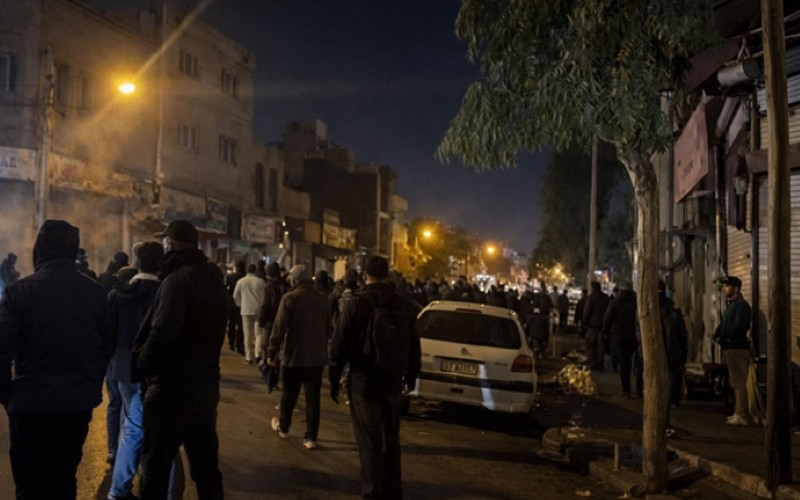

Sustaining the January 2026 Uprising Is Not a Tactical Choice but a Historic Necessity
Today, the uprising for freedom and the removal of the clerical dictatorship has become Iran’s central and daily reality. What now determines the country’s future is not whether the uprising exists, but how it continues. The quality, depth, and persistence of this uprising will define whether it evolves into a transformative force or is fragmented by repression and engineered exhaustion.
As the uprising moves beyond its first week, one lesson stands out with unmistakable clarity: its success depends on continuity. Sustained resistance is not merely a matter of endurance; it is the mechanism through which multiple decisive factors converge and reinforce one another.
First, continuity cultivates collective hope and social solidarity among those present in the streets. A shared demand, sustained over time, transforms scattered anger into a unifying national will. This is precisely why the regime’s strategic “think tanks” remain constantly engaged in psychological operations aimed at discouragement, fatigue, and fragmentation. Vigilance against such manipulation is inseparable from the act of continuing the uprising itself.
Second, the persistence of the uprising prevents deviation from its central target: the ruling system. Sustained protest sharpens focus on the seat of power and blocks diversionary narratives deliberately promoted by dictatorship to dilute responsibility and redirect anger away from systemic change.
Third, continuity deepens political demands. As protests endure, slogans evolve from immediate grievances toward the core demand of overthrowing dictatorship. This deepening is not spontaneous; it is the natural outcome of lived confrontation with a regime structurally incapable of reform.
Fourth, the social expansion of the uprising depends entirely on its duration. Only through sustained action do diverse social strata—workers, merchants, professionals, students, and marginalized communities—enter the struggle. This expansion is not symbolic; it is protective. Broad participation constrains the regime’s ability to deploy unrestricted violence and gradually shifts the balance of power between society and the state.
Fifth, continuity enables self-sustaining support structures within society. As the uprising persists, it generates its own logistical, moral, and material foundations. Needs increase as the movement matures—but so do the capacities to meet them. In this sense, continuity is not repetition; it is evolution.
Iranian society has also reached two irreversible conclusions through 47 years of lived experience: rejection of all forms of dictatorship, and rejection of any religious or ideological rule. Sustaining the January 2026 uprising has the potential to further consolidate this collective consciousness, embedding a clear and lasting boundary against tyranny—past, present, and future.
Most critically, continuity necessitates organization. No nationwide uprising can be administered, protected, or advanced without coordination, division of labor, and strategic coherence. Organization is not an optional refinement; it is the central pillar of the uprising’s maturation. It safeguards protesters, neutralizes regime conspiracies, and ensures endurance until victory. Among all factors, organization stands as the most decisive—and the one that demands tangible cost and commitment in the streets.
Sustained uprising also compels international recognition. Legitimacy in global political relations is not granted by declaration but earned through persistence, social breadth, and moral clarity. Continuity introduces the uprising as a credible national force to international actors, altering how Iran’s crisis is perceived and addressed globally.
Finally, endurance radicalizes and clarifies demands. Over time, genuine forces committed to dismantling dictatorship distinguish themselves from opportunistic or reformist currents. It is through continuity that an authentic alternative—rooted in rejection of all forms of tyranny—emerges as the strategic horizon of the uprising.
For these reasons, intellectual, media, and grassroots engagement around these principles is not secondary work; it is part of the uprising itself. Clarifying, amplifying, and defending the logic of continuity—across media, social networks, and the streets—is how the January 2026 uprising fulfills its historic and national responsibility.
Continuity is not simply how the uprising survives. It is how it wins.