Street Battles and Live Fire Against Civilians Mark January 2026 Protests
On January 8, 2026, Tehran’s southern district of Naziyabad became the scene of intense street confrontations, offering a stark picture of both the scale of repression by Iran’s regime and the organized resistance of protesters during the January 2026 uprising.
Video footage from the area, indicates that the regime’s security forces deployed automatic weapons and fired directly into residential neighborhoods. Sustained and heavy machine-gun fire can be clearly heard echoing through Naziyabad’s streets, particularly during nighttime hours, underscoring the severity of the crackdown.
Regime’s forces opened fire without warning in densely populated areas, an action that placed unarmed civilians at immediate risk. The volume, continuity, and direction of the gunfire strongly suggest indiscriminate use of lethal force rather than crowd-control measures.
Organized Resistance Amid Heavy Fire
Despite the intensity of the assault, recorded footage also shows young protesters actively resisting the advance of special units. Using rudimentary means—including sound-based explosive devices and Molotov cocktails—demonstrators attempted to halt and repel security forces moving into the neighborhood.
Throughout the clashes, chants of “Death to the dictator” were repeatedly heard, reflecting a sustained atmosphere of defiance and political resolve in the face of overwhelming firepower.
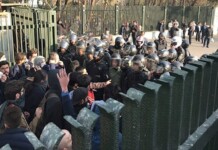
Additional scenes document street battles and the encirclement of regime-linked facilities, believed to include government or security buildings. Large crowds gathered around these sites, while protesters set fires in the middle of roads to obstruct visibility, disrupt armored vehicle movement, and slow the advance of suppression units.
Close-Range Confrontations and Shifting Fear
In several sequences, protesters are seen advancing to very close proximity to security positions. Their coordinated movement and persistent slogans appeared to shift the psychological pressure onto regime forces, reversing the intended climate of fear despite the presence of live ammunition.
Events in Naziyabad on January 8 and 9, 2026, contradict state media claims that the situation remains under control. Instead, they point to a growing reality in which densely populated and strategically significant districts of Tehran have turned into active centers of uprising.
The use of sustained automatic gunfire against defenseless residents does not project authority. Rather, it highlights a regime increasingly reliant on brute force—an indicator not of strength, but of desperation in the face of a population determined to end decades of dictatorship.