



The Regime’s Growing Panic Over Youth, Weapons, and Organized Resistance
As the appetite for direct confrontation with the IRGC grows, panic has spread among both regime insiders and its peripheral loyalists. The prospect of young Iranians turning to weapons and the expansion of organized resistance cells has shaken the ruling establishment. What once appeared unthinkable is now openly discussed—sometimes by the regime’s own heirs.
On January 31, Hassan Khomeini, grandson of the regime’s founder, stood at his father’s grave and referenced a letter written by Akbar Hashemi Rafsanjani to Ruhollah Khomeini during Khomeini’s Najaf exile period. He quoted Rafsanjani’s analysis of why the People’s Mojahedin Organization of Iran (PMOI/MEK) were attracting supporters, stating that their appeal stemmed from taking up arms—before adding that Khomeini opposed armed struggle from the very beginning with shah’s regime fearing its consequences.
Whether Hassan Khomeini grasped the weight of his words or not, this was a major historical admission. Buried inside this seemingly defensive remark are several explosive truths.
First, the statement places the current system of velayat-e faqih—and Ali Khamenei personally—exactly where the Shah stood in the final days of the monarchy: at the moment when young people are no longer reformable, when they are drawn toward overthrow, and when regime change becomes a material possibility rather than a slogan.
Second, it confirms a fundamental political reality the regime has long tried to suppress: when repression and censorship reach their peak, societies radicalize. When every peaceful avenue is sealed, people conclude that dignity, security, and stability cannot be achieved without force. Armed resistance does not emerge from ideology alone—it is born from systematic suffocation.
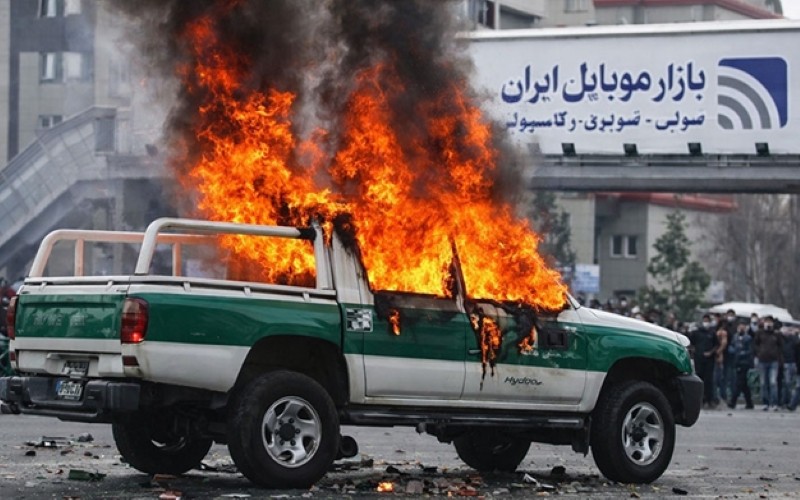
But the nightmare haunting the regime is far larger than a single speech by Khomeini’s grandson. The real terror lies in the possibility of an armed populace confronting IRGC forces—the same forces that have gunned down unarmed civilians in the streets, city after city. That fear surfaced clearly in the same gathering, when the regime’s president Masoud Pezeshkian attempted to extend the argument.
He insisted that “the Imam’s path was the people’s path,” claiming it was not a path of war or bloodshed, and recalled that Khomeini allegedly ordered flowers to be given to armed forces because “they are also people.”
What Pezeshkian did not—and could not—explain is why, if that path truly rejected bloodshed, the regime incinerated nearly a million lives in an anti-national war; why the 1980s witnessed systematic mass executions; why political prisoners were slaughtered in 1988; why Kahrizak happened; why November 2019 happened; why January 2026 uprisings happened—and why Kahrizak happened again.
These omissions are not accidental. They are the fault lines of the regime’s narrative.
Pezeshkian then reached the core of his anxiety, pleading almost helplessly:
“In ordinary social protests, people don’t take up guns, they don’t kill security forces, they don’t burn ambulances or markets.”
Yet in saying this, he unintentionally delivered the regime’s clearest confession.
If people do not take up arms in “ordinary protests,” then what is unfolding in Iran today is no longer ordinary. It is not a protest cycle. It is an uprising. A rupture. An eruption that cannot be talked down, cosmetically rebranded, or repressed back into silence.
What the regime fears most is not slogans or strikes—it is the irreversible moment when a society concludes that there is nothing left to lose. By their own words, that moment has arrived.