


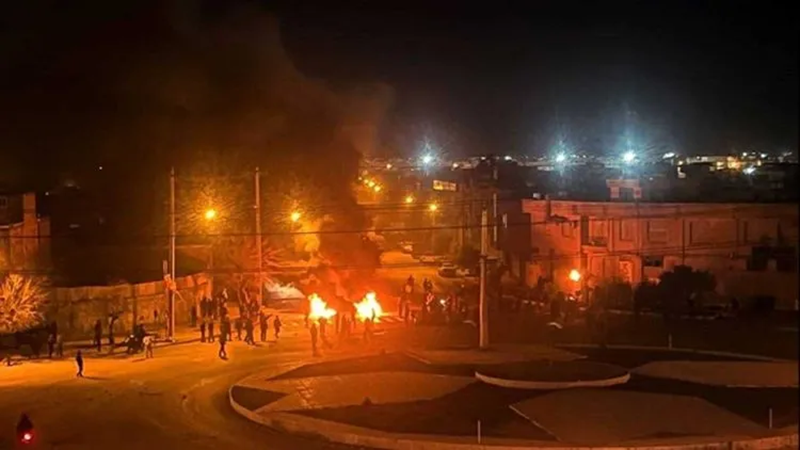

On February 1, Iran regime’s Supreme Leader’s remarks revealed fear, organizational failure, and the persistence of popular uprising in Iran.
What did Ali Khamenei effectively acknowledge in his February 1 address this year? Contrary to its intended purpose, the speech did not demonstrate strength or control. Instead, it functioned as an implicit admission by a political system increasingly encircled by recurring uprisings.
Khamenei appeared publicly to consolidate his authority and reassert control over a deeply shaken regime. Yet his remarks ultimately exposed the depth of his concern. As in previous instances, he described popular protests as “riots” and attributed them to foreign adversaries.
This familiar narrative, however, has lost much of its credibility. The scale, persistence, and social breadth of recent protests point to domestic causes: economic deprivation, political repression, systemic discrimination, and entrenched injustice.
More revealing than his accusations was what he conceded indirectly. Khamenei acknowledged the organized nature of the protests—their coordination, tactical awareness, and capacity to mobilize new participants, particularly among younger generations.
This recognition undermines the long-standing official claim that protests are spontaneous, leaderless, or short-lived disturbances. By admitting that demonstrators knew how to act, where to apply pressure, and how to expand their networks, the Supreme Leader effectively confirmed the existence of structured resistance and the erosion of the regime’s security control.
Equally significant was his statement that such uprisings “have occurred and will continue.” This phrasing amounts to an acknowledgment of systemic impasse. After more than four decades in power, the Mullahs’ regime has not resolved any of the fundamental social and economic contradictions confronting Iranian society.
On the contrary, long-term mismanagement, resource extraction, and regional adventurism have compounded public grievances. Khamenei’s leadership has neither demonstrated the capacity nor the willingness to address these underlying problems.
In this context, his explicit praise for security forces carries particular weight. By framing violent repression as the fulfillment of duty, Khamenei placed direct political responsibility for state violence at the apex of power. This removes any remaining ambiguity about command structures and accountability within the system. The use of lethal force against protesters is not a deviation or excess—it is a sanctioned instrument of governance.
His renewed rhetoric against the United States and threats of regional confrontation should be understood within this framework. Such statements are less about external deterrence and more about internal stabilization.
They aim to divert attention from domestic unrest and to consolidate a base that is increasingly fragmented. The primary audience for these warnings is not foreign governments, but a regime constituency experiencing fatigue, defections, and declining legitimacy.
This internal contradiction becomes even clearer when considering the regime’s evolving stance on negotiations. The same leadership that once dismissed diplomacy as weakness is now, in practice, seeking engagement—not to resolve structural crises, but to gain time.
The objective is survival, not reform. Yet the space for maneuver has narrowed. Neither negotiations, repression, nor rhetorical escalation appear sufficient to alter the regime’s trajectory.
What emerges from Khamenei’s February 1 speech is not confidence, but recognition of limits. The continuation of protests, their increasing coordination, and the inability of the state to restore durable control point to a political reality in transition.
The prospect of systemic change is no longer confined to slogans or speculation; it is becoming a measurable dynamic shaped by social pressure and sustained resistance.
February 1 thus marked more than a routine address. It crystallized a central fact: the uprising persists, it is organized, and it remains an unresolved challenge to the existing political order.