Berlin conference signals the end of appeasement and highlights a structured democratic alternative to Iran’s clerical regime
On February 8, 2026, Berlin hosted a pivotal international conference titled “Iran: Prospect for Change Redefining Policy.” Bringing together Mrs. Maryam Rajavi, President-elect of the National Council of Resistance of Iran (NCRI), alongside prominent international political figures, the gathering evolved beyond a high-level policy forum. It became a platform for reassessing decades of Western policy toward Tehran and for articulating a clear alternative to the ruling theocracy.
The timing of the conference was critical. Iran, under the doctrine of Velayat-e Faqih, is confronting sustained unrest, deep economic deterioration, and growing social mobilization. Against this backdrop, speakers argued that the debate is no longer about reforming the regime but about managing an inevitable transition.
The Collapse of Appeasement and the Rise of a Democratic Alternative
One of the most prominent speakers, Charles Michel, former President of the European Council (2019–2024) and former Prime Minister of Belgium, delivered a direct critique of Europe’s longstanding approach toward Tehran.
He observed that few, if any, political actors within the European Union could mobilize crowds on the scale demonstrated by supporters of the Iranian Resistance, suggesting that such mobilization reflects genuine social backing rather than symbolic activism. In his assessment, this level of organization indicates that the movement represents a significant current within Iranian society.
Michel further argued that decades of conciliatory engagement with Tehran have failed to moderate its behavior. According to him, policies rooted in accommodation have only emboldened the regime by reinforcing a sense of impunity. He stressed that the essential dividing line between democratic governance and authoritarian substitutes lies in free and fair elections. In this context, he described the NCRI’s Ten-Point Plan as a comprehensive political framework capable of guiding a transition from dictatorship to democracy.
Warning Against False Alternatives and Digital Manipulation
A central theme of the Berlin conference was the rejection of what speakers described as artificial or regressive alternatives to the current regime.
Michel cautioned against efforts to rebrand monarchical restoration through coordinated online campaigns. He characterized certain social media movements linked to the former Shah’s son as largely inflated by algorithmic amplification, automated networks, and industrial-scale digital tactics. European democracies, he warned, must not mistake online visibility for legitimate political legitimacy, nor allow public opinion to be shaped by manipulated narratives that could derail Iran’s democratic aspirations.
Ambassador Joachim Rücker, former President of the UN Human Rights Council, reinforced this concern. Referring to academic analyses, he noted that some proposed platforms associated with monarchical revival have been criticized by scholars as containing elements compatible with authoritarian or neo-fascist governance models.
In contrast, Rücker highlighted Mrs. Rajavi’s Ten-Point Plan’s explicit commitments to gender equality, the abolition of the death penalty, separation of religion and state, and pluralistic democracy. In his view, these principles distinguish it as a rights-based and forward-looking political program.
A Regime Beyond Crisis
Ambassador Robert Joseph, former U.S. Under Secretary of State for Arms Control and International Security, described the current situation in Iran as surpassing cyclical instability. Drawing on historical parallels, he suggested that the regime is not merely entering a phase of decline but approaching a terminal stage.
Joseph emphasized the political significance of Iran’s merchant class distancing itself from the ruling establishment. From a historical perspective, he argued, when traditional economic pillars withdraw support from a governing authority, the structural foundations of that authority begin to erode irreversibly.
He also underlined that any meaningful transformation must originate within Iran itself. International actors, he said, should recognize the Iranian people’s right to determine their political future without imposing external blueprints or reverting to discredited past systems. The issue, he maintained, is neither foreign-imposed regime change nor restoration of monarchy, but enabling a sovereign democratic transition.
Organized Transition and the Need for International Action
Former German Ambassador Andreas Reinicke approached the issue from a regional stability standpoint. Referring to failed transitions elsewhere in the Middle East, he argued that the decisive variable in preventing chaos is organizational preparedness.
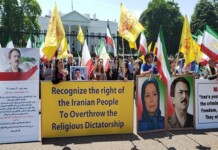
According to Reinicke, the Berlin conference and the accompanying public rally conveyed a clear message: unlike fragmented opposition movements seen in other contexts, Iran possesses a structured and articulated alternative. The existence of a defined political platform and organized leadership, he suggested, reduces the risk of a post-collapse power vacuum.
Robert Joseph complemented this assessment with concrete policy recommendations. He called for stronger diplomatic and economic pressure, including the closure of regime embassies involved in malign activities, comprehensive oil sanctions, and measures to guarantee unrestricted internet access for Iranian citizens. Such steps, he argued, would accelerate internal dynamics already in motion.
Toward a Democratic Republic
The Berlin conference demonstrated a growing consensus among segments of the international political community: the clerical regime is structurally incapable of reform and increasingly isolated both domestically and globally. The convergence around the Ten-Point Plan as a democratic roadmap marked a shift away from tactical engagement toward strategic clarity.
Speakers collectively framed the moment not as speculative optimism but as a phase of active transformation. They pointed to ongoing protests inside Iran and expanding international advocacy as evidence that the question is no longer whether change will come, but how it will be structured.
The vision articulated in Berlin was explicit: a future Iran defined by a democratic republic, separation of religion and state, gender equality, and the abolition of capital punishment. In this framing, Iran’s trajectory does not lead back to authoritarian monarchy nor remain trapped in the present theocracy. Instead, it points toward a constitutional order grounded in popular sovereignty and institutional accountability.
The conference title—Iran: Prospect for Change Redefining Policy—thus encapsulated both an internal and external transformation: a redefinition of Western policy away from appeasement, and a redefinition of Iran’s political future toward democracy.