


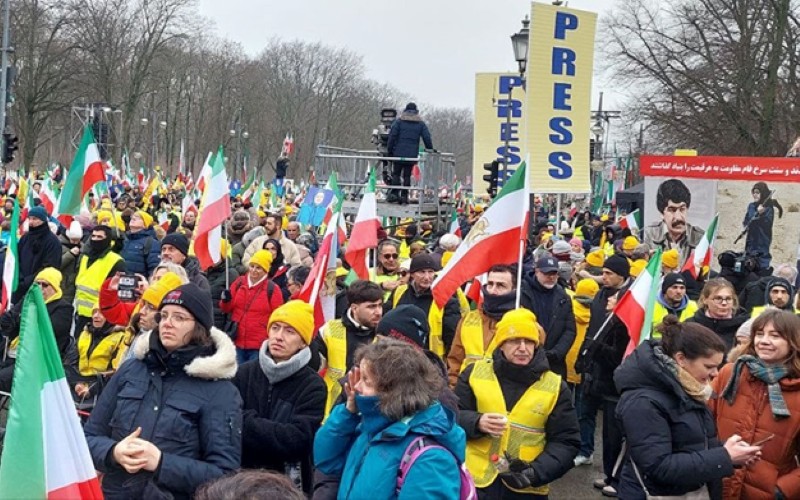

On the eve of February 11, tens of thousands of Iranians in Berlin reaffirmed a national red line: neither Shah nor mullahs
On February 7, on the eve of the historic anniversary of the fall of the Shah’s dictatorship and the February 11 Revolution, Berlin once again became the stage for a powerful political statement by the Iranian people. Tens of thousands of Iranians, joined by prominent international political, cultural, and social figures, gathered in Germany’s capital in one of the most significant demonstrations of recent years.
This was not merely a commemorative event. It was a clear declaration of political will.
The massive turnout reflected a broad national spectrum: supporters of the Iranian Resistance, members and sympathizers of the People’s Mojahedin Organization of Iran (PMOI/MEK), as well as democratic and republican forces united by a shared vision—a free Iran and a democratic republic.
Organization, Alternative, and Political Clarity
The scale and coherence of the demonstration underscored a central reality: without organized resistance, sustained effort, and a credible democratic alternative, the Iranian people’s struggle would remain vulnerable to distortion and hijacking. The existence of a structured movement—anchored in a clear program, including Maryam Rajavi’s Ten-Point Plan—has prevented the space from being reclaimed either by remnants of the former Shah’s regime or by the current clerical dictatorship.
This political clarity is precisely what gave the Berlin demonstration its strategic weight. It was not only a call for the overthrow of the ruling theocracy, but a firm and unmistakable boundary between the camp of republicanism and popular sovereignty on one side, and all forms of authoritarianism—clerical or monarchical—on the other.
A National Unity Beyond Differences
Iranians from all ethnicities, religions, regions, and political backgrounds participated, demonstrating that Iran’s future can be built on national unity and democratic cooperation. The message was explicit: tomorrow’s Iran will be free of both Shah and Mullahs, grounded in respect for territorial integrity, pluralism, and equal citizenship.
The unifying slogan—
“Down with the oppressor, whether Shah or Supreme Leader”—
has now become a powerful political barrier against attempts by opportunistic media networks, foreign-backed think tanks, and colonial narratives seeking to rehabilitate authoritarian rule under a different name.
Rejecting Opportunism and Political Hijacking
The Berlin rally once again exposed the deep national consciousness of the Iranian people against those seeking to ride the wave of revolution for personal or dynastic gain. The Pahlavi family, long removed from Iran and living in comfort abroad on wealth stolen from the nation, has resurfaced at a critical historical moment, attempting to reinsert itself into Iran’s democratic struggle.
This pattern is not unfamiliar to Iranians. History has taught them the cost of replacing one dictatorship with another. The attempt to exploit the sacrifices of martyrs, prisoners, and grieving families for political “share-seeking” has been decisively rejected.
As was emphasized during the rally: such ambitions are illusions.
The Alternative Exists—and Has Endured
Maryam Rajavi, the president-elect of the National Council of Resistance of Iran and the main speaker at the event, addressed a question often raised internationally: Is there an alternative?
Her answer was unequivocal: yes. An alternative has existed for 44 years—guided by the principle of neither Shah nor Mullahs, enduring repression, bloodshed, and exile. This principle represents the rejection of dictatorship and dependency, and the affirmation of freedom and national independence.
Defeating Fake “Alternative-Making” Projects
Above all, the Berlin demonstration disrupted ongoing efforts to manufacture artificial alternatives designed to steer Iran toward another imposed authoritarian structure. Those political engineering projects—whether domestic or foreign—received a clear message: Iran’s revolution will not be outsourced, hijacked, or recycled into another dictatorship.
The Iranian people are not transitioning from one autocracy to another. Their demand is rooted in over 120 years of continuous struggle—from the Constitutional Revolution, through the era of Dr. Mohammad Mossadegh, to the anti-monarchical revolution—for democracy, sovereignty, and human dignity.
A National and Independent Path Forward
The participation of Iran’s oppressed nationalities in this demonstration further confirmed that despite deep historical wounds inflicted by both monarchical and clerical dictatorships, these communities stand united with the nationwide uprising and the resistance units against any foreign interference or fabricated alternatives.
In this context, the most national, independent, and democratic path forward lies in the National Solidarity Front—a framework initiated by the Iranian Resistance to safeguard the democratic revolution and prevent its derailment.
This reality, already visible in Berlin, is poised to reshape Iran’s political and social landscape in the not-too-distant future.