


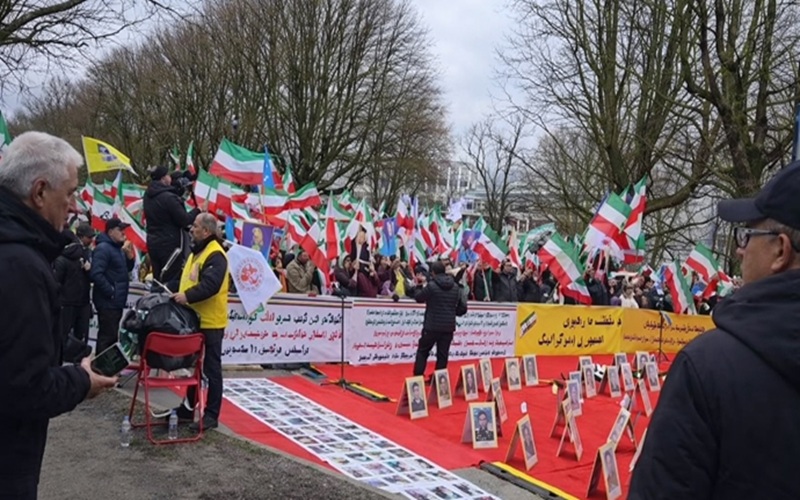

Speakers from Iranian communities, European political figures, and activists voice support for a democratic alternative to Iran’s ruling system during a major rally in Germany.
Iranian communities and supporters of democratic change gathered in Hamburg on March 13, 2026, to express solidarity with the Iranian people and call for the establishment of a democratic republic in Iran. The demonstration brought together activists, political figures, and members of the Iranian diaspora who delivered speeches emphasizing continued resistance against both clerical rule and the return of monarchy.
The rally, organized by Iranian communities in northern Germany, featured speakers who stressed that the struggle for freedom and independence in Iran must continue until the establishment of a democratic system chosen by the Iranian people.
Iranian Community Voices Support for Democratic Transition
Opening the gathering, Iranian community representative Sania Kohandel welcomed participants and emphasized the importance of unity among Iranians abroad during what she described as one of the most critical moments in Iran’s modern history.
She noted that many participants had gathered to reaffirm their commitment to the ongoing struggle against authoritarian rule in Iran. Kohandel expressed support for the transitional government proposal announced by the National Council of Resistance of Iran, which aims to transfer sovereignty to the Iranian people based on the political platform proposed by Maryam Rajavi.
According to her remarks, the Iranian people have risen up in recent years with the goal of determining their own political future. She also highlighted the role of organized resistance forces in shaping that struggle and called on participants to amplify the message that Iran’s future should be built on a democratic republic chosen by its citizens.
Calls for “Neither Shah nor Mullah”
Another speaker, Iranian activist Mahyar Shahriari, stressed that the Iranian protest movement is determined to continue until the establishment of a democratic republic.
He argued that the country should not return to monarchy and warned that attempts to maintain the current political system through leadership succession would not prevent its eventual collapse. Shahriari emphasized that many Iranians reject both war and international appeasement policies toward Tehran, instead supporting a democratic transformation driven by the Iranian people themselves.
German Politicians Express Solidarity
Messages of solidarity were also delivered by several European political figures.
Ralf Stegner, a member of the German Bundestag’s foreign affairs committee, sent a message emphasizing humanitarian responsibility and solidarity with the Iranian people. He stressed that democratic opposition groups seeking a secular and democratic Iran deserve the support of Germany and the European Union.
Stegner noted that in discussions with Iranian democratic activists in exile, he encountered strong commitments to principles such as the separation of religion and state, the protection of minority rights, and gender equality. According to his message, these groups also reject foreign military intervention, instead advocating peaceful political change.
Former Bundestag member Thomas Lutze also addressed the rally. He expressed hope that Iran would soon experience freedom and democratic governance. Lutze noted that many discussions in international policy circles revolve around the question of what political alternative might replace the current regime.
He pointed to the existence of organized opposition movements and said that proposals such as the democratic platform presented by Rajavi provide a potential framework for a future political transition in Iran.
European Perspective on Policy Toward Tehran
Former member of the European Parliament, Helmut Geuking, criticized what he described as decades of inconsistent European policy toward Tehran.
Geuking argued that economic engagement with the Iranian government has often benefited the ruling authorities rather than the Iranian population. He called for stronger support for democratic opposition groups and suggested that European governments should consider recognizing a transitional political alternative supported by Iranian opposition movements.
According to Geuking, international backing for such an alternative could help accelerate democratic change and reduce regional instability.
German Youth Activists Back Democratic Aspirations
German political activist Benjamin Welling from the youth wing of the Christian Democratic Union of Germany also addressed the crowd, praising the determination of Iranian demonstrators who gathered despite cold weather.
He argued that the Iranian regime’s actions have increasingly revealed its authoritarian nature to the international community. Welling said many Europeans are only now beginning to recognize the scale of the threat posed by institutions such as the Islamic Revolutionary Guard Corps.
He emphasized that Germany should support Iranian groups seeking to establish a democratic republic that guarantees equal rights for women and men.
Minority and Regional Voices Join the Rally
Representatives from different ethnic and political communities also spoke during the event.
Activist Obeidollah Baluch highlighted the importance of unity and cooperation among Iranians of different backgrounds. He argued that building a future based on equality, justice, and mutual respect is essential for lasting stability and progress.
Behrouz Ardalan, representing the Khabat Organization of Iranian Kurdistan, expressed solidarity with Kurdish communities and other groups resisting authoritarian rule. He warned that decades of hostile policies by Iran’s leadership have pushed the country into a deep crisis, while emphasizing the need for cooperation among democratic forces to prevent any new form of dictatorship.
Women’s Role in the Iranian Protest Movement
Women’s rights activist Afsaneh Garshasbi highlighted the role of Iranian women in protest movements across the country. She described women as a driving force behind recent uprisings and praised the courage of activists who continue to challenge repression despite serious risks.
According to Garshasbi, women in Iran have become a central force pushing for political transformation and democratic change.
Youth Emphasize Future Democratic Republic
Youth activist Hanif Mahoutchian, speaking on behalf of Iranian youth groups in Germany, voiced support for the opposition coalition’s proposal for a transitional government.
He argued that younger generations see the current moment as a historic opportunity to achieve the democratic aspirations that many Iranians have pursued for more than a century. According to Mahoutchian, the movement aims to establish a pluralistic republic representing Iran’s diverse ethnic and cultural communities.
Vision for a Transitional Government
The rally concluded with remarks from Dr. Saeed Ferdowsi, representing Iranian communities in Germany. He emphasized that Iran stands at a critical historical moment after decades of repression, imprisonment, and political violence.
Ferdowsi argued that any future political transition must ensure that power ultimately rests with the Iranian people. He outlined a proposed six-month transitional government under the framework of the National Council of Resistance of Iran, which would be tasked with organizing free and fair elections after the fall of the current system.
He also referred to the democratic platform proposed by Maryam Rajavi, which includes commitments to free elections, gender equality, separation of religion and state, the abolition of the death penalty, and equal rights for ethnic and religious minorities.
According to Ferdowsi, the goal of such a transition would not be to establish a permanent government but to create the conditions necessary for Iranians themselves to freely determine their country’s future.
A Message of Unity and Democratic Change
Throughout the rally, speakers repeatedly emphasized that Iran’s future should be determined by its citizens rather than imposed by external forces or authoritarian systems. Participants expressed hope that sustained international attention and domestic resistance could ultimately lead to the establishment of a democratic republic.