


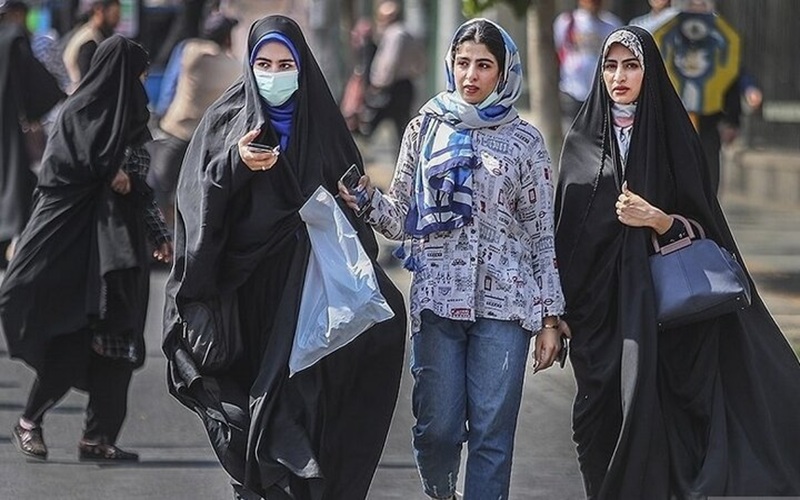

As the fourth anniversary of Mahsa Amini’s death approaches, morality patrols and arrests are reportedly returning to Iranian streets, exposing the regime’s continuing struggle to enforce compulsory veiling.
Four years after the death of 22-year-old Mahsa Amini in the custody of Iran’s morality police, the regime is once again intensifying efforts to enforce compulsory veiling.
Reports from several Iranian cities indicate that morality-patrol vans, plainclothes forces, surveillance operations, and street-level interventions targeting women have returned with renewed intensity. The developments come as the fourth anniversary of Amini’s death approaches, underscoring a central problem that has confronted the regime since the nationwide uprising of 2022: despite repression, it has failed to restore the social conditions that existed before September 2022.
Amini, a young woman from Saqqez in Kurdistan Province, was visiting Tehran with her family when she was detained on September 13, 2022, over her alleged failure to comply with compulsory hijab rules. She was transferred to the morality police facility on Vozara Street and later taken to Kasra Hospital in critical condition. Her death on September 16 triggered nationwide outrage.
What followed was one of the most significant challenges to the regime in decades. Women and men took to the streets across Iran, while women increasingly rejected compulsory veiling as an act of civil disobedience. Even after the regime’s violent suppression of the uprising, millions of women continued appearing in public without the mandated head covering.
That defiance has presented the regime with a dilemma. Its leaders have repeatedly demanded that compulsory hijab be enforced, but they also recognize that aggressive enforcement can provoke another wave of public anger.
The Regime’s Unresolved Hijab Dilemma
The authorities have used a wide range of measures to pressure women into compliance: summonses, judicial cases, fines, text-message warnings, vehicle seizures, business closures, and restrictions on access to services.
The regime’s parliament also approved legislation known as the “Family Protection through the Promotion of Chastity and Hijab” bill. Yet its implementation has remained suspended amid political disagreements and concerns over its potential social consequences.
The suspension should not be mistaken for a change in principle. The dispute inside the ruling establishment is increasingly about how and when compulsory hijab should be imposed, rather than whether it should remain government policy.
Recent statements by senior officials make that distinction increasingly clear.
On September 9, senior regime figure Gholam-Ali Haddad-Adel acknowledged that the authorities currently face greater difficulties in confronting the hijab issue than they did in the early years of the regime. He said that because of the “war situation,” the government could not currently enter the “hijab front” in the manner it otherwise would.
Haddad-Adel’s remarks reveal the regime’s underlying calculation: a major confrontation with women could deepen existing social divisions at a politically sensitive moment.
Other officials have expressed similar concerns. Basij commander Hossein Taeb has emphasized the need to preserve what the regime calls “internal cohesion,” warning that disputes over cultural issues such as hijab could undermine that cohesion.
Government officials have also acknowledged concerns about the consequences of enforcing the suspended legislation. The decision to halt its implementation was reportedly connected not to its cancellation but to intervention by the Supreme National Security Council.
In other words, the regime has not abandoned compulsory hijab. It has been calculating the political cost of enforcing it.
Street-Level Enforcement Returns
Despite these concerns, reports from Iranian cities suggest that enforcement is already being intensified in some areas.
Residents of Islamshahr have reportedly seen groups of women supporting compulsory hijab gathering in public spaces and confronting women who reject mandatory veiling.
In Qom, citizen reports describe a more concealed form of surveillance. Individuals reportedly identified by residents as Basij members or other government agents have appeared in Alavi Park wearing municipal landscaping workers’ clothing. According to these accounts, they monitor visitors and intervene not only over women’s clothing but also over activities such as women cycling and men exercising in shorts.
Nishapur residents have likewise reported the simultaneous return of Basij personnel and morality-police vehicles. According to a citizen account posted on X, officers have stopped young women and men over clothing while also stopping motorcyclists. The same account described checkpoints and vehicle inspections in different parts of the city, portraying the atmosphere as increasingly securitized.
Similar reports have emerged from Mashhad, where residents say morality-police vehicles have again become visible and restrictions have intensified.
The pressure is reportedly extending beyond streets and parks. In Rasht, a citizen account described renewed restrictions in government offices and banks, with women who do not comply with the authorities’ preferred dress standards allegedly facing difficulties accessing services.
Escalation in Isfahan
The situation reported in Isfahan appears particularly serious.
The latest escalation followed a September 3 gathering by supporters of compulsory hijab who demanded enforcement of the regime’s dress regulations and punishment of women who defy them.
The issue was subsequently reinforced from the pulpit of Friday prayers. On September 4, acting Friday prayer leader Hossein Mohammadi argued that calls for preserving “social cohesion” should not mean abandoning the hijab issue. At the same time, he cautioned against what he described as “ill-considered and emotional” actions that could damage social cohesion.
Citizen reports in the days that followed described the renewed deployment of morality-police vans and plainclothes personnel at major intersections and other locations. One account claimed that numerous plainclothes agents, some wearing black masks, were operating alongside morality-police vehicles and stopping and arresting women. Threatening banners targeting women who reject compulsory hijab were also reportedly displayed around the city.
Other accounts described arrests at the Parvaz residential and commercial complex and interventions at cafés in the Mardavij district. One citizen reported witnessing several arrests of women within only a few hours at different locations across Isfahan.
These accounts are difficult to independently verify in their entirety, but taken together they point to a renewed enforcement campaign in parts of the country.
Four Years Later, the Regime Has Not Won
The contradiction in the regime’s approach is revealing.
Some officials and hardline forces openly demand a tougher crackdown. Others warn that the present political and social circumstances make such a confrontation dangerous. Yet neither side has accepted the basic demand of Iranian women to determine their own clothing.
This explains why the suspension of the compulsory-hijab legislation does not amount to a retreat from the regime’s policy. Rather, it reflects a calculation that broad enforcement could create consequences the authorities are currently unwilling or unable to absorb.
Four years after Mahsa Amini’s death, that calculation remains necessary because the social reality created by the 2022 uprising has not disappeared.
Women continue to appear without compulsory hijab in streets, shopping centers, cafés, universities, and other public spaces. They have continued doing so despite arrests, summonses, fines, vehicle confiscations, restrictions on services, and pressure against businesses that serve them.
The regime can deploy more vans, agents, surveillance operations, and legal threats. What it has not been able to restore is the fear-based social compliance that existed before September 2022.
That is the significance of the renewed crackdown. It is not evidence that the regime has resolved the hijab issue. It is evidence that, four years after Mahsa Amini’s death, the issue remains an unresolved point of confrontation between the Iranian people and a government determined to impose control over the most personal aspects of their lives.