


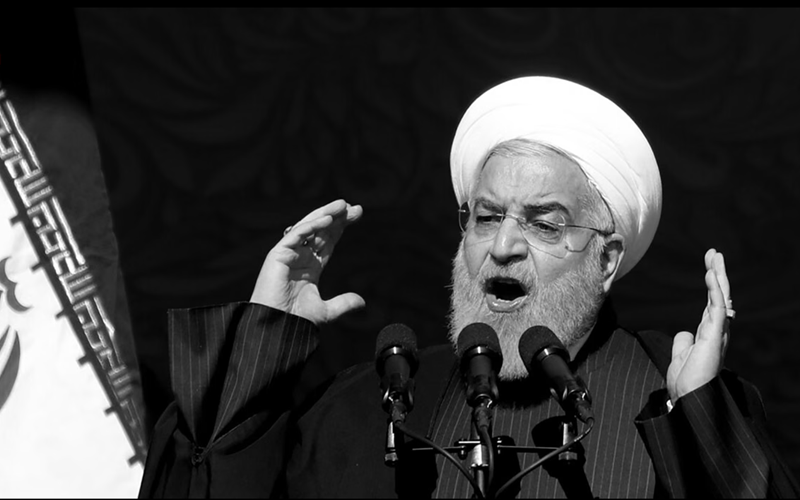

Hassan Rouhani’s defense of diplomacy and the nuclear deal has triggered a sharp backlash, exposing deep divisions inside Iran’s regime over the costs of war and negotiations.
The internal conflict within Iran’s regime over war, negotiations, and the nuclear deal has entered an unusually bitter phase, with rival factions openly attacking one another and accusing their opponents of responsibility for the country’s current crisis.
The latest confrontation was triggered by former president Hassan Rouhani’s recent remarks defending diplomacy and negotiations. His comments have drawn fierce attacks from senior regime figures, who have sought to portray his policies—and particularly the 2015 nuclear deal—as the cause of the current confrontation.
On September 11, Mehdi Fazaeli, a member of the Supreme Leader’s office, launched an unusually personal attack on Rouhani, accusing him of presiding over the “most inefficient” government since the 1979 revolution. He also described Rouhani as one of the “least popular” officials of the post-revolution period and the “rudest” president toward his critics.
Fazaeli further claimed that, according to various opinion polls, Rouhani was the “most unpopular” president at the end of his term and the “most isolated” president since the revolution.
The attacks followed Rouhani’s argument that the regime must stop creating artificial political divisions between military power and diplomacy.
Rouhani: Diplomacy and Military Power Are Not Contradictions
In his speech, Rouhani rejected the regime’s recurring attempt to present negotiations and military capabilities as mutually exclusive.
He argued that the armed forces, diplomacy, missiles, drones, and negotiations all serve the regime’s interests and should not be treated as opposing camps. In his words, reaching a “dignified agreement” that benefits the country should not be considered incompatible with maintaining military capabilities.
Rouhani went further by stressing the importance of public participation and trust. He questioned how negotiations could succeed without public support, saying that diplomacy cannot move forward without the participation and confidence of the people.
His remarks directly challenge the hardline narrative that any willingness to negotiate amounts to weakness or surrender.
Rouhani also invoked his government’s experience in 2014–2017, when negotiations with the P5+1 eventually produced the Joint Comprehensive Plan of Action (JCPOA), commonly known as the nuclear deal.
He claimed that the regime had first sought to strengthen the domestic economy before entering those negotiations. Referring to economic indicators during that period, Rouhani argued that inflation fell, economic growth recovered, employment increased, and non-oil exports approached the level of imports.
He also specifically claimed that, under the nuclear deal, Iran reached self-sufficiency in gasoline and diesel and even became an exporter.
These claims provide the immediate context for the hardline backlash: Rouhani is not merely defending diplomacy in the abstract. He is presenting the nuclear deal as evidence that negotiations can produce tangible economic results, while implicitly challenging those who have defined confrontation as the only viable strategy.
Hardliners Blame the Nuclear Deal for Today’s War
On September 10, Ahmad Alamolhoda, the regime’s representative in Mashhad, directly responded to Rouhani’s argument.
Alamolhoda declared that the current war was the result of the nuclear deal negotiated under Rouhani.
Rejecting any suggestion that the regime should seek public approval over whether to continue fighting, he said that the country was not engaged in a war of choice but was responding to aggression. He argued that the regime must continue defending itself regardless of how long the confrontation lasts—even for decades or centuries.
His remarks reveal the fundamental divide now emerging within the regime. Rouhani is emphasizing diplomacy, public participation, economic stability, and negotiated agreements. The hardliners, meanwhile, insist that continued confrontation is unavoidable and portray calls for negotiations or a referendum as serving the enemy.
Another regime cleric, Mohamad Ali Sadati, in Gilan-e Gharb, similarly rejected the idea of holding a referendum on continuing the war. He argued that “defense” could not be subjected to popular choice and claimed that raising the issue of a referendum was precisely what the enemy wanted.
A Struggle Over the Regime’s Future Strategy
The ferocity of the attacks indicates that the dispute is about more than Rouhani’s political legacy.
At its core is a strategic question confronting the entire regime: can it continue relying on confrontation and military escalation, or does it need to return to diplomacy to alleviate mounting pressures?
Rouhani’s speech also highlights a vulnerability that hardliners appear determined to suppress: the regime’s need for public support. By arguing that diplomacy cannot succeed without public participation and trust, Rouhani implicitly acknowledges the growing distance between the ruling establishment and Iranian society.
The response has been to treat even discussion of a referendum as unacceptable.
This escalation also exposes the contradiction within the regime’s current position. Its officials simultaneously insist that the country is prepared for prolonged confrontation while attacking those who question the economic and political costs of that strategy.
The increasingly personal nature of the attacks suggests that the regime has yet to resolve this contradiction. Instead, as pressure mounts, its factions are turning against one another over who is responsible for the present crisis and which path can preserve the system.
Rouhani’s defense of the nuclear deal has therefore become a political flashpoint. For hardliners, the agreement represents dangerous concessions; for Rouhani, it remains an example of what diplomacy can achieve.
The resulting clash is another manifestation of the regime’s deepening internal crisis, as competing factions struggle to define the course of a system facing mounting economic, political, and external pressures.