
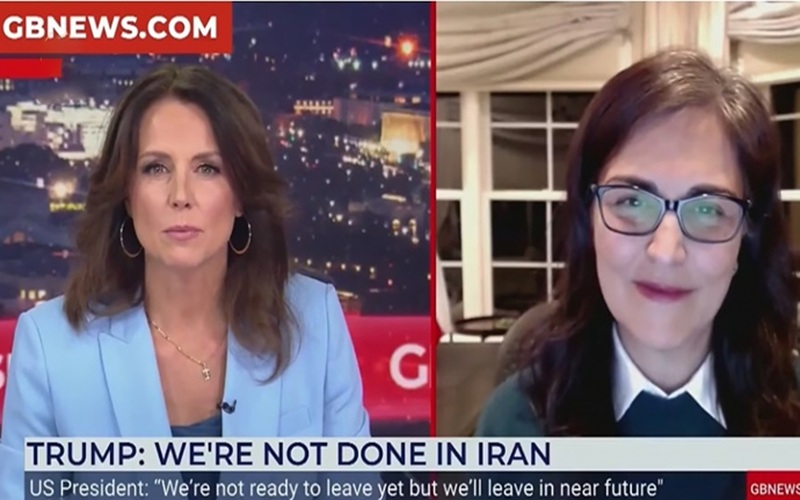

Dr. Ramesh Sepehrrad argues that organized resistance—not internal regime shifts—will determine Iran’s future
As speculation intensifies over potential shifts within Iran’s ruling establishment, a critical question is being overlooked: does changing figures at the top of the regime alter the system itself? According to Dr. Ramesh Sepehrrad, the answer is a decisive no.
In a recent interview with GB News, Sepehrrad challenged the prevailing narrative that Iran’s future hinges on internal power dynamics. She argued that focusing on leadership reshuffles within the regime misses the broader reality—an increasingly organized opposition movement determined to dismantle the system in its entirety.
Her assessment reframes the debate. The central issue, she contends, is not which faction might consolidate control, but whether the Iranian people and their organized resistance can bring about systemic change. In her view, that process is already underway.
At the heart of this argument is the role of the Islamic Revolutionary Guard Corps, long regarded as the regime’s primary instrument of control. While many analysts assume the force can indefinitely dominate public space, Sepehrrad disputes this assumption. She points to a decentralized but extensive network of resistance units operating across all provinces of Iran—structures she believes are capable of challenging the regime’s grip on the streets.
This claim directly contradicts a widely held belief in policy circles: that the regime’s security apparatus remains unassailable. Instead, Sepehrrad suggests that the balance of power is more fluid, particularly as grassroots networks expand and coordinate their activities.
Her argument goes further, invoking the concept of a structured resistance force capable not only of protest but of organized confrontation. While such claims remain contested, they reflect a broader narrative promoted by the National Council of Resistance of Iran—that the opposition is no longer fragmented, but strategically aligned.
This alignment, she argues, is precisely what enables the emergence of a credible post-regime framework. Central to that framework is the transitional government plan announced by Maryam Rajavi. Unlike abstract calls for change, this proposal outlines a defined timeline and governance structure intended to prevent instability in the immediate aftermath of regime collapse.
Sepehrrad presents this initiative as the only viable mechanism to avoid the kind of power vacuum that has destabilized other countries undergoing abrupt political transitions. According to her, the proposed provisional government is not merely symbolic—it is operationally prepared to assume control and manage a transition to popular sovereignty within a fixed, short-term period.
The emphasis here is on continuity and control during a moment of disruption. Without such a framework, she warns, the risk of fragmentation or competing power centers could undermine any democratic outcome. With it, the transition could remain focused, time-bound, and anchored in a clear constitutional vision.
Her remarks also carry an implicit critique of international policy. For years, Western governments have oscillated between engagement and pressure, often without a coherent endgame. Sepehrrad calls for a departure from what she views as failed approaches, urging the international community to recognize and support a structured democratic alternative rather than reacting to events as they unfold.
This is where her analysis intersects with a broader strategic debate. If a viable opposition framework exists—complete with leadership, organizational capacity, and a transition plan—then ignoring it may no longer be a neutral stance. It becomes, in effect, a policy choice with consequences.
What makes this moment particularly significant is the convergence of internal and external pressures. Domestically, protests and resistance activities continue to challenge the regime’s authority. Internationally, discussions about Iran’s future are shifting from containment to transformation. The question is whether these dynamics will align.
Sepehrrad’s intervention is, at its core, a call for clarity. Not about whether change will come, but about how it will be managed. In her view, the difference between instability and a democratic transition lies in preparation—and in the willingness of the international community to acknowledge the alternative already in place.
Because if Iran is indeed approaching a decisive moment, the outcome will depend less on who holds power today, and more on who is ready to govern tomorrow.