



Prolonged nationwide outage, coinciding with wartime conditions, raises alarm over economic collapse and livelihoods
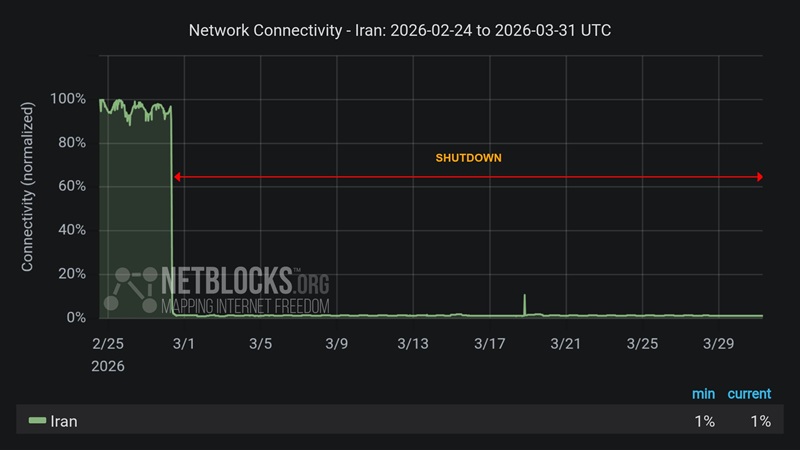
Iran’s sweeping internet blackout has entered its twentieth consecutive day, marking the longest disruption of online access ever recorded in the country and intensifying concerns over its far-reaching economic and social consequences.
⚠️ Update: #Iran's internet blackout has entered day 32 with most users cut off from the outside world for over 744 hours.
Extended digital isolation is bringing new challenges for Iranians, from expired domains and accounts to unpatched servers on a degrading national intranet. pic.twitter.com/SpwVZ95EXP
— NetBlocks (@netblocks) March 31, 2026
According to the internet monitoring group NetBlocks, public access to the internet in Iran has been restricted for more than 744 hours. This unprecedented duration surpasses previous shutdowns, including the blackout imposed during nationwide protests in late 2023, which ended just before reaching the 20-day threshold.
At the time, Iran regime’s Minister of Communications, Sattar Hashemi, had acknowledged that approximately 20 days represents the upper limit of resilience for internet-based businesses. He warned that prolonged disruptions could severely damage the digital economy, placing the livelihoods of nearly 10 million people—directly and indirectly employed in the sector—at serious risk.
The current outage comes amid a broader economic downturn linked to the ongoing war involving Iran, Israel, and the United States. The combination of conflict and connectivity restrictions has significantly disrupted commercial activity, exacerbating fears over the sustainability of businesses and the daily survival of ordinary citizens.
Hashemi had previously estimated the daily economic losses from internet shutdowns at approximately 500 billion tomans for the digital economy and nearly 5 trillion tomans for the broader national economy—figures that underscore the scale of the ongoing damage.
Despite the severity of the situation, regime authorities have offered limited public explanation for the continued blackout, emphasizing only unspecified “security considerations.” Meanwhile, domestic media reports indicate that many citizens have turned to costly virtual private networks (VPNs) for limited and unstable access to global internet services.
Economic stakeholders have increasingly voiced concern. Ali Masoudi, head of the technology commission at Iran’s Chamber of Commerce, warned on March 14, 2026, that while wartime conditions present undeniable challenges, the continuation of internet shutdowns places additional and unnecessary pressure on economic activity. He stressed that reliance on internet infrastructure extends far beyond digital businesses, affecting supply chains, services, and everyday life.
The economic fallout is not limited to the tech sector. Mikaeil Sedighi, a board member of the Construction Workers’ Association, reported on March 18, 2026, that the suspension of construction projects has left between 80% and 90% of workers in the sector unemployed. Many workshops have shut down entirely, leaving workers without income or institutional support.
Sedighi criticized the lack of government assistance, stating that workers have effectively been abandoned during wartime conditions. He also pointed to a sharp increase—between 60% and 70%—in insurance costs, alongside surging inflation. According to his assessment, construction workers are now facing a severe livelihood crisis, with basic goods such as rice and cooking oil experiencing price increases of 200% to 300%. In many cases, even minimal wages are largely consumed by rent, leaving little for essential expenses.
Broader criticism has also been directed at the government’s preparedness during the conflict. Observers have questioned the absence of effective civil defense measures, such as air raid warning systems and shelters, as well as the lack of coherent emergency economic planning.
In response to mounting pressure, Iran regime’s Minister of Cooperatives, Labour, and Social Welfare, Ahmad Meydari, announced in the final week of the Iranian calendar year (March 2026) a 60% increase in the minimum wage for the upcoming year. The base salary is set to rise from 10.3 million tomans to 16.6 million tomans, with additional allowances of 3 million tomans for housing and 2.2 million tomans for food subsidies.
However, these figures remain far below estimated living costs. Mohsen Bagheri, a workers’ representative in the Supreme Labor Council’s wage committee, stated that the minimum livelihood basket for a working-class family has been calculated at approximately 42.9 million tomans—highlighting a substantial gap between income and basic expenses.
Uncertainty remains over whether these wage adjustments account for the economic consequences of the ongoing war. Meydari himself acknowledged that the wage increase is provisional, stating that it will remain in effect only until September 2026, when a reassessment may take place.
Although Iranian officials have repeatedly assured the public that essential goods remain available and that distribution systems are functioning normally, reports from within the country indicate continued and significant price increases across multiple sectors. This trend persists amid a backdrop of economic stagnation and the partial shutdown of business activities.
As the internet blackout drags on and wartime pressures mount, Iran faces a compounding crisis—one that increasingly threatens economic stability, social cohesion, and the basic livelihoods of millions.