
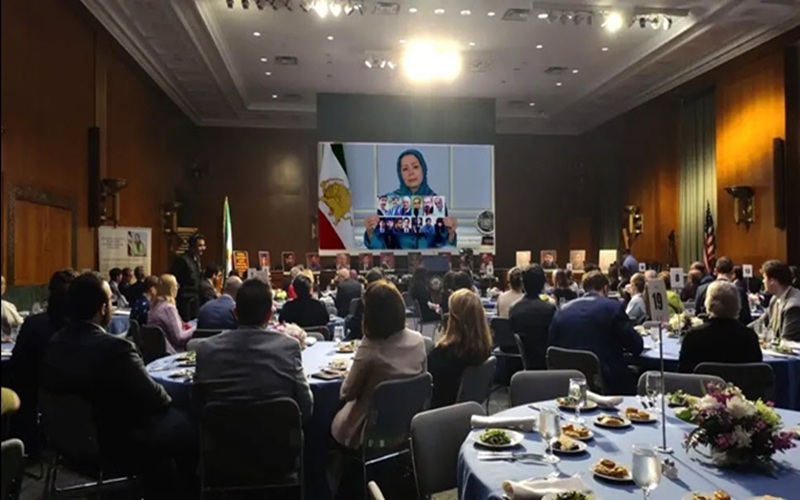

At a pivotal moment, the Iranian opposition leader urges Western policymakers to abandon failed strategies and recognize organized resistance as the path to peace and democratic change
At a critical juncture for Iran and the broader Middle East, Maryam Rajavi delivered a forceful message to a U.S. Senate briefing titled “Iran: Towards Peace and Freedom” on April 16, 2026. Her central argument was unequivocal: the path out of Iran’s deepening crisis does not lie in diplomacy with the ruling theocracy or external military pressure, but in the Iranian people themselves and their organized resistance.
“The solution to the crisis in Iran lies in its people, in their courage, and in their organized resistance,” she stated, framing the issue as one that decades of international policy have fundamentally misunderstood.
Failed Policies and an Unchanged Regime
Rajavi argued that nearly every conceivable external strategy has already been tested over the past 47 years—from appeasement and Europe’s “critical dialogue” to negotiations and even war. None, she emphasized, have succeeded in altering the regime’s core behavior.
According to her, the reason is structural: “The regime would lose its power if it were to accept any reform.” Despite its current weakness, she stressed, Tehran remains committed to repression, nuclear ambitions, regional interference, and support for proxy forces.
Executions as Tool of Fear
Highlighting the regime’s internal crackdown, Rajavi pointed to a recent wave of executions. “Since March 19, at least 13 political executions have taken place in Iran, including six PMOI members and seven defiant protesters,” she said, noting that all were accused of seeking to overthrow the regime.
She characterized these executions as a deliberate strategy: “Through these executions, the regime is intensifying an atmosphere of terror in an effort to prevent another uprising.”
Yet, she argued, repression has failed to extinguish dissent. Instead, it has given rise to a resilient and organized opposition movement.
A Resistance Rooted in Society
Rajavi described a resistance that is both deeply embedded and historically tested. “Despite decades of repression, there is a determined, selfless, and organized resistance inside Iran,” she said, adding that this movement has endured massacres and built four decades of experience confronting the Islamic Revolutionary Guard Corps (IRGC).
Its strategy—combining organized resistance with reliance on popular uprisings—has, in her view, gained significant traction among Iran’s youth over the past year.
She also drew a clear political boundary regarding Iran’s future: “The people of Iran do not want to return to the dictatorship of the Shah.”
Ceasefire, But Not a Solution
While welcoming recent diplomatic developments, Rajavi underscored their limitations. “We believe the ceasefire was the most appropriate decision at a highly sensitive moment by the United States,” she said, expressing hope it could open a path toward de-escalation.
However, she made clear that such measures are insufficient: “Real and lasting peace can only be achieved through the overthrow of the ruling religious dictatorship by the people of Iran and their organized resistance.”
Challenging the Regime’s Legitimacy
Referring to claims by the regime that millions are willing to die in its resistance, Rajavi issued a direct challenge: “If this claim is true, [the regime] should accept a free election under United Nations supervision and based on the principle of popular sovereignty.”
She concluded that the ruling system lacks the courage to submit to such a test—an implicit acknowledgment of its crisis of legitimacy.
The Missing Element in Western Policy
A central axis of Rajavi’s address was her critique of Western strategy. “The most important missing element in Western policy has been a failure to recognize the role of the Iranian people and their organized resistance,” she argued.
Instead of focusing on engagement with the regime or containment strategies, she called on lawmakers to shift their attention: “I urge lawmakers to support the Iranian people and the organized resistance inside the country, including the resistance units on the front lines.”
A Framework for Democratic Transition
Rajavi presented the National Council of Resistance of Iran as offering a viable alternative. She outlined a structured plan for a peaceful transition: free elections within six months of the regime’s fall, followed by the transfer of power to elected representatives.
At the core of this vision is her Ten-Point Plan, which she described as a blueprint for a future Iran based on democratic governance and human rights. “It outlines a future based on free elections, gender equality, separation of religion and state, a non-nuclear policy, and peaceful coexistence,” she said.
“This is a plan for stability, democracy, and peace.”
A Defining Moment
Rajavi concluded by framing the current moment as decisive—not only for Iran, but for the international community. The question, she argued, is no longer whether change is possible.
“The question is whether the world is prepared to recognize the Iranian people’s Resistance and stand on the right side of history.”
Her final appeal was direct and unambiguous: “I call on all of you to support the Iranian people and Resistance, and their effort to bring about regime change.”