
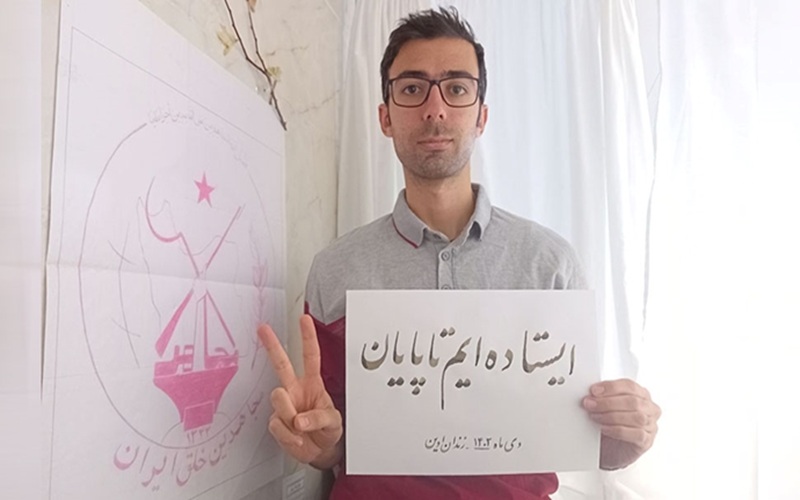

The case of Vahid Baniamerian reflects a deeper confrontation between authoritarian legitimacy and the politics of resistance
The final statements and courtroom defense attributed to Vahid Baniamerian should not be interpreted merely as emotional testimony from a prisoner facing execution. They represent something far more politically significant: a direct challenge to the legitimacy of authoritarian power in Iran and a broader articulation of resistance as a political identity rather than a personal act of sacrifice.
🚨 Simay Azadi Exclusive – The Defense of “Commander Vahid”
Iran News AlertIn a video recorded from prison, PMOI member Vahid Baniamerian explains why he joined the organization and delivers a defiant response to the regime, standing firmly by his ideals.
He also voices his… pic.twitter.com/ST9kdQyYGJ— SIMAY AZADI TV (@en_simayazadi) April 8, 2026
What emerged from his statements was not the language of pleading, repentance, or negotiation. Instead, it was the language of refusal — refusal to recognize the moral authority of institutions designed not to deliver justice, but to enforce obedience through fear.
At the center of Baniamerian’s position lies a critical political question that has shaped modern authoritarian systems for decades: can a state maintain legitimacy when its judicial structure functions primarily as an instrument of intimidation?
His rejection of what he described as “formalistic courts” strikes at the heart of that contradiction. In authoritarian systems, courts often retain the outward appearance of legality while operating within a framework where verdicts are politically predetermined. In such conditions, legality and justice become separated. Procedure survives, but legitimacy erodes.
Political theorist Hannah Arendt explored similar dynamics in The Origins of Totalitarianism, arguing that authoritarian systems preserve institutional forms while emptying them of independent meaning. The courtroom remains, but its function changes — from adjudication to political theater.
Baniamerian’s refusal to fully participate in that theater transforms silence itself into a political act. Short answers, rejection of procedural legitimacy, and refusal to engage according to the regime’s script become forms of resistance aimed not at acquittal, but at exposing the system’s underlying coercive structure.
One of the most politically important aspects of his defense is the repeated emphasis on remaining “steadfast” — what Iranian political discourse often describes as “sar-e Mozeh” or remaining firm in one’s position. In this context, steadfastness is not rhetorical symbolism. It is an assertion that coercive power cannot automatically produce ideological surrender.
That distinction matters politically because authoritarian systems rely not only on physical repression, but also on psychological submission. Public confessions, forced denunciations, and ritualized displays of compliance are central tools in preserving state authority. A prisoner who openly refuses ideological capitulation disrupts that mechanism.
The significance of such defiance becomes even more pronounced when linked to the broader history of political executions in Iran. Since the early years following the Iranian Revolution, the state has repeatedly used executions as instruments of deterrence aimed at preventing organized dissent. Yet resistance movements have historically attempted to invert that logic by transforming executions into symbols of political continuity rather than defeat.
Baniamerian’s assertion that execution can produce “multiplication” rather than erasure reflects precisely this political inversion. The argument is not mystical or purely emotional. It is strategic. When fear ceases to function as an effective deterrent, the political value of repression begins to diminish.
This dynamic exposes a deeper vulnerability within authoritarian systems: the more dependent a state becomes on coercion, the more it reveals insecurity regarding its own social legitimacy.
Equally significant is the issue of transparency. Reports surrounding politically sensitive trials in Iran frequently point to restricted public access, limited independent oversight, and heavy control over information dissemination. In such an environment, the state’s reluctance to permit open scrutiny becomes politically revealing in itself.
A regime fully confident in the legitimacy of its judicial process would not fear public visibility. Secrecy becomes necessary only when exposure threatens the credibility of the system.
What makes Baniamerian’s case politically resonant is therefore not simply the emotional weight of an individual confronting execution, but the broader conflict it symbolizes between authoritarian control and the persistence of dissent inside Iran.
His statements also reflect a larger generational phenomenon. Across recent years, particularly following nationwide protest waves, Iran has witnessed the emergence of a younger political generation less willing to negotiate within the boundaries imposed by the ruling establishment. For many within this generation, political resistance is no longer framed solely through reformist expectations, but through a more fundamental rejection of the ideological foundations of the system itself.
That shift has altered the political landscape. The state continues to possess overwhelming coercive power, yet coercion alone cannot permanently resolve crises of legitimacy, economic deterioration, generational alienation, and growing distrust toward state institutions.
The political significance of Baniamerian’s words ultimately lies in this broader context. His defense represents an attempt to redefine power itself — arguing that legitimacy cannot be manufactured through courts, prisons, or executions if the governed no longer recognize the moral authority behind them.
In authoritarian systems, the state seeks to monopolize both force and narrative. Resistance begins when individuals refuse to surrender either.
Whether one agrees with his political affiliations or not, the broader reality remains unavoidable: the continued emergence of figures willing to confront the state despite the threat of execution signals a deeper and unresolved crisis within Iran’s political order.