


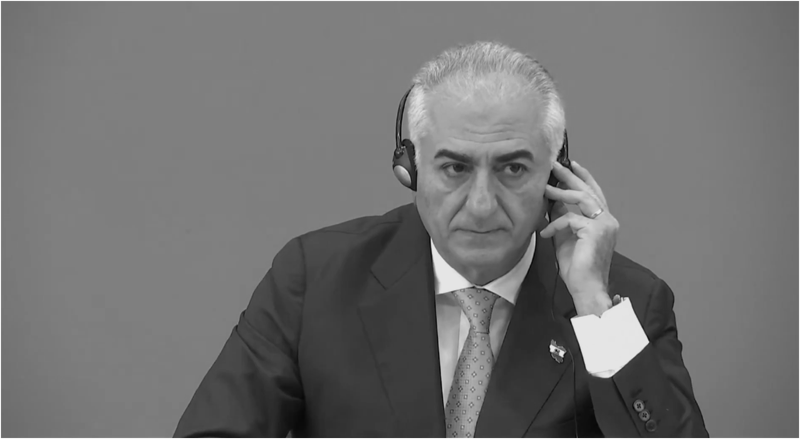

How toxic intimidation and coordinated harassment among pro-monarchy networks undermine democratic discourse on Iran’s future
For years, segments of Iran’s monarchists have attempted to market themselves internationally as the polished face of a modern, democratic alternative to the ruling clerical establishment. Wrapped in the language of “civilization,” “national revival,” and “development,” they present an image of moderation and political maturity. Yet beneath this carefully managed façade, a far more troubling reality has emerged — one increasingly defined by intimidation, online mobs, vulgar attacks, and organized political thuggery.
The contradiction is difficult to ignore. A movement that claims to champion democracy and pluralism has, in practice, fostered an atmosphere where critics are routinely harassed, smeared, and silenced. Across social media platforms and even within Iranian diaspora communities in Europe, critics of the monarchist current tied to the son of the former Shah have reported waves of coordinated abuse, personal attacks, and threats designed not to debate ideas, but to destroy reputations and drive dissenting voices out of public discussion.
This phenomenon is not new in political history. Political theorist Hannah Arendt examined similar dynamics in The Origins of Totalitarianism, where she described how authoritarian and proto-fascist movements often rely on an uneasy alliance between elites and mobs. According to Arendt, polished leadership figures present a respectable and diplomatic image to the outside world, while unofficial street-level actors carry out intimidation campaigns against opponents.
That framework offers a striking lens through which to view the current behavior of radicalized monarchist circles surrounding the exiled crown prince. Public representatives appear in tailored suits, speaking the language of democracy and human rights in interviews and conferences abroad. At the same time, loosely coordinated online networks and aggressive activists unleash campaigns of insults, harassment, and character assassination against journalists, activists, dissidents, and ordinary users who challenge their narrative.
This dual structure creates plausible deniability. The leadership remains formally detached from the abuse, while benefiting politically from the climate of fear it produces.
Social media has become the primary arena for this form of political thuggery. Numerous observers and activists have documented how coordinated accounts amplify toxic rhetoric, target independent voices, and flood discussions with abusive content. The objective is rarely persuasion. Instead, it is disruption — turning political dialogue into emotional chaos where rational debate becomes impossible.
The pattern reflects a broader political strategy familiar to scholars of authoritarian behavior. Official discourse remains polished and outwardly respectable, while the unofficial sphere is transformed into a battlefield dominated by intimidation and humiliation. In this environment, organized harassment functions as an informal enforcement mechanism.
Media analysts have increasingly warned about the “toxicification” of political discourse among parts of the Iranian diaspora opposition. Independent commentators who refuse to align with monarchist narratives often face aggressive campaigns aimed at exhausting them psychologically and professionally. Many eventually withdraw from public debate altogether to avoid constant abuse and defamation.
The German sociologist Elisabeth Noelle-Neumann described this mechanism decades ago in her theory of The Spiral of Silence. Individuals, fearing social isolation and public humiliation, begin censoring themselves when confronted with hostile and aggressive majorities — or even the appearance of such majorities. Authoritarian movements exploit this fear by making dissent socially and emotionally costly.
That is precisely what appears to be unfolding within parts of the Iranian opposition space today. The flood of vulgarity, coordinated insults, and digital mobbing is not accidental. Its function is to silence independent voices, particularly those who speak about social inequality, economic injustice, war, marginalization, or the lived realities of ordinary Iranians rather than ideological fantasies promoted abroad.
Digital monitoring also suggests that this behavior is not confined to isolated individuals. Similar patterns emerge repeatedly across multiple platforms. Clusters of anonymous or fake accounts become active simultaneously during politically sensitive moments, often amplifying identical messages and targeting the same critics. Such synchronization has raised growing suspicions among observers about centralized coordination and organized manipulation of online discourse.
Equally troubling is the absence of accountability. Critics frequently note that when difficult questions are raised about political programs, leadership structures, funding transparency, or long-term strategies for Iran’s future, substantive answers rarely follow. Instead, discussions quickly deteriorate into personal attacks and emotional confrontation. Serious political questions are drowned beneath waves of outrage and abuse.
The consequences extend far beyond social media. Healthy opposition politics require pluralism, tolerance, and the ability to engage in disagreement without dehumanization. When political spaces become dominated by intimidation tactics, only the loudest and most aggressive actors remain visible. Intellectual diversity shrinks, nuanced debate disappears, and democratic culture deteriorates before it even has a chance to emerge.
Ironically, this behavior ultimately serves the interests of the ruling establishment in Tehran. A fragmented and toxic opposition incapable of constructive dialogue poses little genuine threat to authoritarian power. By deepening divisions, spreading fear, and normalizing political bullying, these monarchist networks risk reproducing the same culture of repression they claim to oppose.
The tragedy is that many Iranians seeking freedom from dictatorship increasingly find themselves confronted not with democratic alternatives, but with competing forms of political intolerance. If the future of Iran is to be genuinely democratic, opposition movements must reject not only authoritarian governments, but also the authoritarian methods that poison political life from within.