
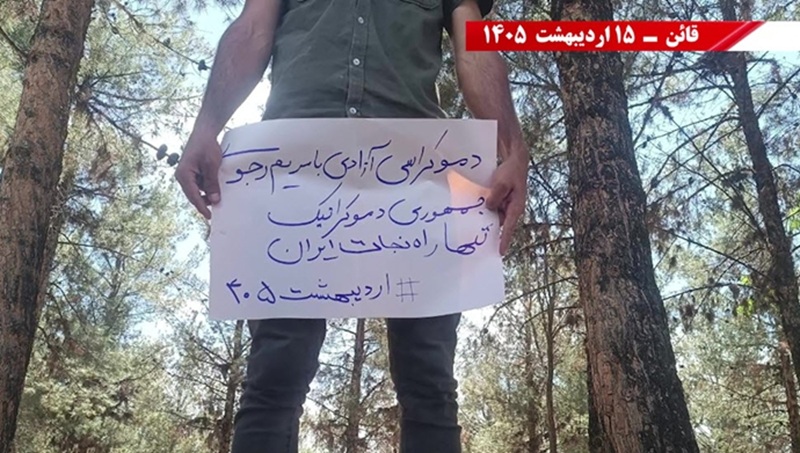

The crisis in Iran demands recognition of organized popular resistance rather than failed cycles of compromise and militarization
For decades, international policy toward Iran has oscillated between two failed approaches: appeasement of the ruling religious dictatorship and the threat or reality of foreign military confrontation. Neither strategy has produced democracy, stability, or lasting security for the Iranian people. Instead, both have contributed to the survival of a political system that has repeatedly demonstrated its hostility toward political freedom, pluralism, and human rights.
The central political reality often ignored in discussions about Iran is that the country’s crisis cannot be resolved externally alone, nor managed indefinitely through diplomatic accommodation. The decisive factor remains the Iranian people themselves and their capacity for organized resistance against authoritarian rule.
From the earliest days following the Iranian Revolution, large segments of Iranian society demanded political participation, civil liberties, equality before the law, and democratic governance. Yet the regime consolidated power through ideological control, repression, and elimination of political rivals. Over time, international actors frequently prioritized geopolitical calculations and regional stability over the democratic aspirations of ordinary Iranians.
This strategic pattern allowed the ruling system to survive repeated crises that might otherwise have forced structural political change.
The debate surrounding Iran is therefore not simply about foreign policy. It is fundamentally about political legitimacy. A government capable of maintaining itself primarily through executions, mass arrests, censorship, and suppression inevitably faces a crisis of popular consent. In such conditions, the question becomes whether the international community continues managing the symptoms of authoritarianism or begins addressing its root causes.
The failure of appeasement is now difficult to deny. Decades of negotiations, concessions, economic engagement, and political accommodation did not moderate the ideological structure of the regime. Instead, the state expanded domestic repression while simultaneously deepening regional interventionism through proxy networks and militarized influence across the Middle East.
At the same time, foreign military escalation has likewise failed to offer a sustainable political solution. External war risks strengthening nationalist reactions, intensifying instability, and further militarizing Iranian society without guaranteeing democratic transition. History repeatedly demonstrates that durable political transformation cannot simply be imposed through outside force.
This is why the concept of organized internal resistance has gained renewed political significance among opposition movements and segments of Iranian civil society.
Supporters of this position argue that democratic transition requires neither accommodation with authoritarianism nor dependence on foreign military intervention, but rather the strengthening of organized domestic resistance capable of mobilizing social forces across ethnic, religious, gender, and political lines.
Within this framework, issues such as women’s equality, separation of religion and state, decentralization of political power, ethnic inclusion, religious pluralism, and a non-nuclear Iran are not secondary demands. They are presented as foundational conditions for any legitimate post-authoritarian political order.
The political importance of these demands lies in their direct contrast with both forms of dictatorship that have shaped modern Iranian history: the former monarchy and the current clerical establishment. For many opposition activists, both systems concentrated power through exclusionary political structures while limiting genuine democratic participation.
This explains why growing numbers of activists increasingly reject attempts to frame Iran’s future as a choice merely between competing authoritarian models.
The emphasis on organized resistance also reflects lessons learned from repeated cycles of failed reform efforts inside the system. Over the past decades, many Iranians participated in elections, reformist movements, labor protests, civil campaigns, and issue-based activism with the hope of gradual transformation. Yet each major wave eventually encountered institutional barriers enforced by unelected centers of power.
As a result, a broader political conclusion has emerged among many opposition groups: structural authoritarianism cannot be fundamentally reformed from within if the mechanisms of repression remain intact.
This perspective has become even more pronounced following successive nationwide protest movements, during which demonstrators openly challenged the legitimacy of the entire governing structure rather than seeking limited reforms.
At the international level, advocates of organized resistance increasingly call for policies centered on human rights accountability rather than narrow nuclear negotiations alone. Their demands often include stronger action against officials linked to executions and repression, restrictions on regime operatives abroad, and diplomatic pressure tied directly to human rights benchmarks.
Such arguments stem from the belief that treating Iran exclusively as a nuclear or security issue ignores the internal political crisis driving instability itself.
Critics of current international policy further argue that silence regarding executions, political imprisonment, and systematic repression has contributed to the normalization of authoritarian violence inside Iran. The more the global conversation focuses solely on military tensions or nuclear diplomacy, the less attention is directed toward the social and political struggles unfolding within the country.
Another major concern involves fragmentation inside the opposition. Iranian opposition movements have long suffered from ideological divisions, personal rivalries, and competing visions for the future. The regime has historically benefited from this fragmentation, often portraying itself as the only force capable of preserving national cohesion.
Consequently, proponents of organized resistance increasingly stress coalition-building among democratic forces, ethnic minorities, religious communities, women’s rights activists, labor organizations, and secular political movements.
The broader argument is ultimately straightforward: sustainable political change in Iran must emerge through a democratic movement capable of replacing authoritarianism with accountable governance rather than reproducing new forms of centralized domination.
Whether one agrees with every opposition current or not, one reality has become increasingly visible after decades of crisis: neither appeasement nor war has resolved Iran’s underlying political deadlock. The demand for democratic transformation remains alive inside Iranian society itself.
The future of Iran will ultimately be determined not by diplomatic slogans or geopolitical maneuvering alone, but by whether the aspirations of its people for freedom, representation, and political dignity can finally overcome the structures that have suppressed them for generations.