
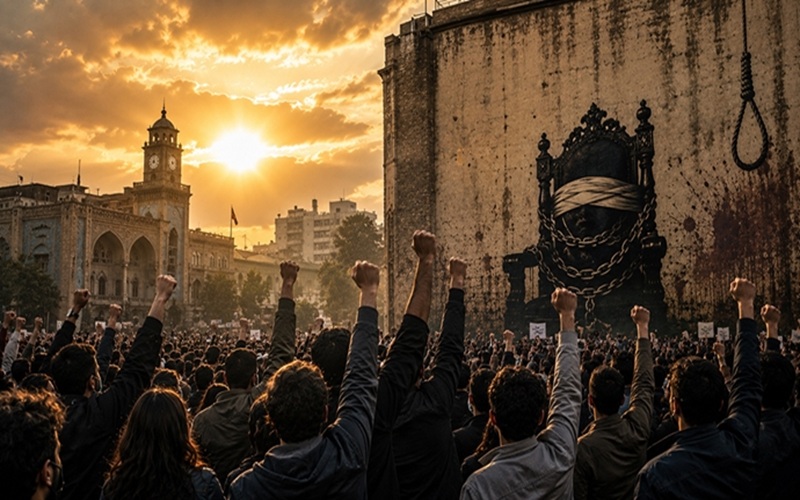

More than a century after Iran’s Constitutional Revolution, the country remains trapped in a recurring conflict between a society demanding participation and a ruling system determined to preserve absolute control.
In Iranian political memory, the phrase “Minor Despotism” is not merely a historical reference to a short period during the Qajar dynasty. It has become a political metaphor — a symbol of those moments when power responds to popular demands for participation, accountability, and freedom with repression and violence.
The term originally referred to the period following Iran’s Constitutional Revolution in the early twentieth century, when hopes for representative government and the rule of law were abruptly crushed by authoritarian backlash. Yet the concept survived because the pattern itself never disappeared. Throughout modern Iranian history, whenever society has moved toward greater political awareness and public participation, entrenched centers of power have often treated those demands as existential threats.
That historical cycle remains deeply visible in Iran today.
The Constitutional Revolution and the Birth of a Political Struggle
Iran’s Constitutional Revolution of 1905–1911 marked the first major attempt to limit absolute monarchy and establish a parliament capable of representing the people. For the first time, Iranians experienced the possibility of constitutional governance and restrictions on unchecked authority.
But the experiment was short-lived.
In 1908, Mohammad Ali Shah ordered the shelling of the Iranian parliament in Tehran, effectively beginning the period later known as “Minor Despotism.” Newspapers were shut down, constitutionalists were hunted, dissidents imprisoned, and public debate violently suppressed. The state attempted to reverse history itself — restoring centralized power through force and intimidation.
What transformed this episode into a lasting political symbol was not only the violence of that era, but the broader pattern it revealed: authoritarian systems often resort to security crackdowns whenever society seeks a greater role in determining its future.
More than a century later, that same tension continues to define Iran’s political landscape.
Modern Iran and the Echo of “Minor Despotism”
Today’s Iran is not a direct replica of Qajar-era rule. History never repeats itself in identical form. Yet the underlying struggle remains remarkably familiar.
On one side stands a society increasingly demanding freedom, justice, accountability, and political participation. On the other stands a political structure that views centralized authority and ideological control as necessary for its survival.
The tools of repression may have evolved, but the logic remains consistent. In the Constitutional era, newspapers were closed and reformists jailed. In contemporary Iran, authorities rely on censorship, mass arrests, executions, internet restrictions, surveillance, and security institutions to silence dissent.
The central conflict remains unchanged: who has the right to shape Iran’s future — the people or the ruling establishment?
This question has become especially visible during repeated waves of unrest in recent decades. From the student protests of 1999 to the nationwide demonstrations of 2009, 2017, 2019, and 2026, large segments of Iranian society have repeatedly challenged the concentration of power and demanded broader political and social freedoms.
Despite severe repression, the persistence of these movements reflects a deeper reality within Iranian society: the demand for dignity and political participation has not disappeared.
The Forgotten Third Force: Foreign Powers
Iranian history, however, has never been solely a struggle between society and domestic authoritarianism. A third actor has consistently shaped the country’s political trajectory: foreign powers.
During the Constitutional Revolution, the Qajar monarchy was not acting alone. Imperial Russia played a decisive role in supporting Mohammad Ali Shah and strengthening anti-constitutional forces. Russian-backed Cossack units were instrumental in suppressing constitutionalists, while Britain also sought to preserve its own strategic interests in Iran.
For many Iranians, this created a lasting historical lesson: authoritarianism inside Iran has often intersected with foreign geopolitical calculations.
The same perception persists today.
While the Iranian government intensifies repression at home, global powers continue to approach Iran primarily through the lens of regional security, nuclear negotiations, energy interests, and geopolitical competition. For many critics of the regime, international actors frequently prioritize strategic stability over the democratic aspirations of the Iranian people.
This has contributed to a deep sense of distrust toward both domestic authoritarianism and foreign intervention alike.
Resistance as Historical Continuity
Within this context, opposition movements often frame themselves as part of a longer historical continuum stretching back to the Constitutional Revolution and later nationalist movements.
Groups such as the National Council of Resistance of Iran and the People’s Mojahedin Organization of Iran portray their struggle as a continuation of earlier resistance movements against both monarchical dictatorship and clerical authoritarianism.
Supporters of these groups argue that organized resistance remains necessary against what they describe as a system sustained through repression, executions, and ideological control.
Regardless of political affiliation, one reality remains difficult to ignore: resistance movements repeatedly emerge wherever political systems deny meaningful participation and suppress peaceful dissent.
Why “Minor Despotism” Still Matters
The enduring relevance of “Minor Despotism” lies not in nostalgia for a distant historical era, but in what it reveals about the recurring relationship between society and power in Iran.
Authoritarian systems may succeed temporarily in slowing political change through force, fear, and censorship. But history also shows that repression alone rarely eliminates public demands for freedom and participation permanently.
The Constitutional Revolution survived military assault because cities like Tabriz resisted. Constitutionalists reorganized. Society eventually reclaimed political space despite severe repression.
That lesson continues to resonate today.
As long as political exclusion, inequality, censorship, and concentrated power persist, new forms of protest and resistance are likely to emerge. This dynamic is not unique to one ideology, organization, or historical period. It reflects a broader social reality visible across generations of modern Iranian history.
“Minor Despotism,” therefore, is more than the name of a past political crisis. It is a mirror through which successive generations of Iranians continue to examine the unresolved struggle between authoritarian rule and popular sovereignty.
And that struggle — between society’s demand for dignity and power’s instinct for control — remains one of the defining political battles of modern Iran.