


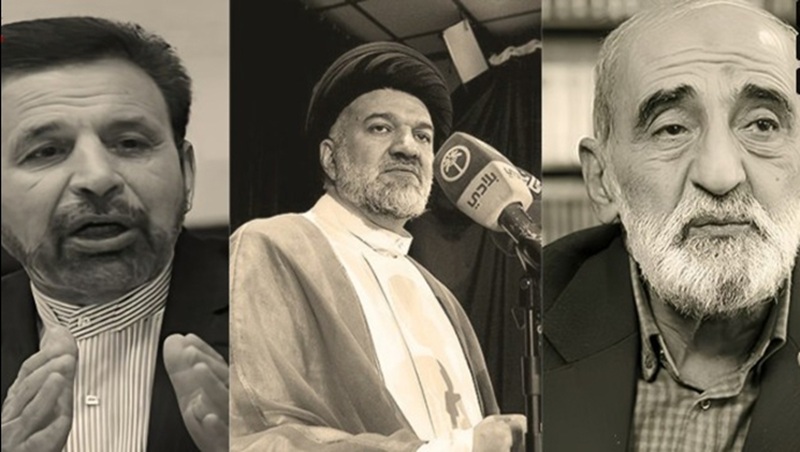

Public threats, accusations of treason, and calls for street unrest expose growing fractures inside Iran’s regime amid renewed tensions over talks with Washington.
Internal divisions within Iran’s regime have escalated sharply as competing factions intensify their conflict over possible negotiations with the United States. The dispute has now moved beyond political criticism into open threats, accusations of betrayal, and warnings of unrest from figures closely tied to the regime’s power structure.
The latest exchanges reveal growing tensions inside the Iranian regime at a time when economic pressure, regional instability, and political uncertainty continue to deepen the system’s internal crisis.
Rouhani-Era Official Attacks Hardliners
Mahmoud Vaezi, former chief of staff and spokesman for former regime President Hassan Rouhani’s administration, publicly attacked opponents of negotiations, including hardline parliamentarian Amir Hossein Sabeti and former nuclear negotiator Saeed Jalili.
Vaezi accused anti-negotiation factions of exploiting the authority of the Supreme Leader for political purposes, arguing that if the leadership opposed talks with Washington, such opposition would be explicitly declared.
He stated that hardliners were once again resisting negotiations despite the process allegedly having received approval from the leadership itself. According to Vaezi, such behavior damages national unity and exposes divisions within the regime at a sensitive moment.
His remarks reflect a broader struggle between factions advocating tactical engagement with the West to ease pressure on the regime and ideological hardliners who view negotiations as political surrender.
Regime Newspapers Warn Against Extremists
The internal dispute has also spread into state-affiliated media.
The regime-affiliated newspaper Jomhouri Eslami issued an unusually harsh warning against extremist anti-negotiation figures, arguing that some hardliners are actively pushing the country toward confrontation and war.
The newspaper criticized radical parliamentarians and state television personalities who openly call for military escalation and the destruction of foreign governments, claiming their actions are helping close off every path except conflict.
In one of its sharpest statements, the paper argued that such extremist factions pose no less danger to Iran than Israeli Prime Minister Benjamin Netanyahu or U.S. President Donald Trump.
The paper also called for “decisive and practical action” against groups it accused of undermining national cohesion through divisive rhetoric and anti-unity slogans.
Escalating Threats Against Foreign Minister Araghchi
At the center of the latest controversy is the regime Foreign Minister Abbas Araghchi, who has become a target of increasingly aggressive attacks from hardline circles.
The regime-affiliated newspaper Sazandegi reported on statements made by Mohammad-Bagher Kharazi, secretary-general of Hezbollah Iran and a figure reportedly close to Mojtaba Khamenei, the new regime’s supreme leader.
Kharazi accused Araghchi not only of weakness and capitulation in negotiations but also suggested suspicious links to a reported attack on the leadership’s location. He further warned that if current negotiations resulted in an outcome similar to the 2015 nuclear agreement, known as the JCPOA, he would support street protests and even the destruction of the Foreign Ministry and President Masoud Pezeshkian’s government.
Such rhetoric marks a significant escalation even by the standards of the regime’s factional politics, where accusations of infiltration, betrayal, and ideological deviation have historically been used during periods of internal instability.
Kharazi’s Direct Threats
In a social media post, Kharazi wrote that he and others were “completely suspicious” of Araghchi, particularly regarding his efforts to meet the current Supreme Leader and his conduct during negotiations.
He accused the foreign minister of attempting to separate the United States from Israel politically while downplaying ongoing regional conflicts. Kharazi warned that if negotiations produced what he described as another humiliating compromise similar to the JCPOA, hardline forces would not hesitate to organize protests and target the government directly.
The language used in the statement was extraordinary because it openly threatened internal mobilization against state institutions and senior officials from within the regime’s own political camp.
IRGC-Linked Media Removes Controversial Statement
Further highlighting the sensitivity of the dispute, the Islamic Revolutionary Guard Corps-affiliated news agency that initially published Kharazi’s remarks later removed the report from its website.
The deletion suggests concern within sections of the regime over the political consequences of openly broadcasting threats against the government and the foreign ministry at a time of heightened internal tensions.
However, the incident has already exposed the depth of the fractures now emerging inside Iran’s ruling establishment.
A Regime Under Growing Pressure
The conflict over negotiations with Washington is increasingly becoming a proxy for a broader struggle over the future direction of the Iranian regime itself.
One faction appears to view limited diplomatic engagement as necessary for preserving the system amid mounting economic and international pressure. Another sees compromise with the United States as a strategic and ideological defeat that could weaken the regime internally.
The increasingly public nature of these disputes — including threats of unrest, accusations of treason, and attacks on senior officials — points to a leadership structure under growing strain.
For many observers, the significance of these confrontations lies not only in the debate over negotiations, but in what they reveal about the regime’s deepening internal instability and the erosion of cohesion among its competing power centers.