
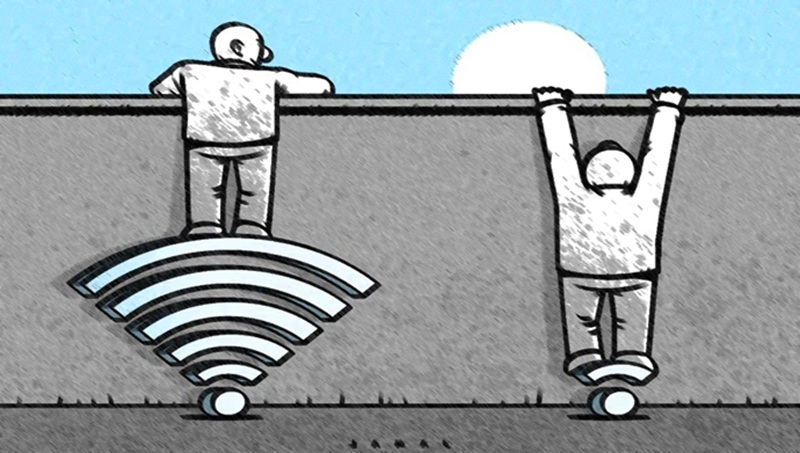

From censorship to economic exclusion, Iran’s ruling establishment is transforming free access to information into a luxury reserved for the wealthy and the politically connected.
Political crisis, economic crisis, cultural crisis, unemployment crisis, migration crisis, and a deepening cost-of-living catastrophe — modern Iran has become synonymous with permanent crisis. Yet beneath all these visible layers lies a deeper structural collapse that sustains and reproduces every other failure: the regime’s growing class divide.
Whenever a government institutionalizes political repression as the core of its survival strategy, it inevitably produces a society built on inequality, privilege, and organized plunder. The clerical regime ruling Iran has followed precisely this path since its inception. What began with censorship and political control has now evolved into something even more dangerous: the creation of a class-based internet system — an “approved” internet for insiders and a restricted, unaffordable version for ordinary citizens.
This is not simply a technological issue. In today’s Iran, internet access has become a marker of social status and political proximity to power. Just as education, healthcare, housing, and economic security have increasingly become privileges reserved for specific segments of society, free access to information is now being absorbed into the same architecture of discrimination.
For years, the regime relied on mass censorship, website blocking, intimidation of journalists, and restrictions on digital communication. But the latest phase reveals a more sophisticated and deeply authoritarian objective: transforming uncensored internet access into a luxury commodity available only to the wealthy and to those connected to the state apparatus.
Even sections of the regime-aligned media have been forced to acknowledge the contradiction at the heart of this policy. In its May 7, 2026 issue, the Iranian newspaper Donya-e-Eqtesad questioned the legal basis of the so-called “tiered internet” project approved by the Supreme National Security Council. The paper highlighted the absurdity of the government’s logic: unrestricted internet access is supposedly “dangerous” for ordinary citizens, yet the same internet suddenly becomes “acceptable” when sold at exorbitant prices to a select group.
That contradiction exposes the regime’s real motive. The issue has never been morality, public safety, or national security. The objective is social control through economic exclusion.
According to the same report, the price of 50 gigabytes of international internet access — previously costing between 300,000 and 400,000 tomans — has surged to nearly 3 million tomans. In a country where millions already live below the poverty line, such pricing effectively excludes large sections of society from unrestricted access to global information.
The economic dimension of this policy is just as revealing as its political purpose. Internet restrictions have created enormous financial opportunities for regime-linked operators and monopolistic networks. Every shutdown, filtering campaign, and limitation imposed on public access becomes a source of profit for institutions tied to the state. Crises themselves become mechanisms of extraction.
Statements from regime officials further confirm the institutional nature of this policy. Authorities openly defend the launch of “Pro Internet” services, claiming they were approved by the Supreme National Security Council and are fully legal. Meanwhile, the judiciary remains silent, effectively endorsing the discrimination.
The result is a society in which citizens are forced to pay extraordinary sums simply to exercise one of the most basic rights of the modern age: access to free information.
Perhaps the clearest expression of the regime’s thinking came from Mohammad Kahvand, secretary of the Cyberspace Headquarters of the Qom Seminary, who reportedly suggested that internet prices should rise so dramatically that ordinary people would no longer find it worthwhile to use. The statement stripped away every remaining pretense. The goal is not regulation. It is deprivation.
Class-based internet access is therefore not merely an economic policy or a temporary wartime measure. It is the continuation of a decades-long project aimed at controlling society by monopolizing knowledge, restricting communication, and deepening inequality. The same authoritarian logic that created political prisoners, economic monopolies, systemic corruption, and widespread poverty is now reshaping cyberspace into another arena of exclusion.
Iran’s ruling establishment understands a fundamental reality: access to uncensored information empowers society. A connected population is harder to manipulate, isolate, and silence. For that reason, internet restriction has become inseparable from the regime’s broader survival strategy.
What is unfolding in Iran today is not simply digital censorship. It is the construction of a new form of class apartheid — one in which information itself becomes a privilege reserved for the loyal, the wealthy, and the politically protected.