


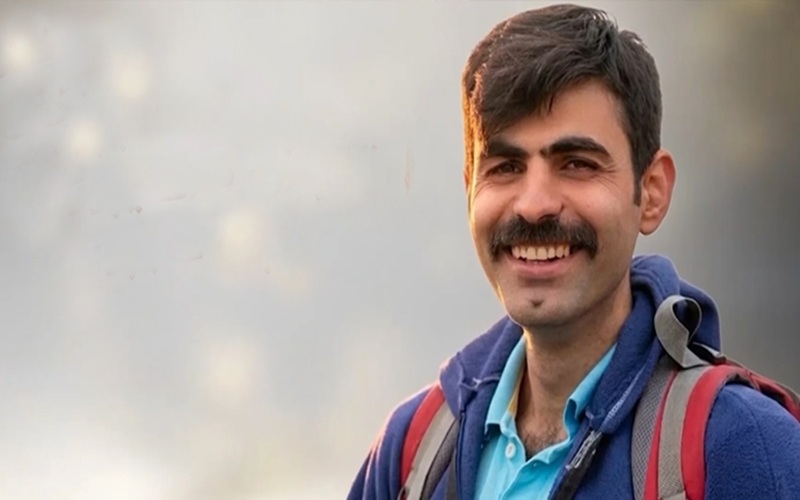

A political prisoner facing execution renews his commitment to organized resistance, portraying Iran’s prisons not as instruments of defeat, but as battlegrounds for ideological endurance and democratic struggle.
Prison as a Frontline of Resistance
For committed political dissidents in Iran, prison has never represented surrender. For those who remain steadfast in their beliefs, incarceration becomes a space where conviction is tested, refined, and strengthened. The recent prison message delivered by Iranian political prisoner Babak Alipour stands as a striking example of that reality.
Recorded behind prison walls in December 2025, Alipour’s statement reflects the convergence of legal awareness and revolutionary commitment. A law graduate facing execution, he speaks not with hesitation or fear, but with unwavering certainty about what he considers the only viable path for Iran’s future: organized resistance against clerical dictatorship.
Throughout his remarks, there is no trace of retreat or remorse. Instead, his words amount to a renewed oath to continue resisting until the overthrow of the ruling system.
From Legal Studies to Organized Resistance
Born in 1991 in Amol, Babak Alipour entered political activism with an academic background in law, a discipline rooted in justice and legal legitimacy. Yet his experience inside Iran’s judicial system led him to reject the very institutions claiming legal authority over his life.
In his statement, Alipour directly challenges the legitimacy of the courts that upheld his death sentence and those of five other political prisoners. He argues that these tribunals fail to meet even the most basic international legal standards and therefore cannot be recognized as legitimate courts of justice.
This rejection of judicial legitimacy is central to his political stance. For Alipour, the issue is not merely personal persecution; it is the broader nature of a political system that, in his view, produces poverty, corruption, unemployment, social despair, suicide, and violence throughout Iranian society.
He portrays his decision to join the organized resistance movement as a conscious alternative to what he describes as societal decay under the doctrine of Velayat-e Faqih. According to his account, without that political commitment, he himself could have become another casualty of the systemic crises imposed on Iranian society.
“Resistance Units” as a Strategy Against Political Deadlock
One of the most significant themes in Alipour’s message is his emphasis on the role of the so-called “Resistance Units,” underground networks associated with the People’s Mojahedin Organization of Iran.
For Alipour, these units represent more than symbolic activism. He describes them as operational instruments for political change and credits them with sustaining his morale during solitary confinement, interrogations, and years of imprisonment.
His remarks frame resistance not as an abstract political slogan, but as a living connection between imprisoned dissidents and activists operating inside Iranian cities and neighborhoods. Even from behind prison walls, he portrays himself as part of a broader organized movement.
Alipour also references remarks by Maryam Rajavi during a youth conference in Paris, interpreting her mention of political prisoners like himself as a direct call to remain steadfast, even under threat of execution.
A Historical Continuum of Resistance
Alipour consciously places himself within a historical lineage of Iranian political resistance dating back to the 1980s. In his message, he honors those killed during the June 20, 1981 crackdown and the mass execution of political prisoners during the 1988 Mass Execution of Iranian Political Prisoners.
He describes his own struggle as a continuation of sacrifices made by previous generations of dissidents. Particularly emotional are his references to fellow prisoners Behrouz Ehsani and Mehdi Hassani, whom he presents as symbols of shared ideological commitment formed inside prison corridors.
For Alipour, prison solidarity becomes part of a larger political narrative — one linking today’s condemned prisoners to decades of opposition against authoritarian rule in Iran.
Executions as Instruments of Fear
As a trained legal scholar, Alipour interprets the Iranian regime’s growing use of executions in 2025 not as a demonstration of strength, but as evidence of deep political insecurity.
He argues that the escalation of death sentences is intended to intimidate what he describes as an increasingly volatile and dissatisfied society. Yet he insists that repression cannot alter the long-term trajectory of political change.
According to his analysis, executions may temporarily instill fear, but they simultaneously deepen public anger and strengthen the resolve of younger generations seeking systemic transformation.
For that reason, he dismisses half-measures and reformist alternatives, arguing that only organized resistance aimed at the complete overthrow of the ruling system can produce meaningful change.
Sacrifice as the Core of Political Commitment
The concluding section of Alipour’s prison message centers on the concept of sacrifice. Echoing the ideological language long associated with the Iranian resistance movement, he declares his readiness to give his life and possessions for what he describes as the liberation of the Iranian people.
His vision is not limited to opposition against the current ruling establishment. He explicitly links the struggle to the establishment of a democratic republic founded on freedom and popular sovereignty.
In his final remarks, Alipour expresses confidence that Iran’s future liberation is inevitable and frames participation in organized resistance as both a political duty and a personal honor.
Whether one agrees with his political ideology or not, his message illustrates a broader reality within Iran’s political prisons: despite decades of executions, repression, and intimidation, the regime continues to face dissidents who view imprisonment not as defeat, but as another arena of confrontation.