


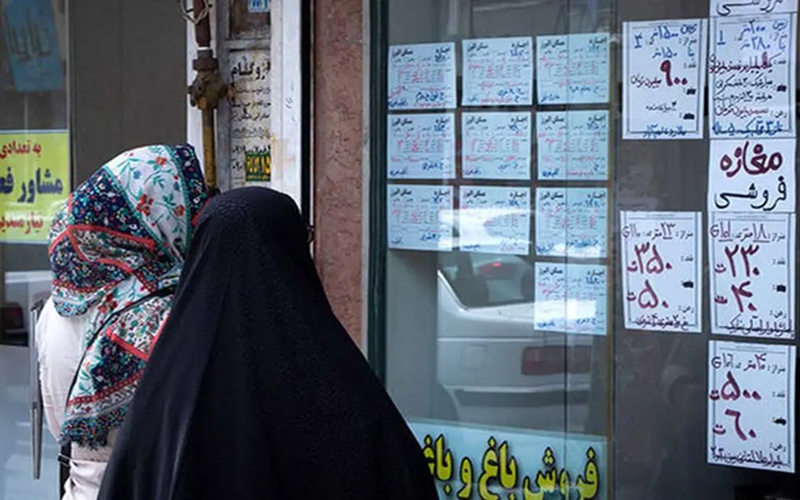

Rising rents, stagnant wages, and a widening gap between income and living costs are pushing millions of Iranian households into housing poverty and forcing many to relocate to city outskirts.
Iran’s rental housing market has become one of the most severe sources of economic pressure on households, as soaring rents, declining purchasing power, and years of inflation continue to erode living standards across the country. For millions of Iranians, securing adequate housing has evolved from a basic necessity into a daily struggle for survival.
In the latest acknowledgment of the crisis, Abdoljalal Iri, a member of the Iranian Parliament’s Civil Engineering Commission, stated that in some cities more than 70 percent of household income is now spent on rent. His remarks highlight the growing burden facing tenants and underscore the extent to which housing costs have outpaced earnings.
According to Iri, the relentless rise in rental prices has significantly reduced families’ ability to pay for other essential needs, including food, healthcare, education, and transportation. He also noted that many tenants have been forced to leave their neighborhoods and relocate to suburban areas, smaller apartments, or lower-quality housing in an effort to reduce costs.
Housing Costs Far Above International Standards
Housing economists have long warned that the share of household income devoted to housing in Iran has moved far beyond internationally accepted standards. In most developed countries, housing expenses typically account for between 20 and 30 percent of household income, with higher levels considered a sign of financial distress.
Iran, however, has followed a dramatically different trajectory. Official statistics indicate that housing remains the single largest expenditure for urban households. Continuous increases in both property prices and rents, combined with limited wage growth, have steadily expanded the share of income required to secure housing.
For lower- and middle-income families, housing costs frequently consume more than half of household earnings. According to the parliamentarian’s latest assessment, that figure has now exceeded 70 percent in some areas, a level widely associated with severe housing stress and economic vulnerability.
The Growing Reality of Housing Poverty
The consequences of rising housing costs extend far beyond the real estate sector. When most of a household’s income is devoted to rent, families are left with fewer resources for nutrition, healthcare, education, recreation, and other basic needs.
Economists increasingly describe this phenomenon as “housing poverty,” a condition in which households technically earn an income but are unable to meet essential living expenses because such a large share of their earnings is consumed by housing costs.
The result is a decline in overall living standards and a growing number of families trapped in a cycle of economic insecurity despite remaining employed.
Rent Inflation Reaches Historic Highs
Official figures show that rent inflation in Iran has reached unprecedented levels in recent years. Rental inflation was reported at approximately 34 percent in 2022, 41 percent in 2023, and 40.3 percent in 2024, significantly above the average annual rent growth of roughly 17 percent recorded during the previous decade.
Many analysts believe the real increase is even higher than official figures suggest. In parts of Tehran, security deposits for apartments measuring between 70 and 90 square meters have reportedly more than doubled in just a few years. Units that required deposits of 400 to 500 million tomans in 2023 now often demand more than one billion tomans.
Similar trends have been observed in provincial capitals and other major cities throughout the country.
At the same time, the lack of transparent and up-to-date official data has made it increasingly difficult to accurately assess market conditions. Davood Beiginnejad, vice chairman of the Tehran Real Estate Consultants Association, recently acknowledged that the absence of updated government statistics prevents a precise calculation of annual rent increases.
Nevertheless, market observations and rental listings indicate that many landlords are demanding rent increases of 40 to 50 percent—or even more—when renewing contracts.
Forced Migration and Expanding Urban Margins
One of the most visible consequences of the housing crisis has been the growing migration of tenants to cheaper districts and satellite cities. Families that once lived in central urban neighborhoods are increasingly relocating to distant suburbs in search of affordable housing.
These moves often come with substantial social and economic costs. Longer commuting times, higher transportation expenses, reduced access to public services, and a lower quality of life have become common realities for many households.
Experts also link the housing crisis to broader social challenges, including declining marriage rates, delayed family formation, overcrowded housing, and the expansion of informal settlements around major cities.
A Structural Economic Crisis
The evidence emerging from official statements, economic data, and market realities suggests that Iran’s rental housing crisis is no longer merely a problem of the real estate sector. It has become one of the country’s most significant economic and social challenges.
When families are forced to allocate more than 70 percent of their income to housing, rent ceases to be just another household expense and instead becomes a driver of poverty, inequality, and social instability. For millions of Iranian tenants, each new lease renewal season brings greater uncertainty and financial strain, reflecting the deeper structural problems that continue to plague Iran’s economy.
As inflation persists and housing affordability deteriorates, the rental crisis is likely to remain a defining feature of the country’s broader cost-of-living emergency.