


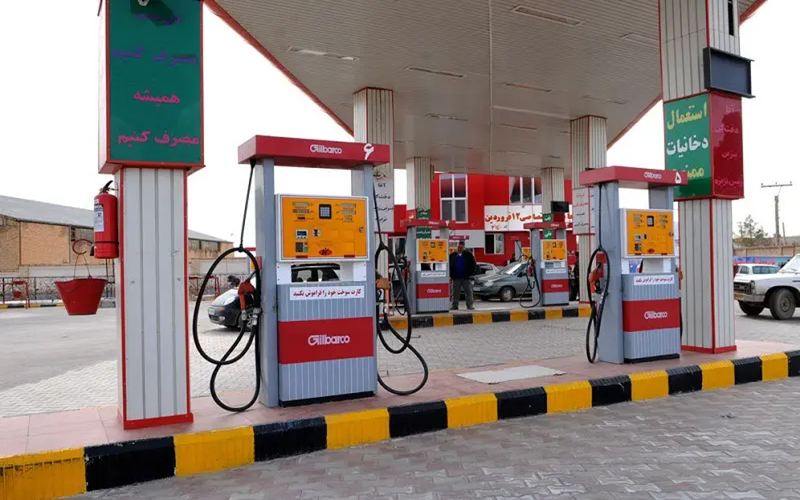

A failed gasoline-price experiment in Kerman highlights the regime’s dilemma: preserve costly subsidies or risk triggering renewed protests amid a widening fuel deficit.
For more than a decade, gasoline prices in Iran have been a political flashpoint. Few economic issues have so consistently threatened to shake government policy and trigger warnings of social unrest. The fundamental imbalance between the Iranian regime and society remains economic hardship and deteriorating living conditions—and gasoline has become one of its most combustible manifestations.
Over the past several days, the government quietly tested a sharp increase in gasoline prices. A price of 78,200 tomans per liter was initially announced and then implemented in Kerman. Within hours, however, the governor of Kerman ordered the sale of gasoline at that price halted. The episode triggered warnings from regime officials and experts, many of whom invoked the memory of the November 2019 nationwide uprising, which followed a gasoline-price increase and rapidly became a major political crisis.
The sequence—announcement, trial implementation, and rapid suspension—suggests an attempt to measure public reaction. The apparent strategy is to announce an exceptionally high price, provoke resistance, retreat, and then introduce a lower but still significantly increased price. In effect, the government would seek to make a substantial increase appear more acceptable by comparison.
On August 13, the Khodro-Bank website quoted Majid-Reza Hariri, head of the Iran-China Chamber of Commerce, as describing the announcement of figures such as 88,000 tomans as a classic psychological “anchoring” technique. According to Hariri, presenting an extremely high and frightening figure can make lower figures appear more reasonable and digestible, ultimately preparing society to accept gasoline at around 23,000 tomans.
The political risk is precisely what makes gasoline so sensitive. The regime knows that widespread economic dissatisfaction could rapidly turn into protests. Hariri described the strategy as potentially causing “severe and dangerous damage,” particularly through the erosion of social capital and the remaining trust between people and policymakers.
A dilemma the government cannot escape
Gasoline is no longer merely an economic calculation for the government. Previous price increases have transformed any sudden adjustment into a social and security issue. Even media outlets close to the government have warned that price reform without public persuasion and consumer protection could impose heavy social costs. Members of parliament have also cited concerns about mounting pressure on household livelihoods as a reason for opposing further increases under current conditions, despite the government’s legal authority to change prices.
The government is therefore trapped between two costly alternatives.
Maintaining heavily subsidized prices preserves the existing imbalance and increases dependence on imports and the consumption of national reserves. Raising prices, however, risks generating another wave of public anger in an already inflationary environment.
The Kerman experiment made this dilemma particularly visible. The plan was to sell unsubsidized gasoline at its full cost of 87,200 tomans at 204 filling stations across Kerman Province. The Energy Commission spokesman said the cheaper fuel quotas would remain in place and that the 87,200-toman rate would apply to consumption beyond those quotas. The experiment was nevertheless suspended.
Even if the stated purpose was to demonstrate the actual cost of gasoline or combat fuel smuggling, announcing such a figure establishes a new psychological ceiling in the public debate. The subsequent rapid retreat has consequently been interpreted by some analysts as an attempt to gauge the public reaction.
However, there is no reliable and direct evidence that the government has decided to eventually price gasoline at between 25,000 and 35,000 tomans after introducing the 87,000-toman figure. Such claims should therefore be treated as political-economic speculation rather than as an established government decision.
A widening gap between gasoline production and consumption
What is increasingly difficult for the government to ignore is the structural gap between domestic production and consumption.
Iran’s gasoline consumption has reached approximately 135 million liters per day, while domestic production has failed to keep pace. The issue has therefore moved beyond a chronic imbalance and become a costly policy choice.
The government must either absorb the enormous financial burden of importing gasoline and covering the supply deficit, or reduce consumption by restricting access and raising prices, thereby transferring part of the cost to consumers.
Neither option is painless.
The government’s own IRNA news agency, in a commentary published on August 13, acknowledged the persistent nature of the problem. Reviewing production and consumption figures over the past 20 years, it stated that none of the policies implemented during the past two decades had succeeded in preventing consumption from growing faster than production.
That admission underscores the structural character of the crisis. The gasoline shortage is not simply the result of a temporary disruption; it reflects two decades of policies that have failed to reconcile rising consumption with domestic supply.
The November 2019 precedent still haunts the regime
The political significance of gasoline prices is rooted in the events of November 2019. A sudden increase in fuel prices rapidly transformed an economic grievance into nationwide protests, creating one of the most serious challenges to the regime in recent years.
That experience remains a political red line.
In a commentary published on August 14, 2026, Euronews highlighted the continuing sensitivity of the issue under the headline “Gasoline at 87,000 Tomans; Is the Islamic Republic on the verge of a new price shock?” It noted that the government is not dealing with merely an economic equation: the events of November 2019 demonstrated that a fuel-price increase in Iran can quickly evolve from an economic issue into a political and social crisis.
This is precisely why the recent Kerman experiment matters.
The government appears to recognize that the existing gasoline model is becoming financially unsustainable. Yet it also knows that any serious attempt to correct the imbalance could carry significant political consequences.
The gasoline crisis therefore exposes a broader contradiction within the Iranian regime: the longer it postpones structural reform, the larger and more expensive the economic imbalance becomes; but the more aggressively it attempts to correct that imbalance through higher prices, the greater the risk of renewed social unrest.
For a regime already confronting deep economic dissatisfaction, gasoline is not simply fuel. It is a potential trigger sitting atop a much broader reservoir of public anger.