



The fall of Iran’s theocratic regime cannot be left to a presumed spontaneous collapse; organized resistance and a prepared democratic alternative are essential to preventing a power vacuum and securing a peaceful transition.
The belief that Iran’s theocratic regime will simply collapse on its own under accumulated economic, political, and international pressure is a dangerous illusion. It ignores the central role of the regime’s repression apparatus and risks turning popular dissatisfaction into prolonged political paralysis.
The fundamental question in Iran is no longer whether change is necessary, but how that change can be achieved and what mechanism can secure the country’s transition afterward.
The regime’s survival is deeply tied to the Revolutionary Guards, its principal instrument of organized repression. Unlike conventional authoritarian systems that may sometimes respond to economic or political pressure through internal reforms, the theocratic dictatorship has repeatedly demonstrated that it relies on repression to preserve itself.
Consequently, expecting the system to reform or organically disintegrate can only prolong authoritarian rule and encourage social passivity. Meaningful political change requires an organized force capable of confronting the machinery of repression and changing the balance of power in favor of the Iranian people.
The role of the Resistance Units
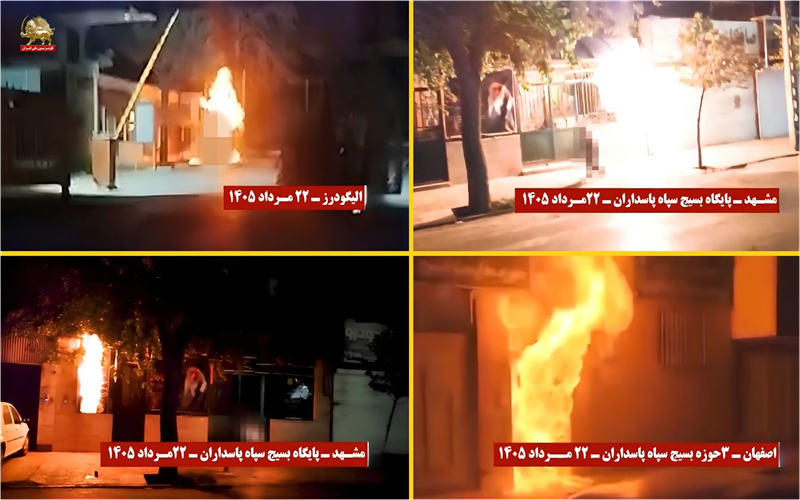
Within this framework, the PMOI’s Resistance Units represent an organized network of resistance inside Iranian society. Their significance lies in transforming popular opposition from a purely spontaneous reaction into sustained, organized resistance.
The central argument is that a nationwide uprising requires an organized field structure capable of maintaining momentum and challenging the regime’s repression apparatus. Without such organization, the regime can attempt to contain protests through arrests, executions, intimidation, and the deployment of its security forces.
The Resistance Units are therefore presented as the field component of a broader resistance strategy, while the NCRI provides the political framework for the country’s future.
Why a democratic alternative matters
Another major concern surrounding the collapse of a dictatorship is the possibility of a power vacuum, institutional breakdown, and social chaos.
The regime has repeatedly exploited such fears to discourage people from demanding fundamental change. But the answer to the danger of instability is not preserving dictatorship. It is preparing for the transition before the dictatorship falls.
This is where the National Council of Resistance of Iran positions itself as a democratic alternative.
The NCRI says it has spent decades preparing for the transition and has outlined mechanisms intended to prevent an interruption in essential government and public services.
Its proposed transition includes mobilizing the expertise of specialists inside and outside Iran to administer public institutions and essential services, while ensuring a lawful transfer of authority without disrupting the country’s administrative and executive structures.
According to the NCRI’s program, an interim government would be established immediately after the regime’s overthrow. Its principal responsibility would be to organize free elections for a Constituent Assembly within six months.
The Constituent Assembly would then draft a new constitution based on the direct will of the Iranian people, with the constitution submitted to a nationwide referendum.
This framework is intended to establish a clear distinction between an uncontrolled uprising and an organized political transition.
From resistance to political transition
The central challenge for Iran is therefore not merely removing the existing dictatorship. It is ensuring that political authority can pass from the regime to the Iranian people without creating a prolonged vacuum.
An organized resistance can provide the capacity to confront the regime’s repression, while a prepared democratic alternative can provide a framework for governing the country immediately afterward.
This combination is intended to prevent the two dangers often associated with the collapse of authoritarian systems: a return of repression and the emergence of chaos.
The NCRI’s proposed transition framework—maintaining essential services, establishing a provisional government, holding elections for a Constituent Assembly, and submitting the resulting constitution to a popular referendum—seeks to ensure that sovereignty ultimately rests with the Iranian people.
The broader strategic choice facing Iran is therefore between waiting passively for an unlikely spontaneous collapse and building the organized forces necessary to make political change possible and sustainable.
The experience of authoritarian systems shows that repression rarely disappears simply because a government becomes economically or politically weakened. Institutions of coercion must be confronted, while the institutions needed for the post-dictatorship period must be prepared in advance.
For this reason, the significance of the NCRI and the PMOI’s Resistance Units extends beyond opposition to the current regime. Together, they represent two complementary dimensions of an organized transition: a resistance network capable of sustaining the struggle inside Iran and a political alternative with a defined framework for the country’s future.
For Iran, the decisive issue is ultimately whether change will be left to chance—or whether an organized movement can transform popular resistance into a structured transition from dictatorship to a democratic system based on the will of the Iranian people.