


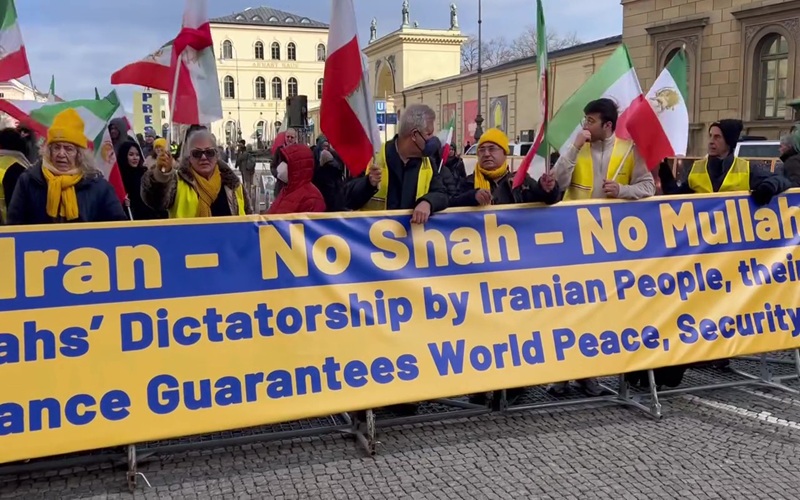

As Iran approaches a decisive political moment, the struggle is no longer merely against the ruling clerical dictatorship—it is also a battle to distinguish genuine democratic opposition from manufactured alternatives designed to preserve authoritarianism in new forms.
For nearly five decades, Iran has been shaped by a profound political conflict whose significance extends far beyond a simple contest for power. What stands before the Iranian people today is the culmination of 47 years of resistance, sacrifice, political experience, and historical testing. Understanding this reality—and distinguishing between authentic democratic forces and deceptive alternatives—is essential to identifying the path toward the overthrow of the ruling clerical regime and the establishment of a free Iran.
The current political landscape is not a blank slate. It is the result of decades of struggle between two opposing visions: one represented by the system of Velayat-e Faqih and its mechanisms of repression, and the other embodied in the democratic forces that reject all forms of dictatorship, whether religious or monarchical.
Why the Regime Fears the “No Shah, No Mullahs” Alternative
The strategic priority of the clerical regime’s political apparatus has become increasingly clear. After decades of testing every available method of repression, propaganda, and manipulation, the regime understands that its greatest threat is not foreign pressure or internal factional disputes. Its greatest threat is the emergence of a credible, independent democratic alternative capable of connecting with Iranian society.
For this reason, the regime and its various allies devote enormous resources to obscuring the distinction between genuine opposition movements and artificial alternatives. Their objective is straightforward: prevent the Iranian people from recognizing which political forces genuinely represent democratic change and which merely seek to recycle authoritarianism under a different banner.
The democratic current often summarized by the principle of “No Shah, No Mullahs” has survived decades of political pressure, disinformation campaigns, repression, and attempts at marginalization. Rather than disappearing, it has emerged from these tests with greater clarity, organizational experience, and political legitimacy.
That reality explains why efforts to sever the connection between Iranian society and the democratic opposition remain a central component of the regime’s survival strategy.
The Battle Over Political Clarity
Authoritarian systems thrive in confusion. When distinctions between democratic and anti-democratic forces become blurred, citizens struggle to identify a viable path forward. The Iranian regime understands this dynamic well.
As a result, numerous political and media platforms seek to rehabilitate authoritarian tendencies, particularly those linked to Iran’s monarchical past, while presenting them as democratic alternatives. Such efforts aim to create barriers between society and the genuinely independent opposition that advocates democratic transformation.
The challenge facing Iranians today is therefore not only resistance against the ruling dictatorship. It is also the necessity of political clarity.
Every citizen concerned with Iran’s future must ask fundamental questions: Which political forces have consistently opposed dictatorship? Which organizations have demonstrated independence from foreign interests and domestic authoritarian structures? Which movements possess a coherent program for democracy, human rights, national sovereignty, and political pluralism?
The answers to these questions are becoming increasingly important as Iran approaches a period of profound political change.
A Nation Approaching a Historic Turning Point
The clerical regime enters each new day haunted by the possibility of renewed nationwide unrest. Years of protests, uprisings, economic hardship, and social resistance have eroded its legitimacy and exposed the depth of public dissatisfaction.
The lessons of recent decades are unmistakable. Repeated cycles of protest have demonstrated that the Iranian people reject the current regime. At the same time, historical experience has shown the dangers of replacing one form of dictatorship with another.
This is why the democratic alternative represented by the “No Shah, No Mullahs” principle has gained growing relevance. It is not defined by ideological uniformity or political monism. Rather, it encompasses diverse political tendencies, social backgrounds, and democratic aspirations united around several fundamental objectives:
- The overthrow of the system of Velayat-e Faqih.
- The preservation of Iran’s independence and territorial integrity.
- The rejection of all forms of dictatorship, whether past or present.
- The establishment of a democratic republic based on popular sovereignty.
- The protection of fundamental rights and political freedoms.
These principles offer a framework capable of uniting broad segments of Iranian society while avoiding the authoritarian pitfalls that have repeatedly plagued the country’s modern history.
The National Responsibility of the Present Moment
The outcome of Iran’s struggle for freedom will depend largely on the relationship between society and the democratic opposition. No political transformation can succeed without a strong and direct connection between the aspirations of the people and the forces seeking democratic change.
At this critical juncture, the most urgent national task is therefore the expansion of political awareness. Historical truth, democratic values, and clear political alternatives must be communicated both inside Iran and throughout the international community.
For advocates of freedom, democracy, and human rights, this is not merely a political responsibility—it is a moral obligation. The future of Iran will be shaped by those willing to expose authoritarian deception, defend democratic principles, and strengthen the movement that rejects both monarchy and theocracy.
The central question facing Iran today is no longer whether change is coming. The question is whether that change will produce genuine democracy or simply another version of authoritarian rule. The answer lies in strengthening the democratic alternative that stands firmly against both the Shah and the Mullahs.