


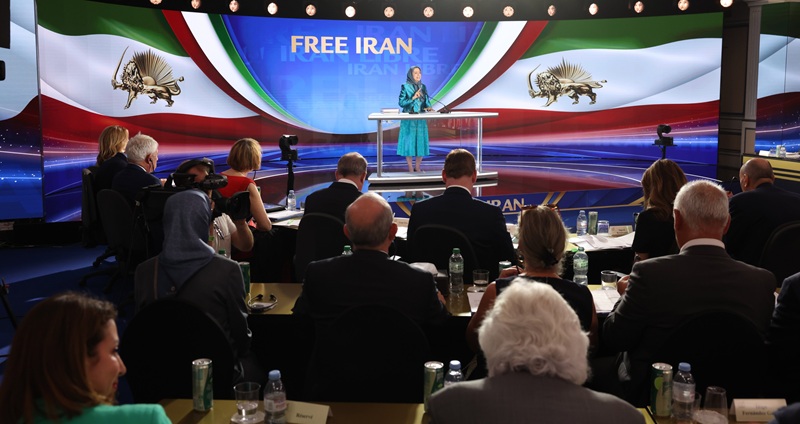

Global dignitaries endorse Maryam Rajavi’s Ten-Point Plan, support the Iranian Resistance Units, condemn appeasement, and reject both the ruling clerical regime and a return to monarchy.
The second day of the Free Iran 2026 Summit brought together an influential coalition of former senior government officials, parliamentarians, military leaders, legal experts, and human rights advocates from Europe and North America, all united behind a common message: the future of Iran belongs neither to the ruling theocracy nor to the remnants of the Shah’s dictatorship, but to the Iranian people and their organized democratic resistance.
Held on the 45th anniversary of the June 20, 1981 nationwide resistance against the newly established clerical dictatorship, the gathering highlighted the role of the National Council of Resistance of Iran (NCRI), the People’s Mojahedin Organization of Iran (PMOI/MEK), and the Resistance Units operating inside Iran as the primary force for democratic change.
The conference also took place amid widespread criticism of French authorities after a planned mass rally by tens of thousands of Iranian expatriates in Paris was blocked at the last minute despite prior agreements.
Defiance Despite Restrictions
Opening the session, moderator Ramesh Sepehrad praised the resilience of the Iranian diaspora and resistance supporters who continued their demonstrations across multiple locations in Paris despite restrictions and police intervention.
Sepehrad recalled the historic June 20, 1981 demonstration in Tehran, when more than half a million Iranians marched peacefully for democracy before being met with gunfire, mass arrests, torture, and executions by the regime.
“Our message remains clear,” she said. “We will never give up until we have a free Iran.”
Throughout the day, speakers repeatedly returned to the events in Paris, describing the attempted suppression of the gathering as a troubling concession to Tehran and a reminder of the challenges facing the Iranian democratic movement.
Growing International Recognition for the NCRI
Retired U.S. General James Jones argued that the Iranian regime is currently at its weakest point in decades. He pointed to economic collapse, deep social unrest, and growing legitimacy crises as indicators that the conditions for democratic change are rapidly emerging.
Jones emphasized that successful political transformation requires three elements: a weakened regime, widespread public dissatisfaction, and an organized democratic alternative.
“The regime fears one organization above all others,” he said, referring to the NCRI and PMOI.
He urged Western governments to recognize Maryam Rajavi and her democratic vision, stressing that the NCRI has never called for foreign military intervention but rather seeks international recognition of the Iranian people’s right to determine their own future.
Rejecting Both Dictatorships
A recurring theme throughout the conference was the rejection of both the current religious dictatorship and any return to monarchical rule.
British MP Bob Blackman stated that democratic change cannot be inherited through family entitlement or restored through foreign intervention.
He sharply criticized efforts to promote Reza Pahlavi as an alternative, noting that genuine democratic change requires an organized resistance movement with popular support and a democratic vision.
Blackman announced that more than 3,000 parliamentarians, former heads of state, and political figures from 55 countries have endorsed a declaration supporting the NCRI’s provisional government framework and Maryam Rajavi’s Ten-Point Plan.
He also welcomed recent British legislation paving the way for the designation of the Islamic Revolutionary Guard Corps (IRGC) as a terrorist organization.
Former UK Cabinet Minister David Jones echoed similar sentiments, saying the Iranian people have clearly rejected both forms of dictatorship.
“The people of Iran reject dictatorship in all its forms,” Jones said. “They reject the present religious dictatorship, and they do not want a return to the past of the Shah.”
Instead, he argued, Iranians seek a democratic future based on freedom, justice, equality, human rights, and free elections.
Resistance Units Recognized as the Engine of Change
Many speakers emphasized that the decisive force for change lies inside Iran.
Belgian MP Kathleen Depoorter said recent events have proven two realities: the regime cannot be reformed, and Iran’s future will not be determined by foreign intervention.
“It will be decided by the Iranian Resistance,” she said. “It will be decided by the Resistance Units.”
Former Finnish Prime Minister Anneli Jäätteenmäki praised the courage of Iranians who continue resisting despite the risks of imprisonment and execution. Drawing parallels with the fall of communist dictatorships in Europe, she expressed confidence that Iran’s dictatorship would eventually collapse.
Retired NATO Supreme Allied Commander General Tod Wolters described the Resistance Units operating across all 31 provinces as evidence of a nationwide movement committed to democratic change.
“The future of Iran will be determined by the Iranian people,” he said.
Criticism of Appeasement and the Paris Ban
Several speakers condemned decades of Western appeasement toward Tehran.
Former Icelandic Prime Minister Geir Haarde argued that Western governments had repeatedly ignored the organized resistance while extending lifelines to the regime.
“The National Council of Resistance of Iran has shown the world that democratic transition will not cause instability,” Haarde said. “It is the only path to peace.”
Former Colombian presidential candidate Ingrid Betancourt delivered one of the conference’s strongest criticisms of the decision to block the Paris rally.
Calling the move a contradiction of France’s democratic values, she warned that the regime is no longer exporting only terrorism but also repression beyond Iran’s borders.
“Silencing a peaceful rally in Paris means silencing worldwide outrage against executions in Iran,” she said.
Betancourt argued that military pressure alone cannot bring freedom to Iran and that support for democratic forces inside the country must accompany any effort to contain the regime.
Human Rights and Accountability
Human rights concerns featured prominently throughout the conference.
Former FBI Director Louis Freeh called for greater focus on accountability for crimes committed by Iranian officials.
He criticized international agreements that discuss shipping lanes and regional security while failing to address political prisoners, executions, and crimes against humanity.
Referring to Maryam Rajavi’s Ten-Point Plan, Freeh highlighted the commitment to justice for victims of massacres and state repression.
“We need accountability,” he said. “We need to hold people personally responsible for these crimes.”
Former German bishop Dr. Margot Käßmann also focused on human rights and religious freedom, warning against viewing Iran solely through the lens of nuclear negotiations and geopolitics.
“First and foremost, it is about people,” she said.
Käßmann praised the NCRI’s commitment to separation of religion and state and called for solidarity with religious minorities and political prisoners.
Support for Maryam Rajavi’s Ten-Point Plan
Virtually every speaker endorsed Maryam Rajavi’s Ten-Point Plan as the roadmap for a democratic transition.
The plan’s principles—including free elections, gender equality, abolition of the death penalty, separation of religion and state, autonomy for ethnic nationalities, freedom of expression, and a non-nuclear Iran—were repeatedly cited as evidence that a viable democratic alternative already exists.
Kathleen Depoorter described it as “a clear democratic alternative.”
Carla Sands, former U.S. ambassador, called it “a practical blueprint for transition.”
Geir Haarde characterized it as “a clear and coherent pathway forward.”
Ingrid Betancourt argued that the international community no longer needs to search for an alternative.
“We have the solution, we have the leader, and we have the legitimacy,” she said.
Debate Over the Post-War Regional Situation
Several speakers addressed recent regional developments and ongoing negotiations involving Tehran.
Retired Lieutenant General Keith Kellogg argued that the regime has been significantly weakened and that the current moment represents the greatest opportunity for democratic change since 1979.
He praised the NCRI’s role in exposing Iran’s nuclear program and stressed that any agreement with Tehran must be rigorously verified.
Former UK Defense Secretary Sir Liam Fox offered a more cautious assessment. While welcoming the ceasefire and diplomatic efforts, he warned that many critical issues remain unresolved, including Iran’s missile program, regional proxy network, and internal repression.
“The hardest questions remain open,” Fox said.
Nevertheless, he insisted that lasting change must come from the Iranian people themselves.
“There is only one group in this world that has the right, the authority, and the power to determine who governs the people of Iran,” he said. “It is only the Iranian people themselves.”
A New Generation of Resistance
One of the most personal speeches came from Mahan Taraj, a second-generation member of the Iranian Resistance.
Born shortly after his pregnant mother fled the June 20, 1981 crackdown, Taraj reflected on growing up in freedom while discovering the NCRI’s vision through his own study and experience.
He argued that a new generation of Iranians—both inside and outside the country—has independently reached the same conclusion.
“The men and women inside Iran have known nothing but dictatorship,” he said. “And yet they are arriving at exactly the same conclusion. They too are choosing resistance. They too are choosing freedom.”
A Unified Message
By the conclusion of the summit, speakers from across the political spectrum had delivered a remarkably consistent message.
They rejected the clerical regime’s claim that no democratic alternative exists. They rejected attempts to revive monarchical rule. They called for the designation of the IRGC as a terrorist organization, condemned executions and political repression, and urged Western governments to abandon policies of appeasement.
Above all, they emphasized that the path to a democratic Iran already exists through the NCRI, the PMOI Resistance Units, and Maryam Rajavi’s Ten-Point Plan.
Forty-five years after June 20, 1981, participants argued that the struggle launched by hundreds of thousands of Iranians against dictatorship continues—and that the prospect of a democratic republic has never appeared closer.