



International Leaders Condemn Ban on Planned Paris Demonstration, Reject Appeasement of Tehran, and Support Democratic Alternative to Both Shah and Mullahs
PARIS – Global Leaders Rally Behind Iranian Resistance
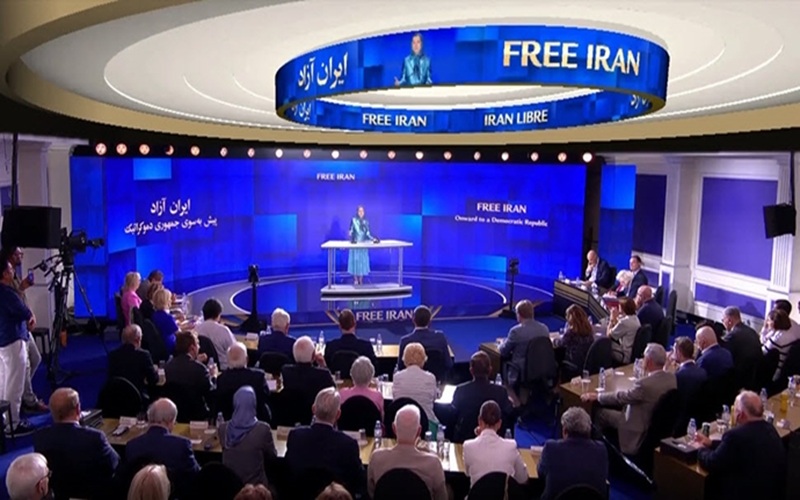
On June 20, 2026, Paris became the center of international support for the Iranian people’s struggle for freedom and democracy as senior political leaders, former heads of government, lawmakers, diplomats, jurists, and human rights advocates gathered for a major international summit in support of a democratic republic in Iran.

The event took place amid extraordinary political controversy after French authorities blocked a planned mass demonstration and march at Place Vauban that was expected to draw approximately 100,000 supporters of the Iranian Resistance. More than 800 buses had been organized from across Europe, while thousands of participants traveled from the United States, Canada, Australia, and other countries to attend the gathering.
Despite the prohibition of the public rally, the international conference itself proceeded successfully, becoming a powerful platform for global figures to condemn the decision, denounce Tehran’s repression, and endorse the National Council of Resistance of Iran (NCRI) as a democratic alternative to the ruling theocracy.

Many speakers argued that the French government’s decision represented a serious concession to pressure from Tehran. According to Reuters, Iranian Foreign Minister Abbas Araghchi held an urgent telephone conversation with his French counterpart shortly before the ban was imposed, prompting widespread criticism from conference participants.
Summit Held Successfully Despite Ban on Planned Demonstration
Although French authorities prevented the large public gathering at Place Vauban, they did not prohibit the international summit itself.

As a result, leading politicians and dignitaries from Europe, North America, and other regions gathered in Paris to express solidarity with the Iranian people and their organized Resistance.
Throughout the conference, speakers repeatedly emphasized that the blocked demonstration and the summit were two separate events. While condemning the decision to ban a peaceful march, they stressed that the message of support for democracy in Iran could not be silenced.

The conference became an unmistakable display of international backing for the Iranian Resistance, its Resistance Units inside Iran, and the vision of a democratic republic outlined in NCRI President-elect Maryam Rajavi’s Ten-Point Plan.
Court Documents Reveal Threats from Monarchist Elements
Court documents discussed during the conference revealed another troubling aspect of the effort to prevent the demonstration.

According to the judgment, remnants of the former Shah’s regime maintain an internal security apparatus identified as SAVAK and had allegedly threatened to plant a bomb if the June 20 demonstration were allowed to proceed.
The court also cited the presence of monarchist groups displaying SAVAK symbols during demonstrations in London and Regensburg earlier this year. It further referred to calls by monarchist activist Mohammad Sadeghi Ahangar urging supporters to block the march.

Speakers argued that these revelations exposed the increasingly destructive role played by extremist monarchist factions that oppose both the clerical dictatorship and the democratic Resistance movement.
Several participants asserted that these groups had once again acted in ways that objectively benefited Tehran’s efforts to suppress organized opposition.
Christine Arrighi: France Must Stand with the Iranian People
French National Assembly member Christine Arrighi, President of the Parliamentary Committee for a Democratic Iran, opened the conference by expressing solidarity with the Iranian Resistance and criticizing the decision to block the demonstration.

She emphasized that parliamentarians from Europe and North America support the Iranian people’s struggle for freedom and reject both dictatorship and repression.
Arrighi argued that the sudden cancellation of a peaceful and long-planned demonstration raised serious questions about France’s commitment to democratic values. She maintained that future relations with Iran should be built around democratic forces rather than the ruling regime and expressed confidence that the Resistance represents the future of Iran.

Charles Michel: Appeasement Has Failed
Former President of the European Council Charles Michel delivered one of the summit’s most significant addresses.
Michel argued that the Iranian regime represents one of the most serious challenges to international peace and democratic values. He condemned Tehran’s escalating use of executions and repression while criticizing decades of Western appeasement.

According to Michel, history has repeatedly demonstrated that accommodation with dictatorships leads only to greater aggression. He compared current policies toward Tehran to past failures in dealing with fascist and authoritarian regimes.
At the same time, Michel rejected military intervention as a solution, insisting that lasting democratic change must come from the Iranian people themselves.
He praised Maryam Rajavi’s Ten-Point Plan as a credible democratic roadmap based on free elections, gender equality, separation of religion and state, abolition of the death penalty, human rights, and a non-nuclear Iran.

Boris Johnson: The French Government Made a Serious Mistake
Former British Prime Minister Boris Johnson strongly condemned the decision to prevent the demonstration.
He rejected arguments that the gathering posed a security threat and described the move as a victory for a regime that fears democratic opposition.
Johnson argued that the Iranian people do not need lectures from the West but rather solidarity and recognition of their right to determine their own future.

He stressed that neither foreign military intervention nor accommodation with Tehran would bring freedom. Instead, democratic change must come through the Iranian people and their organized Resistance.
Drawing comparisons to the collapse of apartheid and communist dictatorships in Eastern Europe, Johnson expressed confidence that the Iranian people would eventually prevail.

Dominique Attias: France Betrayed Its Own Principles
Prominent French lawyer and human rights advocate Dominique Attias delivered a passionate condemnation of the ban.
She argued that preventing a peaceful demonstration in support of freedom dishonored the principles of liberty, equality, and fraternity that France claims to uphold.
Attias stressed that the true threat comes from the regime responsible for executions, torture, and repression—not from those peacefully advocating democracy.

She pledged to continue legal and political efforts to challenge the decision and reaffirmed her support for Iranian women fighting for freedom.
John Bercow: Freedom Cannot Be Silenced
Former Speaker of the British House of Commons John Bercow described the blocked demonstration as a capitulation to Tehran.
He argued that while governments can prohibit rallies, they cannot destroy the idea of freedom.

Bercow sharply criticized attempts to portray monarchy as an alternative to the current regime. He rejected hereditary rule and stated that democracy requires regular free elections, accountability, and popular sovereignty.
He praised the NCRI and its democratic platform, emphasizing its commitment to secular government, gender equality, freedom of expression, environmental responsibility, and a non-nuclear future.
According to Bercow, the Ten-Point Plan offers a genuine democratic alternative and deserves greater international recognition.

Dmytro Kuleba: Regimes Fall, People Prevail
Former Ukrainian Foreign Minister Dmytro Kuleba drew powerful parallels between Ukraine’s struggle against Russian aggression and the Iranian people’s fight against dictatorship.
He noted that Iranian drone technology supplied to Russia has been used against Ukrainian civilians and described the suffering caused by both regimes.
Recalling Ukraine’s democratic uprisings and resistance against invasion, Kuleba stressed that no dictatorship in history has ultimately defeated a determined people.

He encouraged Iranians to remain committed to their struggle, emphasizing that freedom always prevails over repression.
International Delegations Voice Support
German parliamentarian Carsten Müller argued that the regime’s reliance on executions reflects weakness rather than strength. He urged European governments to abandon appeasement and openly support freedom-loving Iranians.
Former Romanian Prime Minister Petre Roman compared Iran’s current situation to Romania’s final days under Nicolae Ceaușescu. Recalling how a dictatorship collapsed almost overnight after resorting to mass violence, he expressed confidence that Iran’s rulers face a similar fate.

Canadian parliamentarian Judy Sgro highlighted the case of political prisoner Zahra Tabari and condemned the regime’s growing use of executions. She endorsed the NCRI’s transitional vision and called for stronger international action against human rights abuses.
Former Canadian Foreign Minister John Baird declared that the Iranian people reject both religious dictatorship and monarchical restoration. He emphasized that the NCRI’s vision of a democratic republic offers the only credible path forward.

Baroness O’Loan of the United Kingdom condemned the decision to block the demonstration and argued that it contradicted France’s commitment to freedom. She called for stronger support for the NCRI and for Maryam Rajavi to be given a greater voice internationally.
Italian parliamentarian Naike Gruppioni praised the courage of Iranian women and described Maryam Rajavi as the most credible leader of the democratic opposition. She pledged to continue advocating sanctions against regime officials and supporting political prisoners.
Former U.S. Senator Robert Torricelli paid tribute to members of the Resistance Units and residents of Ashraf 3, describing them as future heroes of a free Iran whose sacrifices would be remembered for generations.

A Common Message: No to Shah, No to Mullahs
One of the strongest themes throughout the conference was the rejection of both the current clerical dictatorship and any return to monarchical rule.
Speaker after speaker emphasized that the Iranian people deserve neither religious tyranny nor hereditary government.
Instead, participants endorsed a democratic republic based on free elections, the rule of law, equality before the law, freedom of expression, minority rights, and the separation of religion and state.

Many pointed to Maryam Rajavi’s Ten-Point Plan as the most comprehensive framework currently available for a peaceful democratic transition.
Conclusion
Despite the French government’s decision to block what would have been one of the largest demonstrations in support of a free Iran ever organized in Europe, the Paris summit proceeded successfully and delivered a powerful political message.
Political leaders from Europe, North America, and beyond united in condemning Tehran’s repression, criticizing policies of appeasement, and supporting the Iranian people’s right to establish a democratic republic.

The conference concluded with a clear consensus: Iran’s future lies neither with the ruling theocracy nor with a return to monarchy. It belongs to the Iranian people, their organized Resistance, and a democratic alternative founded on freedom, equality, secular governance, and popular sovereignty.