


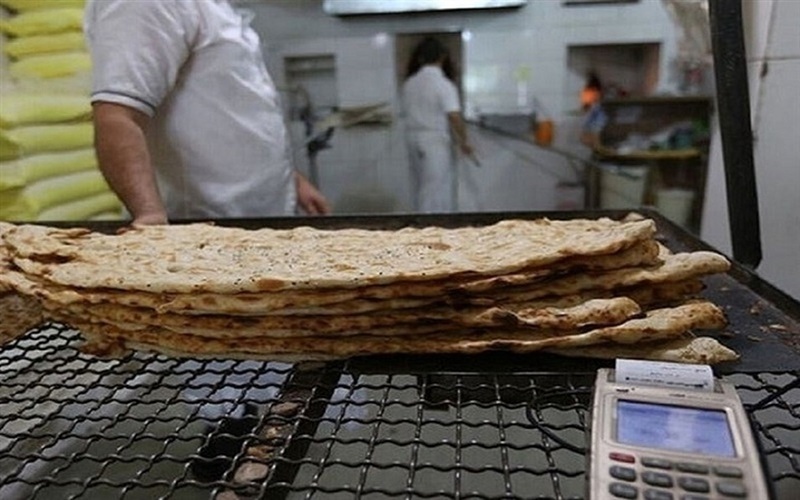

The unprecedented increase in bread prices has become more than an economic issue. It exposes the Iranian regime’s deepening fiscal crisis, growing public desperation, and mounting fears that worsening living conditions could ignite another nationwide uprising.
Bread has long been the most essential staple for millions of Iranian families. For the country’s poorest households, it represents the minimum threshold between survival and hunger. The regime’s decision to dramatically increase bread prices therefore carries consequences that extend far beyond inflation, touching the political and social stability of a society already burdened by years of economic decline.
According to the state-run newspaper Donya-e-Eqtesad, citing new government-approved pricing, the cost of major bread varieties has reached record levels. Lavash bread has increased from 1,400 to 2,700 tomans, Barbari from 5,300 to 10,000 tomans, Taftoon from 2,300 to 4,500 tomans, and Sangak from 7,400 to 15,500 tomans. The nearly 100 percent increase marks one of the steepest bread price hikes in recent years.
The government’s handling of the issue also reflects its awareness of the political risks involved. Since the beginning of the year, officials repeatedly issued contradictory statements, alternately denying and confirming plans to raise bread prices. These mixed messages appeared aimed at softening public reaction before implementing the inevitable increase.
Such caution is hardly surprising. Iranian regime authorities understand that bread prices carry exceptional political sensitivity, particularly in low-income communities where food costs consume a substantial share of household budgets. Throughout Iran’s modern history, rising food prices have repeatedly served as catalysts for widespread social unrest.
Even state-affiliated media have openly acknowledged these dangers. The newspaper Jahan-e Sanat, referring to the nationwide January 2026 protests that began in marketplaces before rapidly spreading across the country, warned that nearly 60 percent of society can no longer tolerate additional economic pressure. The paper cautioned that previous unrest had brought the political system dangerously close to instability and argued that officials must prepare for the possibility of a “hunger uprising.”
These admissions illustrate the difficult position confronting the ruling establishment. Faced with mounting fiscal pressures, authorities continue shifting the costs of economic mismanagement onto ordinary citizens while simultaneously fearing that every additional burden could trigger another wave of nationwide protests.
The broader context further amplifies public frustration. While millions of Iranians struggle to afford basic necessities, critics argue that substantial national resources continue to be directed toward domestic repression, military expansion, regional proxy activities, and projects designed to preserve the rule of the clerical establishment rather than improve citizens’ living standards.
Following the announcement of the bread price increases, Maryam Rajavi, President-elect of the National Council of Resistance of Iran (NCRI), sharply criticized the government’s priorities.
She stated that under Iran’s ruling religious dictatorship, many citizens are being deprived even of access to bread while the country’s wealth is devoted to repression, foreign military interventions, and policies intended to preserve the system of Velayat-e Faqih.
Rajavi contrasted the worsening poverty experienced by ordinary Iranians with what she described as the privileged lifestyles enjoyed by senior regime officials and their families inside and outside the country. She argued that popular resistance and nationwide uprising remain the only path to ending what she called the regime’s oppression.
As inflation continues to erode purchasing power and essential goods become increasingly unaffordable, the bread price increase may prove to be more than another economic hardship. It has become a powerful symbol of the widening gap between Iran’s rulers and its citizens—a divide that many observers believe is steadily increasing the likelihood of renewed social unrest.