


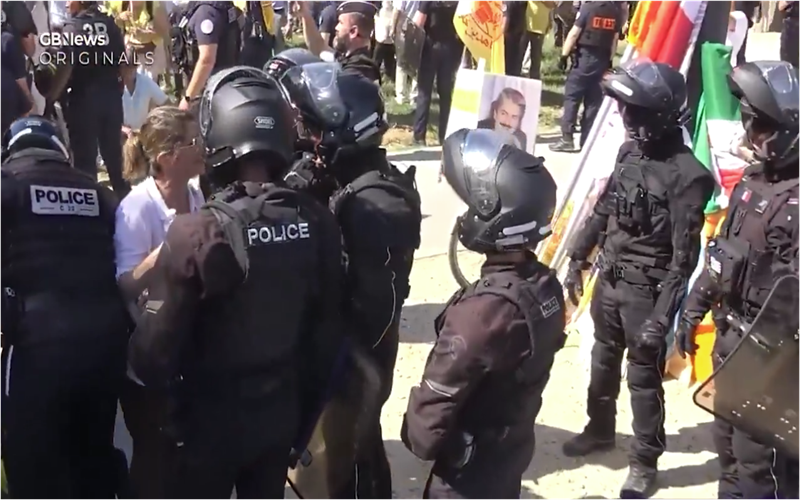

The French government’s decision to prohibit the June 20 Free Iran rally raised questions that extend well beyond public order. It highlighted the increasingly blurred line between defending democratic values and inadvertently serving the interests of Tehran by restricting those who campaign against executions and for democratic change.
The controversy surrounding the French government’s decision to ban the June 20 rally in Paris deserves far more than a passing political debate. The implications extend beyond one demonstration or one security assessment. They touch a more fundamental question: what happens when a democratic country limits peaceful advocacy against executions, human rights abuses, and dictatorship in Iran?
The issue cannot be examined in isolation. The prohibition came as Iran continues to intensify executions, suppress dissent, and eliminate every form of political opposition at home. At precisely such a moment, restricting one of the largest international gatherings in support of democracy and human rights inevitably raises difficult questions about whose interests are ultimately served.
This is why the Paris decision resonated far beyond France. Whether intentional or not, preventing thousands of supporters of democratic change from assembling risked weakening one of the few international platforms dedicated to exposing the Iranian regime’s human rights record. In practical terms, the ban limited public condemnation of executions while reducing the visibility of the organized democratic opposition.
Former Colombian presidential candidate and longtime human rights advocate Ingrid Betancourt addressed this broader context during the Free Iran 2026 conference the following day. She began by recalling the execution of six young political prisoners in March 2026, including Babak Alipour and Pouya Kabadi, arguing that although the authorities intended to erase their cause through execution, their deaths instead amplified the determination of those seeking freedom. According to her, even from prison these young men had succeeded in sending a message of resilience rather than surrender.
Her remarks framed the executions not as isolated judicial acts but as part of a larger struggle between authoritarian repression and democratic resistance.
Against that backdrop, Betancourt argued that silencing a peaceful demonstration in Paris carries consequences extending well beyond French domestic politics. Restricting a rally dedicated to condemning executions, she suggested, inevitably weakens the international voice speaking on behalf of Iranian victims at the very moment they are risking their lives to oppose the same dictatorship that democratic governments claim to confront.
That observation points to an uncomfortable contradiction. Europe has long presented itself as a defender of human rights and freedom of expression. Yet when peaceful demonstrations against one of the world’s most prolific executioners are prevented from taking place, questions naturally arise about the consistency of those principles.
Betancourt expanded the argument even further by warning that the Iranian regime no longer exports only terrorism or regional instability. Increasingly, she argued, it seeks to export repression itself by influencing how democratic societies respond to criticism of Tehran. If voices opposing executions can be marginalized within Europe’s democracies, then the boundaries of repression begin extending beyond Iran’s borders.
Whether one agrees entirely with this assessment or not, the concern deserves serious consideration. Democracies are ultimately tested not by how they protect popular speech, but by how they protect controversial political expression that challenges powerful interests.
Perhaps the most significant point raised during the conference concerned the nature of the conflict itself. Betancourt argued that the Iranian regime clearly understands where the genuine threat to its survival lies—not merely in foreign governments or sanctions, but in the existence of an organized democratic alternative capable of mobilizing public support both inside and outside Iran.
From this perspective, the battle over a rally in Paris becomes part of a much larger political contest. If Tehran identifies democratic opposition movements as its principal strategic challenge, then efforts—intentional or otherwise—that reduce their visibility inevitably alter the balance within that contest.
The debate surrounding the June 20 rally therefore reaches beyond questions of permits or public security. It forces democratic governments to confront a more profound dilemma: can they effectively defend human rights while restricting those who peacefully advocate for them? Can they oppose executions in Iran while limiting demonstrations dedicated to condemning those very crimes?
These questions remain unanswered. Yet the Paris controversy has demonstrated that decisions made in European capitals can carry political consequences far beyond their borders. In the struggle over Iran’s future, silence is rarely neutral. Whether imposed by censorship, fear, or administrative decision, it inevitably benefits one side more than the other.