
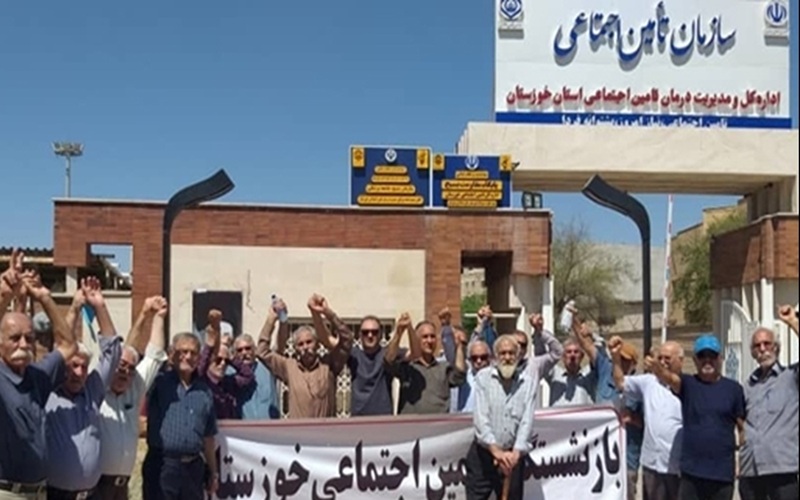

Despite attempts by the Iranian regime to create a climate of fear through security theatrics and war rhetoric, nationwide protests by workers and retirees reveal a society increasingly willing to challenge both economic hardship and authoritarian rule.
For years, the Iranian regime has relied on fear, intimidation, and manufactured security crises to suppress public dissent. Today, however, those tactics appear increasingly ineffective. As economic conditions deteriorate and public frustration reaches unprecedented levels, workers and retirees across Iran are demonstrating that neither threats of repression nor carefully orchestrated displays of force can extinguish a society demanding fundamental change.
Recent nationwide demonstrations suggest that the government’s efforts to cultivate an atmosphere of fear are not merely aimed at maintaining order. Rather, they reflect growing anxiety within the ruling establishment itself—particularly over the possibility that worsening economic conditions could ignite another nationwide uprising.
Regime Officials Fear Rising Public Expectations
The regime’s own analysts have openly acknowledged these concerns.
According to the state-affiliated Entekhab news website, government commentator Hojat Mirzaei warned that any easing of international tensions could generate public expectations that authorities would be unable to satisfy. He cautioned that people might expect wages to recover, inflation to decline, and living standards to improve following any political agreement.
He further warned that if those expectations remain unmet, Iran could face widespread social unrest and serious protests.
Such remarks offer a rare glimpse into the regime’s internal calculations. Officials appear less concerned about diplomatic developments themselves than about the possibility that ordinary Iranians will demand tangible improvements after decades of economic decline.
Streets Across Iran Reject the Climate of Fear
Those fears were reflected on Sunday, June 28, when workers and retirees took to the streets in Tehran, Isfahan, Ahvaz, Kermanshah, and Shush despite an atmosphere of heightened security.
In Khuzestan Province, where temperatures exceeded 50 degrees Celsius, demonstrators still marched through the streets, chanting:
- “Free political prisoners.”
- “Only in the streets can we win our rights.”
The protests demonstrated that neither security threats nor official war rhetoric have succeeded in discouraging public demonstrations.
Instead, citizens appeared determined to reclaim public spaces that authorities have long attempted to dominate through intimidation.
From Economic Demands to Political Opposition
Perhaps the most significant development was not simply the continuation of protests but the transformation of their message.
While demonstrations by workers and retirees have traditionally focused on unpaid pensions, wages, and inflation, recent gatherings increasingly adopted overtly political slogans challenging the broader system of governance.
In Kermanshah, protesters called for the release of political prisoners while declaring:
- “Oppression and injustice brought us to the streets.”
- “The streets are the fortress of working people.”
In Tehran, retirees emphasized the right to organize, chanting that assembly and independent associations are fundamental rights.
Meanwhile, Social Security retirees in Shush condemned widespread corruption and accused both parliament and the government of abandoning the public. Protesters linked their economic suffering directly to systemic mismanagement, corruption, and state-controlled institutions rather than isolated policy failures.
The shift illustrates how economic grievances are increasingly evolving into broader political demands, reflecting declining confidence that reforms within the existing system can resolve the country’s deepening crises.
Inflation Deepens Public Anger
The growing political dimension of the protests is rooted in an economic reality that continues to worsen.
Even state-controlled media have acknowledged the severity of the crisis. The state-run newspaper Siasat-e Rooz recently warned that household budgets can no longer withstand additional economic pressure, noting that year-on-year inflation has surpassed 100 percent in eleven Iranian provinces.
Such figures underscore why public frustration continues to intensify despite repeated promises of economic stabilization.
For millions of Iranians, rising prices, shrinking purchasing power, unpaid pensions, and declining wages have transformed economic hardship into a daily struggle for survival.
A Regime Facing an Increasingly Defiant Society
The latest wave of demonstrations suggests that Iran’s ruling establishment faces a challenge extending far beyond economic management.
The regime’s strategy of combining repression, security theatrics, and war rhetoric has historically sought to deter collective action. Yet the persistence of nationwide protests indicates that many citizens no longer view fear as a sufficient reason to remain silent.
As workers, retirees, and other social groups continue to broaden their demands from economic justice to political accountability, the protests reflect a widening gap between the state and society.
For the international community, these developments reinforce a broader reality. Iran’s instability is driven not only by external tensions but also by deep internal discontent rooted in decades of repression, corruption, and economic mismanagement.
Lasting stability is therefore unlikely to emerge through military confrontation or diplomatic accommodation alone. Instead, a sustainable solution depends on supporting the Iranian people’s aspirations for democratic change and recognizing their right to resist authoritarian rule and determine their own political future.