


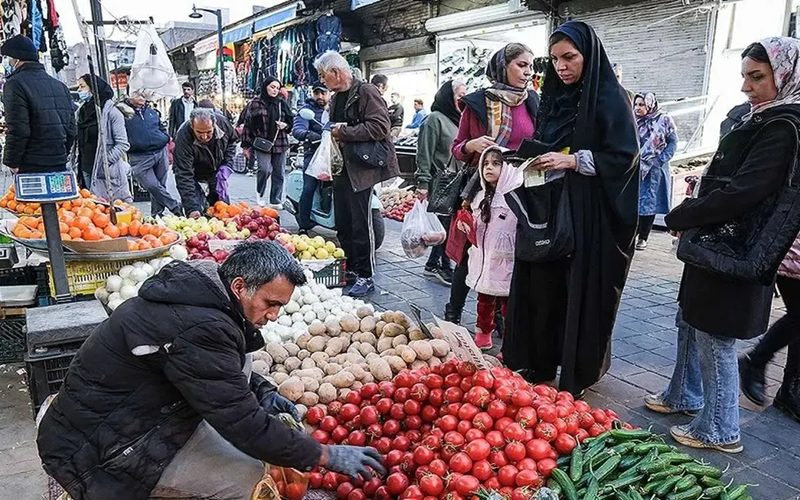

Official data reveal triple-digit inflation across essential goods, with rural households suffering the steepest increases as economic mismanagement continues to erode living standards.
Iran’s inflation crisis continues to intensify, with new official statistics showing unprecedented price increases across food, housing, transportation, healthcare, and other essential goods. The latest figures highlight the growing economic burden facing Iranian households, particularly those in rural areas, where inflation has exceeded 100 percent.
The data, released by the Statistical Center of Iran for the month of Khordad (May–June), paint a picture of an economy struggling under the weight of prolonged structural weaknesses, government intervention, and declining purchasing power.
While officials continue to attribute inflation to external pressures and sanctions, the breadth and persistence of price increases point to deeper domestic problems rooted in decades of fiscal mismanagement, monetary instability, corruption, and the expansion of monopolistic economic networks.
Inflation Accelerates Across the Country
According to the report, Iran’s point-to-point inflation rate reached nearly 89 percent nationwide compared to the same month last year.
Conditions are considerably worse in rural regions, where annual inflation climbed to 108.1 percent, meaning the average cost of goods has more than doubled within a single year.
Annual inflation over the previous twelve months reached 62 percent, while monthly inflation stood at 5.9 percent, reflecting continued rapid increases in consumer prices.
The data indicate that inflation is no longer confined to specific sectors but has spread across nearly every category of household spending.
Food Inflation Reaches Historic Levels
The sharpest increases were recorded in food prices, which continue to consume an ever-larger share of family incomes.
Point-to-point inflation for food and beverages reached nearly 135 percent nationwide, rising from approximately 130 percent recorded the previous month.
Urban households experienced food inflation of roughly 133 percent, while rural families faced an even steeper increase of nearly 141 percent.
Among individual food categories, edible oils and fats recorded the most dramatic price increases.
Official statistics show:
- Edible oils and fats: 278.4%
- Red meat and poultry: 178.2%
- Dairy products and eggs: 151.9%
- Tea and coffee: 102%
- Sugar and confectionery: 101.6%
Most remaining food categories registered inflation rates ranging between 64 and 100 percent.
These figures underscore the increasing difficulty many households face in purchasing basic nutritional necessities.
Monopoly and Market Concentration Raise Further Concerns
The surge in edible oil prices comes after significant changes in the domestic market.
Following the withdrawal of the Saudi-based Savola Group from Iran in early 2025, control of much of the edible oil market reportedly shifted to the Modallal family, one of the country’s most controversial business conglomerates with longstanding ties to Iran’s economic establishment.
The concentration of market power in politically connected networks has long raised concerns among economists, who argue that limited competition, lack of transparency, and preferential access contribute to higher prices and reduced market efficiency.
Such monopolistic structures have become a recurring feature of sectors closely linked to state institutions and politically influential economic actors.
Housing and Utilities Continue to Climb
Housing-related costs also continued their upward trajectory.
According to the Statistical Center:
- Residential rent increased by 31.2 percent
- Housing maintenance and repair costs rose 77.5 percent
- Water, electricity, and fuel prices increased 109.4 percent
For millions of Iranian families already struggling with stagnant incomes, rising utility costs have added another layer of financial pressure.
Inflation Spreads Across Every Sector
Price increases were also recorded across transportation, healthcare, communications, education, and recreation.
Point-to-point inflation reached:
- Healthcare: 81.4%
- Vehicle purchases: 124.1%
- Personal transportation costs: 97.6%
- Public transportation: 82.5%
- Communications: 88.2%
- Recreation and culture: 90.4%
- Education: 48.4%
- Tobacco products: 173.8%
The breadth of these increases illustrates that inflation has become a systemic challenge affecting nearly every aspect of daily life.
Rural Households Bear the Greatest Burden
One of the report’s most striking findings is the widening gap between urban and rural inflation.
Annual inflation over the previous twelve months reached 60.3 percent in urban areas but 72.4 percent in rural regions.
Monthly inflation was likewise higher in rural communities, reaching 6.6 percent, compared to 5.8 percent in cities.
These figures suggest that lower-income households—many of whom already devote a larger share of their income to food and essential goods—are absorbing the harshest effects of rising prices.
An Economic Crisis Rooted in Structural Failures
The latest inflation report illustrates more than temporary market volatility. It reflects the cumulative impact of years of expansionary monetary policy, chronic budget deficits, currency depreciation, weak domestic production, widespread corruption, and economic monopolies.
While external sanctions have undoubtedly placed additional pressure on Iran’s economy, many economists argue that internal governance failures have magnified these challenges. Persistent intervention in markets, inadequate structural reforms, and the concentration of economic power among politically connected institutions have reduced competition while undermining public confidence.
As prices continue to outpace wages, millions of Iranians face a steady decline in purchasing power and living standards. With food inflation reaching record levels and essential services becoming increasingly expensive, the country’s inflation crisis has evolved into one of the defining social and economic challenges confronting Iranian society today.