


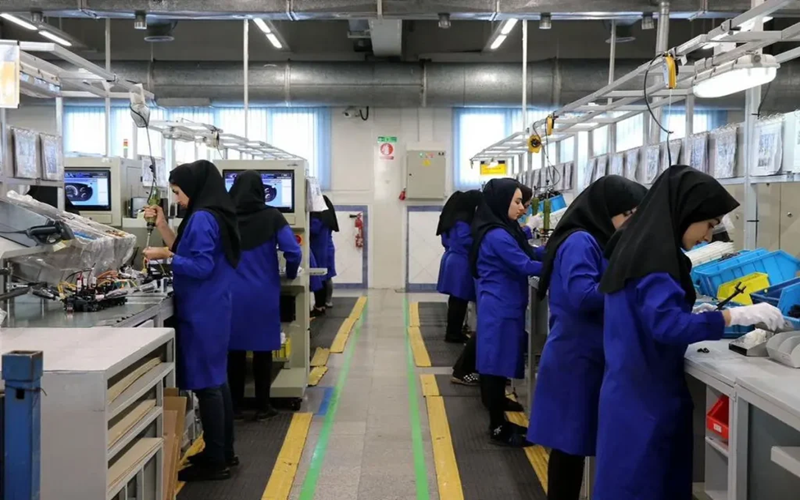

Official statistics reveal falling employment rates, widening gender inequality, and a growing number of economically inactive citizens, highlighting the structural failures of Iran’s economy and labor policies.
New official data from Iran paints an increasingly troubling picture of the country’s labor market. Despite a growing working-age population, employment has failed to expand, women are being pushed out of the workforce at an accelerating rate, and economic inactivity is rising sharply.
The figures, released by the regime itself, underscore a broader reality: years of economic mismanagement, structural stagnation, and discriminatory policies have left the labor market unable to absorb new workers. Women, in particular, have paid the highest price.
Employment Fails to Keep Pace with Population Growth
According to Iran’s Statistical Center, the population aged 15 and older increased from approximately 65.3 million in 2024 to more than 66.1 million in 2025—an increase of roughly 800,000 people.
Yet the total number of employed individuals remained virtually unchanged at around 24.8 million.
As a result, the country’s employment rate declined from 37.9 percent to 37.5 percent despite population growth.
This decline reflects more than temporary labor market fluctuations. It is a symptom of an economy that has largely stopped generating new employment opportunities.
Economic Stagnation Drives Labor Market Weakness
The weak labor market mirrors Iran’s broader economic performance.
According to official economic data, the country experienced negative economic growth in 2025, with gross domestic product shrinking by approximately 0.7 percent compared to the previous year.
In a stagnant economy, businesses invest less, production contracts, and employers become reluctant to hire new workers. The result is a labor market in which population growth no longer translates into job creation.
Rising Economic Inactivity Masks the Full Extent of the Crisis
One of the report’s most revealing findings is that unemployment itself has not increased significantly.
Approximately two million people continue to be officially classified as unemployed.
However, the number of economically inactive individuals increased by roughly 800,000 over the same period.
This category includes retirees, people with disabilities, homemakers, and individuals who are neither employed nor actively seeking work.
The increase suggests that many Iranians are abandoning the search for employment altogether, a phenomenon commonly associated with prolonged economic weakness and declining confidence in labor market opportunities.
Importantly, these statistics were compiled from nationwide surveys conducted throughout the year before the military confrontation involving Iran, Israel, and the United States. Consequently, they do not include the economic impact of that conflict.
Iran’s Ministry of Labor has since acknowledged that the war resulted in the loss of approximately two million jobs, suggesting that current labor market conditions may be substantially worse than the official annual data indicate.
Women Are Losing Ground at an Alarming Rate
Perhaps the most striking finding is the widening gender gap in employment.
Women’s participation in Iran’s labor market has long ranked among the lowest in the region, reflecting decades of legal restrictions, institutional discrimination, and policies that prioritize women’s roles within the household over economic participation.
The latest figures show that these disparities have become even more severe.
While approximately two out of every three men over the age of fifteen are employed, only about one out of every nine women in the same age group has a job.
Even more concerning is the direction of recent change.
Although the male and female working-age populations each grew by roughly 400,000 people during the year, the number of employed men increased by approximately 228,000, while the number of employed women actually declined by around 194,000.
Rather than sharing in whatever limited employment growth occurred, women experienced a net loss of jobs.
Government Policies Have Worsened Gender Inequality
The widening employment gap cannot be explained solely by economic stagnation.
Over recent years, the regime has increasingly promoted policies encouraging higher birth rates while placing greater emphasis on women’s domestic responsibilities. These policies have coincided with reduced support for women’s economic participation and fewer opportunities in the formal labor market.
The repeated internet shutdowns imposed during nationwide protests and periods of military conflict have also disproportionately harmed women.
Many female entrepreneurs and small business owners relied on online platforms such as Instagram to operate businesses from home. Internet restrictions disrupted these enterprises, eliminating an important source of income for thousands of women who had already faced barriers to entering the traditional labor market.
Young Women Face Even Greater Challenges
The inequalities are particularly pronounced among younger generations.
Official statistics indicate that unemployment among women under the age of 35 stands at approximately 26 percent—more than double the 12 percent unemployment rate recorded for men in the same age group.
The gap is equally visible among young people who are neither studying nor working.
Nearly one-third of Iranian women aged 15 to 24 fall into this category, compared to only 15 percent of men of the same age.
These figures point to long-term structural barriers that prevent many young women from participating fully in education, employment, or vocational training.
Economic Crises Continue to Fall Disproportionately on Women
The latest labor statistics reveal a familiar pattern. As during the COVID-19 pandemic, women have borne a disproportionate share of the economic costs generated by Iran’s successive crises.
Behind the official numbers lies a broader structural failure. Economic stagnation, restrictive social policies, internet censorship, and political instability have combined to create a labor market that not only struggles to generate employment but also increasingly excludes women from economic participation.
The findings reinforce a wider reality about Iran’s current crisis. The country’s economic challenges are no longer simply cyclical downturns but symptoms of systemic governance failures.
Without fundamental political and economic changes that expands individual freedoms, protects private enterprise, and removes institutional discrimination, the labor market is unlikely to recover. Instead, the burden of future economic crises will continue to fall most heavily on those who are already the most marginalized—particularly Iranian women.