

The debate over negotiations with the United States has evolved into a broader struggle for power inside Iran’s ruling establishment, revealing fractures that extend from government institutions to the clerical hierarchy.
Negotiations between Iran and the United States were intended to ease external tensions. Instead, they have exposed a growing internal crisis within the Islamic Republic. As rival factions compete for influence over the country’s political future, disputes over diplomacy have evolved into an increasingly bitter struggle for power that now reaches the highest levels of the regime.
The escalating conflict reflects more than disagreement over foreign policy. It reveals an establishment increasingly divided over how to preserve a system facing mounting domestic unrest, economic collapse, and declining public legitimacy.
The Assembly of Experts Enters the Political Battle
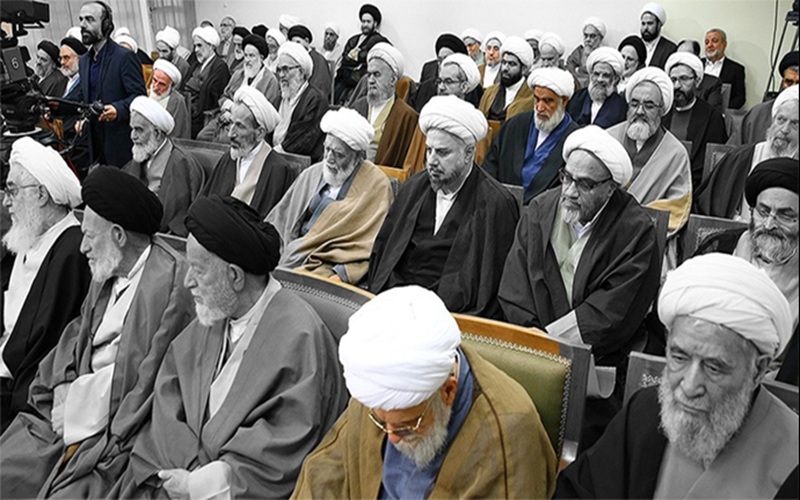
One of the clearest signs of the widening rift came on June 27, when 63 members of Iran’s Assembly of Experts issued an unprecedented public statement on the negotiations.
The signatories declared that, under the doctrine of Velayat-e Faqih, the Supreme Leader’s position must remain the final authority and warned that no official should act contrary to his directives. They further stated that the Assembly would monitor whether the government’s promises and conditions were fulfilled and, if necessary, would carry out what they described as its “religious duty.”
The statement was widely interpreted as a warning to government officials involved in negotiations and as an attempt to tighten political discipline during a sensitive period.
Public Rebuttal Reveals Institutional Divisions
What made the episode even more remarkable was the immediate response from the Secretariat of the Assembly of Experts itself.
In an unusual public clarification, the Secretariat emphasized that statements issued by groups of individual members were not part of the Assembly’s established practice. Official positions, it explained, have traditionally been approved collectively through formal sessions rather than released by self-organized groups of members.
The Secretariat also warned against actions that could undermine the institution or create divisions benefiting what it described as the regime’s enemies.
The public disagreement between senior clerics exposed internal fractures within one of the Islamic Republic’s most powerful constitutional bodies—a rare occurrence in a political system that traditionally projects institutional unity.
Hardliners Seek to Pressure the Government
The dispute has not been confined to the Assembly of Experts.
Regime-aligned religious seminaries have also entered the debate, issuing statements demanding that President Masoud Pezeshkian’s administration immediately abandon negotiations if the United States fails to comply fully with the recently announced memorandum of understanding.
Their statement insisted that the president, the Supreme National Security Council, and the country’s diplomatic officials were religiously, legally, and constitutionally obligated to withdraw from talks and respond with decisive military and diplomatic measures in the event of any perceived breach.
The intervention illustrates how conservative factions are using the negotiations as an opportunity to constrain the government and weaken political rivals rather than simply debate foreign policy.
Negotiations Cannot Solve the Regime’s Fundamental Crisis
Although government officials continue to stress that the talks are being conducted under the supervision of Mojtaba Khamenei, this argument has failed to silence internal critics.
Even some state-affiliated media have acknowledged that diplomacy alone cannot resolve the regime’s deeper problems.
The pro-government Student News Network (SNN), for example, argued that the regime’s primary challenge is not its relationship with foreign governments but its deteriorating relationship with its own people. The publication observed that ordinary Iranians are far more concerned with inflation, declining living standards, and economic hardship than with diplomatic negotiations.
Such assessments implicitly acknowledge what many officials increasingly recognize: economic distress and public dissatisfaction now represent the regime’s greatest political vulnerability.
Escalating Accusations Signal a Deepening Political Rift
The increasingly hostile rhetoric between competing factions suggests that political competition is becoming more confrontational.
The reformist newspaper Arman Melli recently called for firm action against what it described as extremist hardline currents after a series of public attacks on government negotiators.
Among the most inflammatory accusations came from cleric Hassan Ghasemian, who is reportedly close to hardline politician Saeed Jalili. He claimed that members of the negotiating team were connected to what he described as a “Jewish network” and even suggested that a coup attempt was possible and that the Supreme Leader’s life could be at risk.
Such extraordinary allegations reflect a political environment in which rival factions increasingly portray one another not merely as competitors but as existential threats to the regime itself.
The calls for judicial intervention against political opponents further demonstrate that institutional mechanisms are increasingly being used as instruments in factional conflict.
Public Discontent Continues to Grow
While competing factions battle over negotiations, ordinary Iranians continue to express a very different priority.
Across the country, recurring demonstrations by workers, retirees, teachers, and other social groups have shown that neither diplomatic negotiations nor military confrontation have addressed the population’s most urgent concerns. Instead, many protesters argue that years of economic decline, corruption, and political repression have simply continued regardless of shifts in foreign policy.
This widening gap between elite political struggles and public demands underscores the regime’s central dilemma. The fiercest battles within the regime are increasingly focused on preserving power, while much of society is demanding fundamental political and economic change.
As factional rivalries deepen and governing institutions become increasingly divided, the Islamic Republic appears to be entering a period of heightened internal instability. For the international community, these developments reinforce an important conclusion: Iran’s long-term crisis cannot be resolved solely through negotiations or military pressure.
Sustainable stability depends on supporting the Iranian people’s democratic aspirations and recognizing their right to determine their country’s future, rather than seeking accommodation with an increasingly fragmented authoritarian system.