


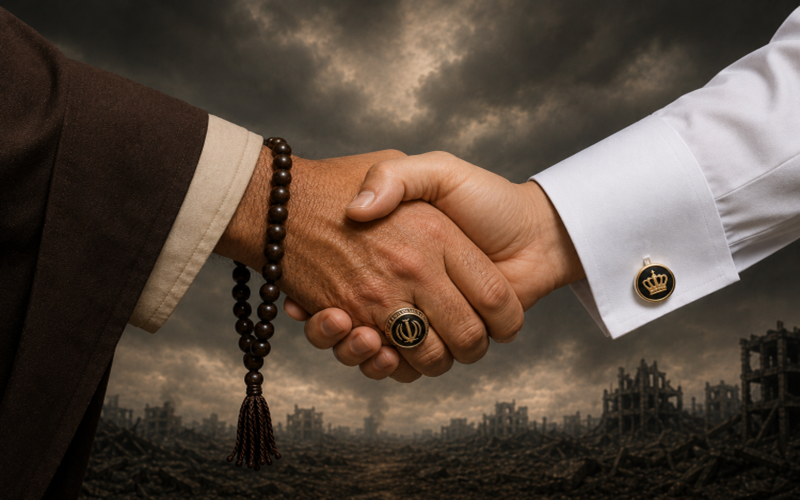

Recent statements from figures linked to both the ruling establishment and the monarchist movement expose a troubling reality: when political power becomes the ultimate goal, the welfare of ordinary Iranians risks becoming secondary.
Recent remarks from two very different corners of Iranian politics have reinforced an uncomfortable truth: Iran’s future cannot be secured by forces that view national crises primarily through the lens of political opportunity. Whether expressed by representatives of the ruling establishment or by leading voices in the monarchist movement, rhetoric that welcomes or encourages prolonged conflict reveals a dangerous willingness to subordinate the interests of ordinary Iranians to political ambitions.
The issue is not simply what was said, but what such statements suggest about the political cultures behind them.
Former regime parliamentarian Mostafa Kavakebian recently recounted an alleged conversation with a government official who, according to his account, dismissed concerns about declining public participation by saying, “Don’t worry. We know what to do. We need another war so people rally behind the system.”
When asked whether such a scenario depended on an external decision, Kavakebian claimed the response was that the authorities would create circumstances that would provoke an attack.
Whether this conversation occurred exactly as described is ultimately less important than the fact that such an idea could be discussed openly within Iran’s political discourse. If war can be viewed as a mechanism for restoring domestic legitimacy, then citizens cease to be individuals whose lives deserve protection and instead become instruments in a broader political strategy.
History offers numerous examples of authoritarian governments using external crises to suppress dissent, consolidate power, and demand national unity. Such strategies rarely strengthen societies in the long run; instead, they deepen repression while imposing enormous human and economic costs.
Yet the willingness to place political objectives above the immediate interests of ordinary Iranians is not confined to the ruling establishment.
In recent public interviews, Reza Pahlavi has argued for maintaining military pressure on the Iranian regime and has portrayed continued external pressure as a necessary component of political change. His supporters argue that such pressure weakens the ruling establishment and creates opportunities for democratic transition.
However, regardless of the stated objective, advocating policies that depend upon the continuation or escalation of armed conflict inevitably raises difficult moral and political questions. The immediate consequences of military confrontation are borne not by political leaders living abroad or by those in positions of power, but by civilians inside Iran whose homes, livelihoods, and security are directly affected.
This exposes an important point of convergence between two movements that otherwise present themselves as irreconcilable alternatives.
The ruling theocracy has repeatedly demonstrated its willingness to exploit external confrontation to reinforce internal control, justify repression, and marginalize domestic opposition. Certain voices within the monarchist current, meanwhile, have at times framed escalating external pressure—including military action—as an acceptable or even desirable catalyst for regime change.
The motivations differ. The political narratives differ. But when viewed from the perspective of ordinary citizens caught between these competing visions, the practical result can appear strikingly similar: the suffering of the population becomes secondary to larger political objectives.
This does not mean the two movements are identical. The Mullah’s regime governs through authoritarian institutions that have ruled Iran for decades, while the monarchist movement is an opposition current without state power. Their responsibilities and capacities are therefore fundamentally different.
Nevertheless, both can be criticized when political rhetoric appears insufficiently attentive to the human cost of conflict. Democratic politics requires that civilian lives remain the central consideration rather than collateral factors in broader strategic calculations.
Iran’s modern history has repeatedly demonstrated the consequences of allowing ideological projects—whether religious or dynastic—to eclipse the interests of society itself. In the 1979 revolution one centralized political model was replaced with another, while Ruhollah Khomeini hijacked the revolution, but neither produced a system built upon genuine popular sovereignty, political pluralism, or institutional accountability.
For many Iranians, this has strengthened the conviction that the country’s future should not involve choosing between competing forms of authoritarianism.
The real alternative lies elsewhere: a democratic republic founded on free elections, the rule of law, separation of religion and state, protection of fundamental rights, and accountable institutions. Such a system rejects both hereditary political privilege and absolute clerical rule because legitimacy must derive from the consent of citizens rather than bloodline or religious doctrine.
Iran’s future should not be determined by those who see war as a political instrument, whether to preserve power or to obtain it. The country’s future belongs to the millions of Iranians who seek neither theocracy nor monarchy, but a democratic republic where governments are accountable to the people, political authority changes through the ballot box rather than violence, and no political project is permitted to place its ambitions above the lives of the nation it claims to represent.