


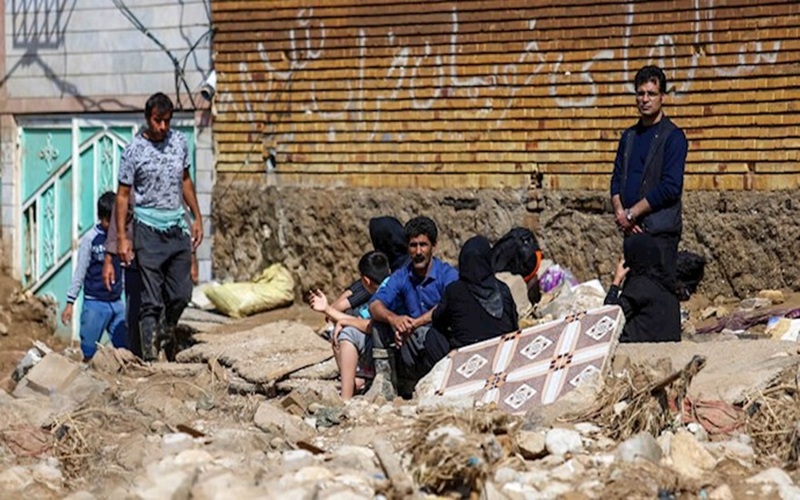

A report by the regime’s own state-run media reveals that working-class families displaced by the war have been abandoned, exposing discrimination, broken promises, and the deepening social crisis facing Iran’s workers.
A remarkable report published by the Iranian regime’s own state-run ILNA news agency has exposed the severe hardships facing working-class families in the aftermath of the recent war. Far from receiving meaningful government assistance, many workers whose homes were damaged or destroyed remain homeless months later, while authorities have offered what even state media describes as unequal and discriminatory treatment.
The report provides a rare public admission that the consequences of the conflict have fallen disproportionately on Iran’s working class, highlighting not only widespread economic hardship but also the regime’s failure to provide basic relief to some of the country’s most vulnerable citizens.
State media acknowledges class discrimination
According to ILNA, while some war-affected families were temporarily accommodated in hotels, many working-class families were told to seek shelter in sports halls, mosques, or even public libraries.
The report argues that this disparity reflects a class-based approach to emergency assistance, in which citizens are treated differently depending on where they live and their economic status.
The testimony of Kamal Gholizadeh, a former worker at the Darougar Company, illustrates the human cost of these policies.
His home, located in a working-class neighborhood of Qaleh Hassan Khan, suffered severe structural damage during a missile strike in March 2026. Although the building remains uninhabitable, Gholizadeh says he, his wife, and their two daughters have spent the past four months moving from place to place without receiving the support repeatedly promised by government officials.
“We have lived in displacement for four months,” he told ILNA. “Do you think anyone placed us in a hotel or provided temporary housing? None of what they promised happened.”
He contrasted his family’s treatment with that reportedly received by some residents of Tehran.
“They give housing assistance and hotel accommodation to some people, but when it comes to us, they tell us to sleep in stadiums, libraries, or mosques. Is a person’s dignity determined by where they live? Just because we live outside the capital or in a working-class district, should we be humiliated like this?”
Broken promises and abandoned reconstruction
The ILNA report comes amid growing criticism of the regime’s handling of post-war reconstruction.
Previous reports indicated that even families temporarily housed in hotels in Tehran have now been ordered to leave despite the fact that many damaged homes have yet to be rebuilt and financial assistance has failed to materialize.
The government’s response has further fueled public frustration after officials acknowledged that they do not intend to provide direct financial compensation for destroyed homes. Instead, authorities have proposed relying on a mechanism intended to encourage private-sector participation in reconstruction.
Critics argue that such proposals offer little practical help to families who have lost everything while construction costs continue to rise sharply across Iran.
“The war has not ended for workers”
Perhaps the most striking passage in the state-run report is ILNA’s own conclusion:
“The war has not ended for workers. Post-war inflation, sudden price increases, and the daily shrinking of family tables remain an open and bleeding wound.”
This unusually candid assessment reflects the growing economic crisis confronting millions of Iranian workers.
According to the report, leaving central Tehran reveals an even harsher reality in working-class suburbs and provincial communities, where unemployment, homelessness, inflation, and declining living standards have combined into a deep social emergency.
For many workers, the destruction caused by the war has simply compounded years of financial insecurity.
Years of work, no protection
Gholizadeh’s experience also illustrates broader problems within Iran’s labor system.
After being dismissed from his job in 2025, he spent months pursuing legally mandated severance payments. Although a court eventually ruled in his favor, six months later his former employer had still failed to pay the money owed.
Meanwhile, soaring inflation has dramatically reduced the value of his unpaid compensation.
According to his account, the 332 million tomans owed to him have lost more than half of their purchasing power while company executives continue to refuse payment and have reportedly blocked his attempts to contact them.
His story reflects a wider pattern in which labor laws exist on paper but are often weakly enforced, leaving workers unable to recover wages or benefits even after favorable court rulings.
Inflation compounds the crisis
The hardships described by ILNA extend well beyond housing.
Iranian households continue to struggle with rapidly rising food prices, shortages of medicines, declining employment opportunities, and widespread layoffs. Inflation has steadily eroded purchasing power, making even basic necessities increasingly difficult to afford.
For displaced workers, these economic pressures are compounded by the absence of stable housing and uncertainty about future employment.
The result is a cycle in which families face multiple overlapping crises with little effective government support.
Even state media questions official policies
In one of the report’s most revealing observations, ILNA argues that Gholizadeh’s case is not exceptional.
The agency notes that dozens of other workers in the same neighborhood are likely enduring similar conditions but remain largely unheard amid the destruction.
It further questions why authorities can swiftly approve layoffs or eviction orders while failing, after nearly four months, to provide dignified temporary shelter for displaced working-class families.
The report goes even further by criticizing the official narrative surrounding worker protests. According to ILNA, whenever workers driven to desperation have protested or harmed themselves under severe economic pressure, the regime’s propaganda apparatus has often attributed these incidents to “personal” or “family” problems rather than acknowledging the government’s own responsibility.
A regime struggling to protect its own citizens
Although ILNA remains a state-run outlet, its report amounts to a significant admission that the Iranian regime has failed to protect many of its own citizens after the war.
The testimonies it presents reveal not isolated administrative shortcomings but structural inequalities that have become increasingly visible as economic conditions deteriorate.
Workers who spent decades contributing to Iran’s economy now find themselves confronting homelessness, unemployment, unpaid wages, and soaring living costs simultaneously, while promised government assistance remains largely absent.
The report ultimately highlights a broader reality confronting the country: for millions of Iranian workers, the greatest challenge is no longer the war itself but the regime’s inability—or unwillingness—to provide accountability, equal treatment, and the basic protections that citizens expect from their government.