


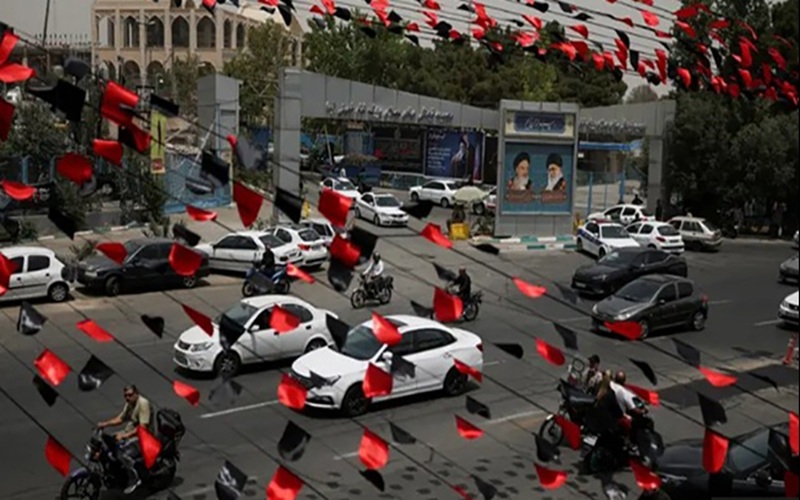

The Iranian regime’s carefully orchestrated funeral for Ali Khamenei was designed to project strength at home and abroad. But behind the spectacle lies a state confronting an unprecedented legitimacy crisis, deep internal fractures, and a society that has largely rejected its rule.
The death of Ali Khamenei, the longtime supreme leader of Iran’s ruling clerical establishment, marked the end of an era. Yet what followed was not merely a state funeral. It was one of the largest propaganda operations the regime has undertaken in recent years.
For international observers unfamiliar with the dynamics of authoritarian politics in Iran, the images broadcast from Tehran and Qom may have appeared to depict a nation united in grief. The reality is far more complex.
The funeral procession served two primary objectives: projecting political strength through carefully staged public imagery and reinforcing the security apparatus by intimidating a population that has repeatedly demonstrated its desire for fundamental political change.
Neither objective changes the underlying reality.
A Regime Seeking to Rewrite the Narrative
For months, authorities reportedly prepared every aspect of the funeral, from urban logistics to transportation networks and media coverage. The objective was clear: erase the perception of weakness that has emerged after months of political turmoil, nationwide unrest, international isolation, and the leadership transition following Khamenei’s death.
The regime understands that public perception matters.
Domestically, it hoped to convince ordinary Iranians that resistance is futile—that the state still commands overwhelming public support and possesses the capacity to suppress dissent indefinitely.
Internationally, it sought to send another message: despite sanctions, diplomatic pressure, internal conflict, and successive crises, the Iranian regime remains stable and enjoys broad popular legitimacy.
These narratives, however, depend less on reality than on spectacle.
Crowds Do Not Always Reflect Consent
Authoritarian governments have long relied on mass public ceremonies to manufacture legitimacy. Large crowds shown on state television often say little about genuine public opinion.
Numerous reports from Kurdish human rights organizations and independent media indicate that government employees, teachers, municipal workers, students, welfare recipients, and families dependent on state institutions faced significant pressure to attend the funeral ceremonies.
According to reports citing Kurdish political sources, security agencies allegedly threatened public-sector employees with dismissal or salary cuts if they refused to participate. Families receiving assistance through government welfare organizations reportedly faced warnings that financial support could be suspended. Sunni clerics in Kurdish regions were also said to have come under pressure to attend official mourning events.
Such reports are consistent with a pattern documented over many years in Iran, where participation in politically significant state events has frequently involved varying degrees of coercion, administrative pressure, or institutional incentives.
When attendance depends on fear rather than free choice, crowd size ceases to be a meaningful measure of public support.
The Crisis the Cameras Cannot Hide
The funeral cannot conceal the structural crisis confronting the Iranian regime.
For more than four decades, the office of the Supreme Leader functioned as the central pillar holding together competing political, military, economic, and intelligence factions. Khamenei exercised ultimate authority over disputes that might otherwise have fractured the system.
His death fundamentally alters that balance.
Without the figure who arbitrated rivalries among competing centers of power, factional competition is likely to intensify rather than diminish. The struggle over political authority, control of state institutions, and access to economic resources has not ended with the funeral—it has only entered a new phase.
No carefully choreographed procession can resolve these internal contradictions.
The Regime’s Greatest Challenge Comes From Society
The funeral spectacle also attempted to overshadow another uncomfortable reality: the profound gap separating Iranian society from its rulers.
Following years of economic deterioration, inflation, unemployment, housing shortages, widespread corruption, political repression, and repeated crackdowns on dissent, public confidence in the governing system has eroded dramatically.
The nationwide protests that culminated in the January 2026 uprising—and the regime’s violent suppression of demonstrators—have only deepened this divide.
If Iran permitted genuinely free public demonstrations by government opponents, the resulting crowds could present a dramatically different picture from the carefully controlled images broadcast by state television.
That possibility explains why independent demonstrations remain prohibited while state-sponsored gatherings receive unlimited logistical and security support.
Propaganda Cannot Solve Political Failure
The regime’s reliance on symbolic displays is hardly new.
For decades, it has used mass rallies, official commemorations, and highly choreographed public events to reinforce narratives of unity and strength. Such tactics have often served both domestic propaganda and broader security objectives by discouraging dissent and projecting confidence.
But propaganda has limits.
- It cannot restore lost legitimacy.
- It cannot reverse economic decline.
- It cannot eliminate public anger.
- It cannot reconcile competing factions struggling over succession and power.
Nor can it convince the outside world that Iran’s political future has become more stable simply because state television captured images of large funeral crowds.
Beyond the Funeral
As international attention moves beyond Khamenei’s burial, the regime will once again confront the crises temporarily obscured by the funeral.
Iranian society continues to demand political freedoms, respect for human rights, economic opportunity, and accountable governance.
Internationally, Tehran still faces mounting pressure over its regional policies, nuclear program, and relations with the wider world.
Internally, the competition among elite factions is likely to become more visible now that the central authority around which the system revolved is gone.
The funeral was designed to demonstrate permanence.
Instead, it underscored a more revealing truth: authoritarian regimes often invest enormous resources in projecting confidence precisely when they feel least secure.
The carefully choreographed images may dominate television screens for a few days, but they cannot erase the political realities that await once the cameras are turned off.