


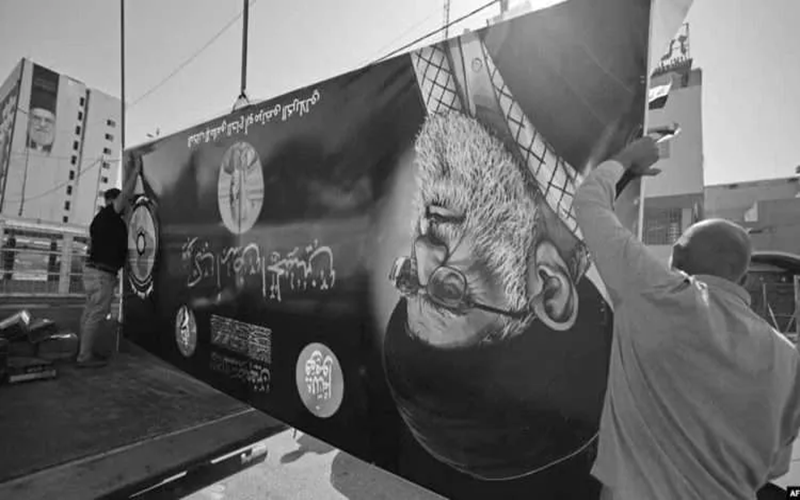

Ali Khamenei built one of the Middle East’s most extensive systems of repression to preserve clerical rule. His death closes a brutal era—but the crises he leaves behind may accelerate Iran’s struggle for democratic change.
With the burial of Ali Khamenei, one of the darkest chapters in modern Iranian history has formally come to an end. For 36 years, Iran’s supreme leader presided over a state defined by political repression, mass executions, systematic censorship, regional destabilization, and repeated violations of fundamental human rights.
His death, however, should not be mistaken for the end of the system he built.
Instead, it offers an opportunity to examine the legacy of a ruler who transformed the Iranian regime into a sophisticated machinery of repression—one that relied not only on brute force but on institutionalized surveillance, ideological control, and the militarization of nearly every aspect of public life.
Yet despite decades of violence, Khamenei failed in his ultimate objective: extinguishing the Iranian people’s demand for freedom.
Khamenei’s Greatest Legacy Was Building a State of Repression
Unlike Ruhollah Khomeini, who seized power amid the revolutionary upheaval of 1979 and enjoyed considerable religious and political legitimacy among his followers, Khamenei inherited leadership under far less favorable conditions.
He lacked Khomeini’s religious authority.
He lacked his revolutionary charisma.
What he possessed instead was a determination to construct institutions capable of compensating for that deficit through coercion.
Over three decades, Khamenei transformed the office of the Supreme Leader into the center of an enormous political, economic, intelligence, and security empire. His office extended influence throughout the judiciary, the armed forces, state-owned foundations, religious institutions, and large sectors of the economy.
At the same time, he expanded Iran’s security architecture far beyond conventional intelligence agencies.
Alongside the Islamic Revolutionary Guard Corps (IRGC), the Basij, the Ministry of Intelligence, and law enforcement bodies, intelligence units proliferated across universities, ministries, municipalities, and other state institutions. Surveillance became decentralized. Repression became institutionalized.
The objective was clear: ensure that every corner of Iranian society could be monitored—and, if necessary, suppressed.
Repression Became the Regime’s Organizing Principle
Under Khamenei, repression was no longer simply a response to dissent.
It became the central organizing principle of governance.
Universities trained ideological cadres as well as security personnel. Educational institutions increasingly served political objectives alongside academic ones. Economic resources flowed toward organizations responsible for maintaining internal control.
Foreign policy also became inseparable from domestic survival.
Khamenei’s often-cited assertion that “if we do not fight in Syria and Iraq, we will have to fight in the streets of Tehran” reflected more than regional strategy. It revealed how external intervention was viewed as an extension of internal security policy.
Regional proxy conflicts, military expansion, and even Iran’s nuclear ambitions increasingly functioned as instruments for preserving the regime’s grip on power rather than advancing purely national interests.
Every major policy ultimately served one overriding objective: regime survival.
Corruption Was Not a Side Effect—It Was a System
Political repression was accompanied by an equally extensive system of economic patronage.
Under Khamenei, enormous economic assets came under the control of institutions affiliated with the Supreme Leader, the Revolutionary Guards, and politically connected networks.
Rather than combating corruption, the system rewarded loyalty through privileged access to public resources, contracts, monopolies, and state-controlled wealth.
The result was a political economy in which corruption became embedded within the very structure of governance.
As ordinary Iranians struggled with inflation, unemployment, housing shortages, and declining living standards, politically connected elites accumulated unprecedented economic influence.
Every Protest Was Met With Violence
Perhaps the defining feature of Khamenei’s rule was his unwavering response to public dissent.
Throughout the 1990s, local uprisings in cities such as Mashhad, Qazvin, and Eslamshahr signaled growing frustration with the regime.
The 1999 student protests demonstrated that universities had become centers of political resistance.
The following decades saw an even broader wave of unrest.
Labor strikes multiplied.
Teachers organized nationwide protests.
Retirees demanded unpaid pensions.
Ethnic minorities protested discrimination.
Environmental crises triggered demonstrations across multiple provinces.
The nationwide protests of 2009 challenged the legitimacy of the political system itself.
The 2017–2018 protests expanded beyond electoral grievances into calls for fundamental political change.
The November 2019 uprising ended in one of the bloodiest crackdowns in the history of the Islamic Republic, with hundreds—and according to some reports, more than a thousand—protesters killed.
The nationwide protests following the death of Mahsa Amini in 2022 once again demonstrated the regime’s reliance on lethal force against peaceful demonstrators.
Most recently, the January 2026 nationwide uprising represented perhaps the gravest challenge to clerical rule since 1979.
Each wave of protest followed a similar pattern.
Public anger intensified.
Authorities responded with arrests, torture, executions, and gunfire.
The protests subsided temporarily—but returned larger than before.
Khamenei Won Battles, But Lost the Political War
Measured by the immediate survival of his regime, Khamenei often succeeded.
Measured by history, his record appears far less impressive.
Despite possessing enormous security resources, he never succeeded in eliminating the social forces demanding democratic change.
Each generation produced new protesters.
Each crackdown generated new grievances.
Each attempt to silence society ultimately expanded the ranks of those seeking fundamental political transformation.
The persistence of nationwide protests over nearly four decades demonstrates that coercion alone cannot produce political legitimacy.
The Crisis Facing the Next Supreme Leader
If Khamenei spent decades constructing the machinery of repression, he leaves his successor a system confronting unprecedented instability.
The economy remains burdened by inflation, structural dysfunction, unemployment, and declining purchasing power.
Iran’s nuclear dispute has once again become a major source of international confrontation.
Regional tensions continue to expose the costs of decades of interventionist policies.
Perhaps most importantly, the succession itself remains contested.
Unlike Khomeini, who managed to oversee a relatively orderly transfer of power in 1989, Khamenei leaves behind unresolved rivalries within the ruling establishment. Competition among political, military, and clerical factions has intensified precisely because the regime’s traditional center of authority has disappeared.
Reports of an accelerated use of executions against political prisoners following the leadership transition further suggest a government seeking to project strength while confronting deep insecurity.
History suggests that regimes most dependent on repression are often those least confident in their own stability.
Iran’s Future Will Be Written by Its People
Khamenei devoted 36 years to preserving a political system through fear.
He expanded surveillance.
He strengthened security institutions.
He empowered coercive forces.
He imprisoned critics.
He executed opponents.
Yet he could not extinguish the aspirations of millions of Iranians seeking freedom, justice, and democratic government.
That may ultimately be the defining verdict on his rule.
The institutions he built remain formidable, but the legitimacy required to sustain them has steadily eroded. His successor inherits not a stable political order but a fractured state, a divided ruling elite, an economy in distress, and a society that has repeatedly demonstrated its willingness to challenge authoritarian rule despite immense personal risk.
Khamenei’s era has ended.
Iran’s struggle for freedom has not.
If anything, it has entered its most consequential phase yet.