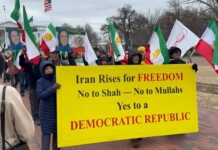
Coordinated operations and anti-regime messaging across Iran underscore the continued activities of the Resistance Units, rejecting both dictatorship and monarchy while calling for a democratic republic.
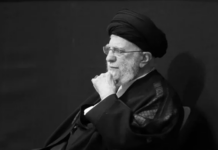
The days surrounding the burial of former regime Supreme Leader Ali Khamenei witnessed a new wave of coordinated activities by the Resistance Units across Iran. Through a combination of direct actions against regime symbols and an extensive campaign of graffiti and public messaging, activists demonstrated that the end of one ruler has not diminished calls for fundamental political change.
According to reports from inside Iran, Resistance Units carried out at least 25 anti-regime operations in multiple provinces on the night of Khamenei’s burial, complementing dozens of similar actions that had already taken place during the funeral ceremonies. The campaign targeted symbols of repression while promoting the vision of a democratic alternative to both clerical rule and monarchy.
Coordinated Operations Across the Country
The campaign stretched from Tehran to Zahedan, reflecting a broad geographic reach.
In Tehran, Resistance Units burned billboards, banners, and posters featuring Ruhollah Khomeini, Ali Khamenei, and Mojtaba Khamenei at four separate locations.
In Isfahan, activists carried out three operations targeting banners of Khamenei bearing slogans such as “Death to the principle of Velayat-e Faqih,” “Long Live the Liberation Army,” and “Hail Rajavi.” A separate operation destroyed a banner depicting former IRGC Quds Force commander Qassem Soleimani.
In Yazd, Resistance Units set fire to a poster of Mojtaba Khamenei and targeted a Basij facility responsible for recruiting and organizing students.
In Babol, in Mazandaran Province, banners featuring Ali and Mojtaba Khamenei were burned in separate locations.
Operations also continued in Lorestan Province, where Resistance Units reportedly carried out four actions. In Khorramabad, a sign directing citizens to Basij and IRGC intelligence offices was burned. Additional operations in Azna and Aligudarz targeted banners of Khamenei and regime institutions.
Further actions were reported in Arak and Saveh, where banners displaying Khamenei’s image were set ablaze.
In Songhor, Kermanshah Province, activists burned a wall image of Khamenei, while in Karaj, a Basij base was reportedly set on fire.
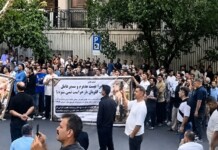
Meanwhile, in Zahedan, Resistance Units continued activities alongside the city’s weekly protest movement by targeting another Basij facility.
Graffiti Campaign Expands Political Messaging
Alongside these direct actions, Resistance Units launched an extensive nationwide graffiti campaign spanning numerous cities.
Messages appeared in Tehran, Mashhad, Isfahan, Shiraz, Kermanshah, Hamadan, Broujerd, Arak, Sari, Rasht, Gorgan, Zahedan, and Shahin Shahr.
Many slogans expressed support for the Iranian Resistance and its leadership, including:
- “Hail Rajavi.”
- “Long Live the Liberation Army.”
- “Hail Maryam Rajavi and the National Liberation Army.”
- “Maryam Rajavi: My commitment is an unbreakable covenant for the freedom of the Iranian people.”
Other messages directly rejected the regime’s ideological foundation:
- “Death to the principle of Velayat-e Faqih.”
- “Death to Khomeini and Khamenei.”
- “Khamenei is dead; the people live on.”
Several slogans also emphasized the Resistance’s longstanding rejection of both forms of dictatorship:
- “Neither monarchy nor religious rule—Democratic Republic.”
- “Death to the oppressor, whether the Shah or the Supreme Leader.”
Resistance Units also commemorated the anniversary of June 20, 1981, describing it as the beginning of organized armed resistance against religious fascism in Iran.
A Message Beyond Symbolic Protest
The coordinated timing of the operations—coinciding with Khamenei’s burial—appears intended to underscore that the succession of leadership within the regime does not resolve the political crisis confronting Iran.
Rather than focusing on individual figures, the campaign consistently targeted the regime’s institutions, ideological symbols, and mechanisms of repression, while presenting a vision centered on democratic change.
The repeated slogans supporting a democratic republic and rejecting both clerical rule and the return of monarchy reflect a message that has become increasingly prominent in Resistance Unit activities across the country.
As political uncertainty continues following Khamenei’s death, these coordinated operations suggest that organized anti-regime activism remains active across multiple provinces, seeking to project both organizational continuity and an alternative political future for Iran.