


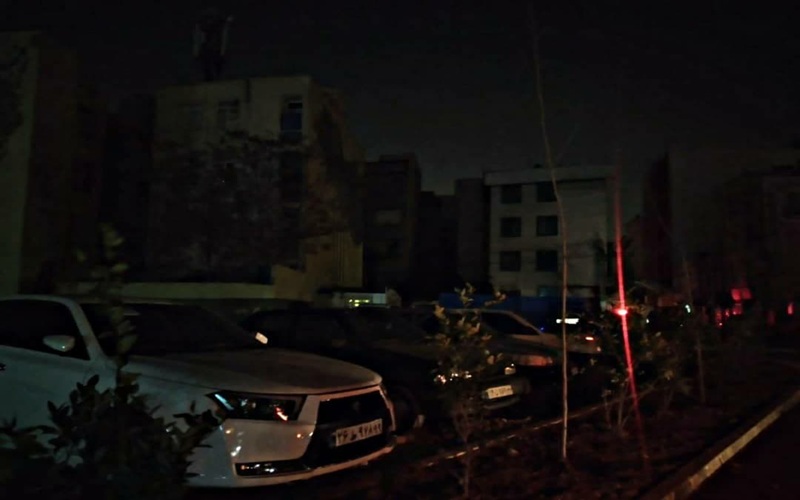

Unannounced power outages, voltage fluctuations, and worsening electricity shortages expose the Iranian regime’s chronic infrastructure failures while businesses and households bear the growing costs.
Iran’s Power Crisis Worsens Amid Extreme Summer Heat
Only days after the conclusion of Ali Khamenei’s week-long funeral ceremonies, millions of Iranians are once again confronting a familiar crisis: widespread electricity outages. As temperatures climb across the country, residents report increasingly frequent power cuts without prior warning, along with severe voltage fluctuations and partial failures of the electrical grid.
While regime officials attribute the crisis to soaring temperatures, increased demand for air conditioning, and damage allegedly inflicted during recent military strikes, the expanding blackouts once again highlight years of neglect, underinvestment, and mismanagement of Iran’s energy infrastructure.
Regime Officials Cite Heat and War Damage
Mohammad Elahdad, CEO of the state-owned electricity company Tavanir, told members of parliament on July 12 that more than 2,000 points of Iran’s electricity network were damaged during the recent 40-day conflict. According to him, the country lost approximately 4,200 megawatts of generating capacity, with damages exceeding 60 trillion tomans.
The regime has increasingly relied on these explanations to justify worsening electricity shortages. However, recurring summer blackouts have plagued Iran for years, long before the latest conflict, pointing to structural problems that successive governments have failed—or refused—to resolve.
Major Cities Experience Lengthy Blackouts
Authorities in Mashhad announced that scheduled residential blackouts began on July 12, citing emergency load management measures necessitated by extreme temperatures.
In Tehran, electricity officials acknowledged that power demand exceeded 10,000 megawatts, with every one-degree rise in temperature adding an estimated 200 to 250 megawatts of additional demand—equivalent to the electricity consumption of roughly 250,000 households.
Despite official assurances that Tehran’s grid remains stable, residents describe a very different reality.
Domestic media reported prolonged outages in several districts of the capital, including areas around Valiasr Street, Motahari Street, and Ghaem Magham Farahani Street, where electricity reportedly remained unavailable for approximately four hours during the hottest part of the day. Other reports described widespread unannounced outages beginning around midday, while inquiries directed to the Ministry of Energy reportedly received no response.
Officials have also warned that Tehran Province is entering at least eight weeks of peak summer electricity demand, indicating that aggressive consumption restrictions will continue.
Businesses Face Mounting Economic Damage
The electricity crisis is extending far beyond households.
Commercial centers and local markets have also suffered repeated interruptions. Employees at the Emerald Star commercial complex in eastern Tehran reported significant outages, while residents in Qeshm said electricity cuts forced the closure of the busy Dirgahan market.
Industrial production is likewise under increasing pressure.
Arman Khaleghi, Secretary-General of the House of Industry, Mine and Trade, stated that electricity restrictions for industrial facilities have expanded to two full days each week. Authorities are reportedly considering extending these limitations into evening and nighttime hours, similar to last year’s restrictions.
Industry representatives have proposed counting blackout days as official production holidays to compensate factories for lost output, but the proposal has yet to be implemented.
For an economy already suffering from inflation, recession, and declining investment, continued electricity shortages threaten to further reduce industrial output and employment.
Voltage Fluctuations Create Hidden Risks
In addition to complete blackouts, many residents report another growing problem: unstable voltage and partial power failures.
Some apartment buildings have experienced the loss of only one electrical phase, leaving portions of buildings without electricity while other sections remain operational.
Although technically possible in three-phase electrical systems, such failures can disable elevators, water pumps, central ventilation systems, and other shared infrastructure. Without adequate protection systems, electrical motors may overheat, operate inefficiently, or suffer permanent damage.
Voltage fluctuations also threaten household electronics.
Repeated drops and surges in voltage can cause lights to flicker, internet equipment to restart, computers and televisions to malfunction, and stored digital data to become corrupted. Refrigerators, freezers, air conditioners, washing machines, and water pumps are especially vulnerable because compressors and electric motors can overheat under unstable voltage conditions.
Sudden voltage spikes may permanently damage power supplies, electronic control boards, capacitors, and lighting systems. Even when appliances continue functioning, repeated fluctuations significantly shorten their operational lifespan.
Public Safety Increasingly at Risk
The consequences extend well beyond damaged appliances.
Power outages interrupt water pumping systems, trap residents inside elevators, disable home medical equipment, disrupt internet and telecommunications services, and make cooling homes increasingly difficult during periods when temperatures in southern Iran are expected to exceed 50°C.
For elderly people, children, and patients with chronic illnesses, prolonged outages during extreme heat pose serious health risks.
Electrical instability also increases the danger of overheated wiring, sparking, equipment failures, and potentially devastating fires.
A Crisis Rooted in Mismanagement
The Iranian regime continues to portray the current electricity shortages as the result of extraordinary circumstances. Yet repeated summer blackouts, declining infrastructure reliability, and worsening power shortages have become annual features of life across Iran.
Years of inadequate investment, poor planning, corruption, and prioritization of security and military spending over public infrastructure have left the country’s electricity network increasingly incapable of meeting domestic demand.
As another scorching summer unfolds, millions of Iranians are paying the price for those failures—not only through hours without electricity, but through mounting economic losses, damaged property, and growing threats to public health and safety.