


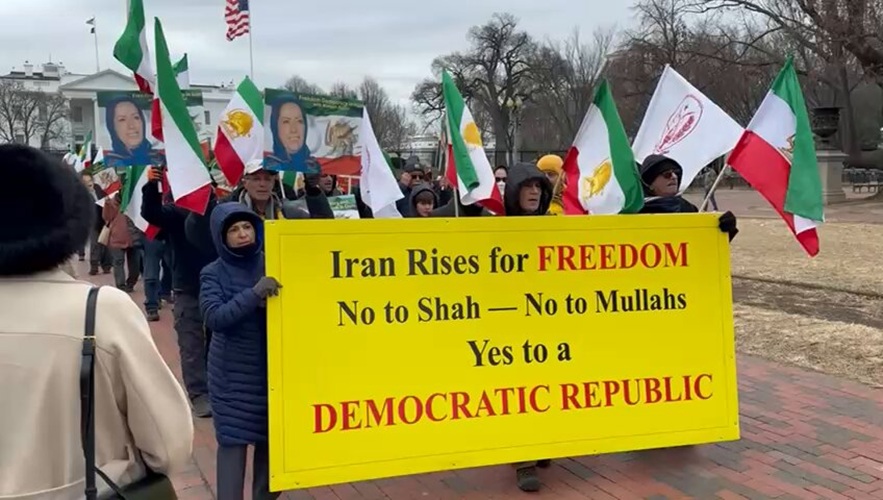

Authoritarian forces thrive on instability. Whether under the banner of clerical rule or royal restoration, crisis politics serves power—not the Iranian people.
Crisis Is the Lifeblood of Authoritarian Politics
One of the defining lessons of Iran’s modern political history is that authoritarian movements rarely survive without a constant state of crisis. Whether they seek to preserve power or reclaim it, they depend on fear, polarization, and instability to silence alternatives and justify extraordinary measures.
Today, this dynamic is visible not only within the Iranian regime’s ruling establishment but also among monarchist factions that portray themselves as the country’s inevitable future. Though they present themselves as ideological opposites, both camps increasingly rely on remarkably similar political strategies: portraying external confrontation and national crisis as opportunities to consolidate power.
The tragedy is that while these rival camps compete for authority, ordinary Iranians bear the consequences.
The Regime’s Reliance on Permanent Conflict
Following the death of Ali Khamenei, the regime has worked to project continuity and strength during a sensitive transition period. Public displays surrounding his funeral, accompanied by highly organized mobilizations and calls for revenge, served a broader political purpose beyond mourning.
Such spectacles reinforce a narrative that Iran remains under existential threat and therefore requires uncompromising centralized authority.
This strategy serves two interconnected objectives.
Domestically, it creates an atmosphere in which dissent can be portrayed as disloyalty during a time of national emergency. Political repression, intensified surveillance, and restrictions on civil liberties become easier to justify under the language of security and wartime necessity.
Within the regime itself, sustained external tensions also strengthen those seeking to consolidate influence during the post-Khamenei era. A leadership transition conducted under conditions of permanent crisis minimizes internal challenges while emphasizing loyalty over accountability.
For authoritarian systems, crisis is not merely a consequence of governance—it often becomes a governing instrument.
The Strategic Similarities with Monarchist Politics
While the ideological narratives differ, the political logic employed by radical monarchist currents often follows a comparable pattern.
Rather than demonstrating broad democratic legitimacy inside Iran, many monarchist voices have increasingly framed external pressure, international confrontation, and systemic collapse as the primary pathways to political change.
The underlying calculation is straightforward.
In a stable political environment where citizens freely determine their future through democratic institutions, competing visions must earn legitimacy through public support, organization, and accountability.
In contrast, periods of chaos create opportunities for self-appointed “saviors” to claim that only they possess the authority to restore order.
This helps explain why both authoritarian camps frequently benefit from heightened polarization. One presents itself as the indispensable guardian of national security; the other seeks recognition as the only viable replacement during a national emergency.
Neither approach centers political legitimacy on the Iranian people themselves.
The Real Cost Falls on Iranian Society
The greatest casualty of this struggle is neither the ruling establishment nor its political rivals—it is Iran itself.
Years of economic decline, international isolation, corruption, environmental degradation, and the steady emigration of skilled professionals have imposed enormous costs on society. Continued confrontation only deepens these problems.
When political movements prioritize acquiring or preserving power above all else, public welfare inevitably becomes secondary. Economic prosperity, functioning institutions, infrastructure development, and social freedoms are sacrificed to narratives of existential struggle.
Iranians have repeatedly demonstrated that their demands extend far beyond replacing one ruling elite with another. They seek accountable government, economic opportunity, civil liberties, and political participation—not another centralized system built around an individual or hereditary authority.
Democracy Requires Rejecting Both Forms of Absolutism
Iran’s future should not be defined by a choice between competing authoritarian projects.
The regime’s effort to consolidate power through militarized rhetoric and perpetual confrontation represents one model of political absolutism. Calls to restore hereditary rule represent another vision rooted in concentrating authority rather than dispersing it through democratic institutions.
Neither offers a durable solution to Iran’s long-standing political crisis.
A genuine democratic transition requires rejecting the false binary that has dominated Iranian politics for decades: clerical dictatorship versus monarchical restoration. Sustainable change can only emerge from institutions that derive their legitimacy from the people, protect political pluralism, uphold the rule of law, and guarantee peaceful transfers of power.
The Path Forward Belongs to the Iranian People
The central political question facing Iran is not which authoritarian tradition should prevail, but whether the country can finally move beyond authoritarianism altogether.
The growing demand inside Iran reflects an aspiration for a democratic republic founded on popular sovereignty rather than inherited or absolute authority. That vision rejects both the concentration of power embodied by the current regime and the nostalgia for a monarchical past.
Iran’s future will ultimately be secured not through perpetual conflict or competing strongmen, but through peace, democratic governance, and the recognition that sovereignty belongs to the people alone.