


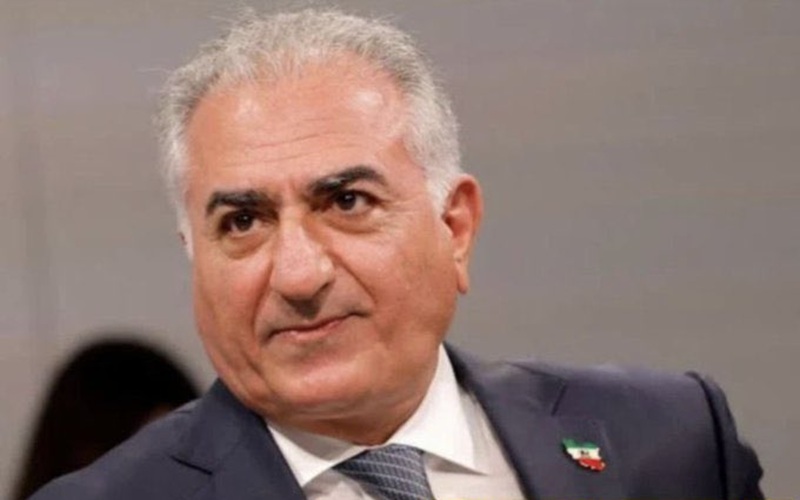

After years of publicly advocating engagement with the Islamic Revolutionary Guard Corps (IRGC), Reza Pahlavi has welcomed Britain’s decision to designate the organization as a terrorist entity. His past statements, however, raise questions about the consistency of his position and his broader vision for Iran’s security apparatus.
Britain’s recent decision to designate the Islamic Revolutionary Guard Corps (IRGC) as a terrorist organization has been welcomed by many Iranians who have long held the IRGC responsible for systematic repression, executions, torture, and regional destabilization. Yet among those expressing support for the move is Reza Pahlavi—a position that stands in sharp contrast to years of public statements defending engagement with the IRGC and its personnel.
For years, Reza Pahlavi repeatedly argued that members of the IRGC and the Basij should be viewed as potential allies rather than as integral components of the regime’s repressive machinery. His latest endorsement of the IRGC’s terrorist designation therefore appears inconsistent with his previous rhetoric.
The UK finally designated the IRGC as a terrorist organization. Reza Pahlavi once defended ties with the IRGC and called its members part of his support base. Now he supports the designation. The Iranian people deserve accountability, not political convenience. #IRGCterrorists… https://t.co/iOKPGUlGll pic.twitter.com/PySbwYbKmG
— Reza Shayesteh (@RezaShayesteh1) July 14, 2026
A Record of Defending Relations with the IRGC
Reza Pahlavi’s own public statements over the years provide a documented record of his approach toward the IRGC.
On November 3, 2018, during an interview with Iran International, he stated:
“I am in contact with members of the Basij and the IRGC.”
He expanded on this position in 2020, arguing that his political strategy relied on the very institutions responsible for enforcing the regime’s rule:
“If the Islamic regime wants to carry out a final crackdown in Iran, we will not allow that to happen, because my support will come from these very law enforcement forces, from these very IRGC members, from these very Revolutionary Guards, from these very Basij members, and from these very military personnel.”
In another 2018 interview with Iran International, he again emphasized his communications with the regime’s military institutions:
“I have two-way contacts with the Army, the IRGC, and the Basij.”
Even earlier, in 2017, he rejected describing the IRGC as a terrorist institution in its entirety, saying:
“Are all IRGC members terrorists? No… You fought with Iraq’s army for Iran, you shed blood for Iran, you are part of the people of Iran.”
This is not surprising. From the very beginning, Reza Pahlavi had officially announced his connection with the IRGC and the Basij.#Iran#No2ShahNo2Mullahshttps://t.co/b9EWzMhA97
— SadeghEsfahani (@SadeghEsfa1809) April 18, 2026
Critics also point to reports that during the Iran-Iraq War, Reza Pahlavi offered to serve as a pilot alongside the IRGC in the conflict, further illustrating what they describe as a long-standing willingness to cooperate with the organization.
The Debate Over Individual Members Versus the Institution
Supporters of Reza Pahlavi often argue that distinctions should be made between individual IRGC members and the institution itself. His critics, however, contend that this distinction ignores the nature of the organization.
The IRGC and the Basij are not merely collections of individuals, they argue, but highly centralized institutions established to preserve the regime through political repression, executions, torture, economic domination, intelligence operations, and proxy warfare. From this perspective, portraying the organization as a source of future political support effectively legitimizes the very apparatus responsible for suppressing Iranian society.
For many opponents of the regime, the demand is not for reform of the IRGC but for its complete dismantlement as an institution.

Calls for Integration Rather Than Dissolution
Critics also point to Reza Pahlavi’s broader political proposals, including ideas presented in his so-called “Emergency Plan,” which they interpret as leaving room for preserving significant parts of the existing security establishment rather than dismantling it.
According to these critics, his repeated appeals encouraging IRGC members to join his political movement demonstrate an effort to integrate elements of the regime’s security apparatus into any future political order rather than holding the institution accountable.
Almost all of Reza Pahlavi’s advisers are linked to the Iranian regime, including individuals connected to the IRGC’s Intelligence Protection Organisation, such as:
1.Amir Hossein Etemadi — former adviser to Ali Fallahian (Iran’s former Minister of Intelligence).
2.Saeed… pic.twitter.com/23Rwajbn3G— Laila Jazayeri (@LJazayeri) February 18, 2026
They further argue that some individuals associated with the IRGC have participated in pro-monarchy gatherings abroad, where Iranian dissidents have reported harassment, intimidation, and threats. These allegations have fueled concerns that remnants of the regime’s security culture could be carried into a post-regime political environment.
Silence on Expelling IRGC Operatives Abroad
Another point frequently raised by critics is that Reza Pahlavi has rarely called on Western governments to expel IRGC operatives or agents of the Ministry of Intelligence from their territories.
An accurate assessment by @RudyGiuliani.
Reza Pahlavi has sought to befriend the IRGC, the very force responsible for killing Iran's children.
A notable chant in the January uprising was: "Down with the Oppressor, be it the Shah or the Supreme Leader".pic.twitter.com/MrHIkQsWJN https://t.co/GaUbxrTWuu
— M. Hanif Jazayeri (@HanifJazayeri) March 1, 2026
Given his longstanding emphasis on maintaining communication with members of these institutions, critics argue that this silence is consistent with his broader political approach toward the regime’s security establishment.
Reza Pahlavi has failed to distance himself from his father’s crimes and openly takes pride in it
Calling for the revival of the SAVAK and Immortal Guard (rebranding of VEVAK and IRGC)
for years he has emphasized he relies on the IRGC for the “transition”pic.twitter.com/gXabocyeuv— Zolal Habibi (@Ashrafi4ever) March 29, 2026
A Question of Credibility
Reza Pahlavi’s endorsement of Britain’s terrorist designation of the IRGC may resonate with widespread public demands for accountability. However, his extensive record of advocating engagement with the IRGC presents a significant challenge to the credibility of that position.
At minute 5:13 of his interview with Jake Tapper, Reza Pahlavi claims that 100K new IRGC and regime military members have joined him, on top of a previous 50K. No evidence. . This is not leadership. This is charlatanism for which he must be hold accpuntable.#No2MullahsNo2Shah https://t.co/Fo9d3mNxSd
— Kazem Kazerounian (@kazemkaz) February 5, 2026
For many Iranians who view the IRGC as the regime’s principal instrument of repression, the issue extends beyond designations. The central issue is that this organization must be dismantled completely as part of any genuine democratic transition.