


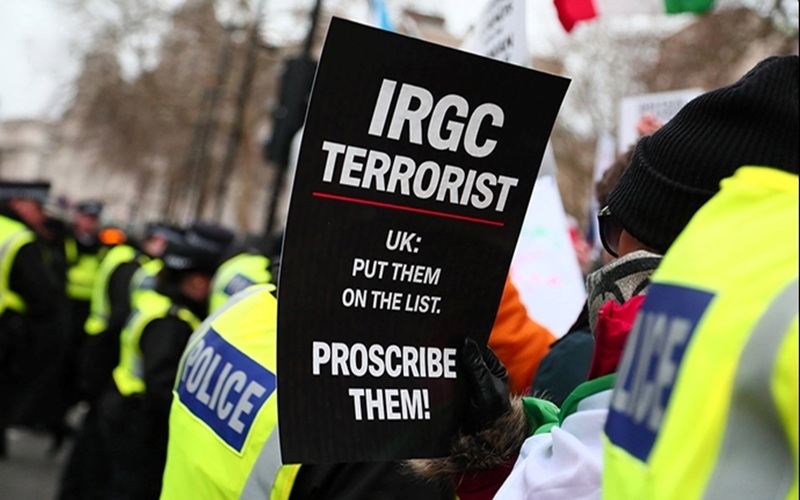

Britain’s move to designate the IRGC as a terrorist organization reflects years of sustained advocacy by the Iranian Resistance—and highlights why supporting the Iranian people, not appeasing the regime, is the only path to lasting regional security.
For years, many Western governments acknowledged the Islamic Revolutionary Guard Corps’ (IRGC) destabilizing activities while stopping short of taking decisive action. Political caution, diplomatic calculations, and commercial interests repeatedly delayed meaningful measures against the regime’s most powerful military and security institution.
Britain’s decision to designate the IRGC as a terrorist organization marks a turning point. But this development did not emerge overnight, nor was it simply the product of changing geopolitical circumstances. It is the culmination of decades of persistent advocacy by the Iranian Resistance, whose warnings about the IRGC’s true role long preceded the current international consensus.
The designation is more than a legal measure. It is an acknowledgment of a reality that Iran’s democratic opposition has documented for over four decades: the IRGC is not a conventional military force but the central pillar of repression at home and terrorism abroad.
Four decades of exposing the IRGC
Since the establishment of the IRGC following the 1979 anti-monarchy revolution, the Iranian Resistance—led by the PMOI/MEK and the National Council of Resistance of Iran (NCRI)—has consistently argued that the force was created not to defend Iran’s national interests but to preserve the system of clerical rule.
The NCRIPMOI has documented the undeniable facts on why the IRGC must be blacklisted, from terror networks to nuclear cover-ups, for years.
Appeasement must end. The world must support the Iranian people’s right to confront the IRGC & establish a democratic republic of Iran. https://t.co/BM47QLseQX pic.twitter.com/HlPKrTwP9U
— Safora Sadidi (@SaforaSM) July 13, 2026
While the regime maintained the regular army, it built the IRGC as a parallel ideological force directly loyal to the Supreme Leader. Over the decades, the organization expanded far beyond military affairs, becoming deeply embedded in domestic repression, intelligence operations, economic monopolies, regional proxy warfare, and international terrorist activities.
Long before many Western policymakers recognized these realities, the Iranian Resistance was documenting the IRGC’s role in suppressing protests, exporting extremism, and financing armed groups across the region.
From terrorist designation to dismantlement
The Resistance’s position has never been limited to seeking a terrorist designation.
For years, Resistance leader Massoud Rajavi argued that merely placing the IRGC on terrorist lists would not be sufficient. In messages issued on April 8, 2019, June 24, 2019, August 15, 2020, September 7, 2020, and again in June 2022, he consistently maintained that lasting change requires the complete dismantling of the IRGC and the redirection of its enormous financial resources toward the Iranian people.
Maryam Rajavi, the NCRI’s President-elect, has likewise made the dissolution of both the IRGC and its Quds Force a central pillar of her Ten-Point Plan for a democratic Iran. In her vision, dismantling these institutions is indispensable for establishing democracy, the rule of law, and a government based on popular sovereignty.
What once appeared to many as a radical demand has increasingly entered mainstream political debate among supporters of a democratic future for Iran.
Building international consensus
Britain’s decision also reflects years of parliamentary engagement by supporters of a free Iran.
Members of the British Committee for Iran Freedom (BCFIF), together with parliamentarians from both major political parties, have repeatedly highlighted the security threat posed by the IRGC inside the United Kingdom.
Among the most vocal has been Conservative MP Bob Blackman, who has consistently urged stronger action against the IRGC’s activities and networks operating in Britain.
On May 18, 2026, Blackman drew attention to evidence presented by the Iranian Resistance regarding organizations allegedly linked to Tehran’s influence apparatus. He argued that institutions operating under charitable or religious cover should be thoroughly investigated where credible evidence indicates links to the regime’s security structures.
Such sustained parliamentary pressure gradually transformed what had long been treated as a foreign policy issue into a domestic national security concern.
The British Committee for Iran Freedom also publicly thanked Maryam Rajavi and the NCRI for their sustained efforts to expose the regime’s activities while reaffirming that the Iranian people reject both dictatorship and authoritarian rule in all its forms, calling instead for a democratic republic founded on universal suffrage, human rights, and the separation of religion and state.
The end of appeasement?
Britain’s terrorist designation of the IRGC represents a significant political defeat for the regime’s strategy of presenting the organization as a legitimate military institution.
It also challenges years of Western policies that often prioritized diplomatic engagement and commercial interests over confronting the IRGC’s role in repression and regional destabilization.
Yet designation alone cannot neutralize the IRGC’s extensive financial, military, and political infrastructure.
Meaningful implementation will require enforcing sanctions, dismantling financial networks, restricting front organizations, and preventing IRGC-linked entities from operating under commercial, charitable, or religious cover.
Standing with the Iranian people
Maryam Rajavi welcomed Britain’s decision as an important step toward regional and international peace and security. However, she emphasized that governments should now act consistently by treating the IRGC and the regime as a terrorist entity in practice rather than limiting themselves to symbolic measures.
She further argued that recognizing the Iranian people’s right—and the organized Resistance’s right—to confront the IRGC is an essential complement to any terrorist designation.
Britain’s decision validates what the Iranian Resistance has maintained for more than forty years: the IRGC is the regime’s principal instrument of repression and external aggression. The international community now faces a broader question—not merely whether to sanction the IRGC, but whether it is prepared to stand with the Iranian people in their pursuit of a democratic republic that rejects both religious dictatorship and any return to authoritarian rule.