


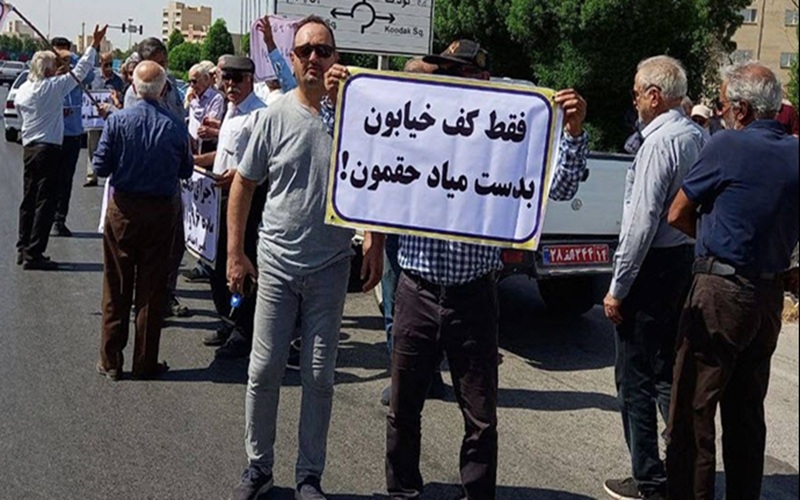

Inflation, currency collapse, and shrinking production reveal that Iran’s economic crisis is rooted in the regime’s political structure, not in temporary sanctions or policy mistakes.
For decades, the Iranian regime has portrayed the country’s recurring economic crises as the product of sanctions, external pressure, or policy missteps. Each new administration has promised better management, fresh reforms, or diplomatic breakthroughs that would restore growth and improve living standards.
Yet Iran’s economic trajectory tells a different story.
Today’s economic paralysis is no longer a temporary downturn or a cyclical recession. It reflects the exhaustion of an economic model built on political repression, institutional corruption, monopolistic control, and the prioritization of regime survival over national development. The mounting evidence suggests that Iran’s crisis is structural, leaving little room for meaningful recovery without fundamental political change.
A System That Can No Longer Sustain Itself
Iran’s economic indicators paint a picture of a country approaching systemic failure.
Structural inflation has reportedly climbed to nearly 89 percent, while food inflation has surged beyond 130 percent, devastating household purchasing power. Essential goods have become increasingly unaffordable for ordinary families. Meat and poultry prices have risen by approximately 178 percent, edible oils by more than 278 percent, and bread—a staple for millions—by nearly 139 percent.
Meanwhile, the national currency has continued its dramatic decline, with the exchange rate reaching roughly 1.75 to 1.83 million rials per U.S. dollar. The official minimum monthly wage has fallen to the equivalent of roughly $95, leaving millions of workers unable to meet even basic living expenses.
These figures illustrate more than inflation; they demonstrate an economy in which wealth is increasingly concentrated within institutions linked to the ruling establishment while the middle class steadily disappears and poverty expands across society.
International forecasts reinforce this bleak outlook. The International Monetary Fund has projected that Iran’s economy will contract by 6.1 percent, underscoring the continuing deterioration of productive capacity and investment.
Why Diplomacy Cannot Repair a Broken Economic Model
Some observers argue that easing sanctions, increasing oil exports, or releasing frozen assets could stabilize the economy.
Such assumptions misunderstand the nature of Iran’s crisis.
The regime’s economy does not primarily suffer from a shortage of foreign currency. It suffers from the absence of transparent institutions capable of allocating resources efficiently. Endemic corruption, opaque budgeting, politically controlled financial institutions, and the dominance of military and state-affiliated conglomerates ensure that new financial inflows rarely translate into productive investment.
Instead, additional revenue has historically strengthened parallel institutions, expanded patronage networks, financed the regime’s security apparatus, and preserved monopolistic economic structures.
Under these conditions, even improved diplomatic relations would not address the structural incentives that perpetuate economic decline. The problem lies not in temporary liquidity shortages but in an economic architecture designed to protect political power rather than encourage growth.
The Myth of Reform from Within
The argument that the regime can gradually reform its economy has repeatedly collided with reality.
Every major economic initiative over the past several decades has ultimately been constrained by the same political priorities: preserving the ruling system, protecting entrenched economic interests, and maintaining institutions that operate beyond public accountability.
As long as these priorities remain unchanged, meaningful structural reform becomes impossible.
The economic model itself depends upon monopolies, rent-seeking, limited transparency, and political control over major industries. Asking such a system to voluntarily dismantle its own foundations is inherently contradictory.
A Society Under Mounting Pressure
Economic deterioration is producing consequences that extend far beyond financial hardship.
The rapid depreciation of the rial, inflation approaching 90 percent, and wages that reportedly cover less than 40 percent of an average family’s essential expenses have intensified social pressures across the country.
At the same time, unresolved budget deficits, unsold oil cargoes, and declining investor confidence point to an increasingly fragile fiscal position.
Perhaps even more damaging is the accelerating exodus of capital and human talent. Professionals, entrepreneurs, scientists, engineers, physicians, and skilled workers continue to leave Iran in growing numbers, depriving the country of the expertise necessary for future recovery.
This ongoing brain drain represents not merely an economic loss but a long-term erosion of Iran’s development prospects.
Economic Recovery Requires Political Transformation
Iran’s deepening economic collapse cannot be understood as a conventional financial crisis.
It is the predictable outcome of a governing system whose institutions prioritize political control over economic development and public welfare. Inflation, currency depreciation, shrinking production, and widespread poverty are symptoms of that underlying structure rather than isolated policy failures.
For this reason, expectations that modest economic reforms or renewed diplomatic engagement alone can reverse the decline overlook the fundamental causes of the crisis.
A sustainable recovery requires institutions based on transparency, accountability, competitive markets, the rule of law, and integration with the international economy—conditions that cannot coexist with a political system built on centralized control, economic monopolies, and repression.
The future of Iran’s economy therefore depends not only on economic policy but on political transformation. Only the establishment of a democratic republic founded on popular sovereignty, respect for human rights, and constructive engagement with the international community can create the institutional foundations necessary for lasting prosperity, stability, and national renewal.