


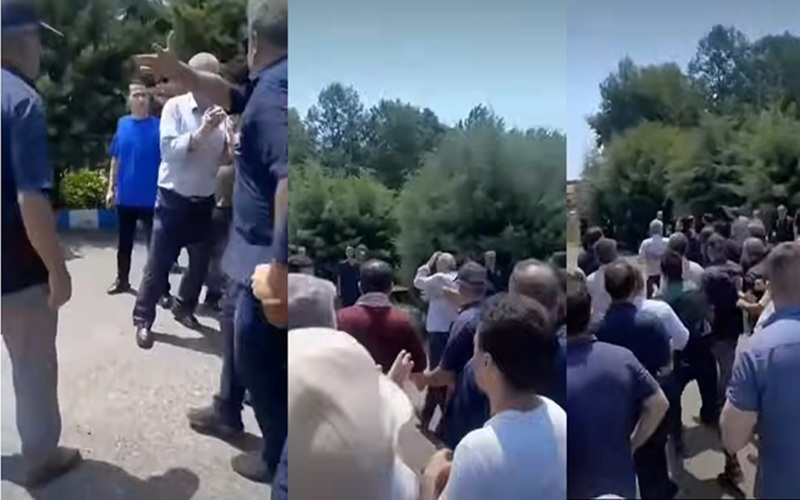

From factory workers to truck drivers and public employees, a new wave of demonstrations signals that economic hardship and demands for change are overcoming the regime’s attempts to suppress dissent through war rhetoric.
As the Iran regime seeks to drown out domestic dissent by beating the drums of war, a growing wave of social protests is demonstrating that many Iranians are refusing to be intimidated. Instead of retreating in the face of official rhetoric, workers, public employees, truck drivers, and other citizens are once again taking to the streets to voice grievances over worsening living conditions and decades of economic mismanagement.
The resurgence of demonstrations suggests that the regime’s strategy of using external tensions to divert attention from internal crises is losing slowly its effectiveness. Across multiple provinces, protesters are increasingly linking their economic demands with broader political criticism, signaling a growing rejection of the regime’s priorities.
Workers Force Factory Executive Out
On July 15, protesting workers at the Chooka paper factory in Gilan Province gathered after their longstanding demands remained unanswered. The demonstration escalated when workers reportedly forced the factory’s chief executive to leave the premises, highlighting growing frustration over unresolved labor grievances.
The protest reflects a broader trend of labor unrest that has intensified despite the regime’s efforts to portray national security concerns as the country’s overriding priority.
State Media Acknowledges the Return of Protests
Even regime-affiliated media have begun acknowledging the renewed momentum of public protests.
The state-run newspaper Tose’e Irani published a report under the headline “The Return of Demands”, noting that July 2026 has witnessed the resumption of strikes and demonstrations across different regions of Iran.
According to the newspaper:
“The events of Tir 1405 indicate the resumption of protests and strikes in different parts of the country—from the workers of Tabriz Machine Manufacturing Company to the personnel of the Islam-Abad-e Gharb Health Center… These movements show that the workforce is dissatisfied with the current conditions and is seeking structural changes in labor relations.”
Such admissions from state media underscore the depth of dissatisfaction among workers and employees despite continuing government pressure.
Nationwide Demonstrations Continue
The scale of the protests has become increasingly difficult to ignore.
On July 12 alone, at least fifteen protest gatherings were reported in cities including Kermanshah, Shush, Ahvaz, Dezful, Tehran, Rasht, and Tabriz.
Despite intense summer heat, demonstrators filled the streets with slogans that reflected both economic hardship and political frustration. Among the chants heard during the protests were:
- “Enough warmongering—our tables are empty.”
- “Inflation and high prices; no to war and destruction.”
- “Free the imprisoned teachers.”
- “With empty tables, we continue to protest.”
- “So much injustice and oppression brought us into the streets.”
- “The streets are the stronghold of working people.”
The evolution of these slogans illustrates how demonstrations that begin with workplace or livelihood concerns increasingly expand to include demands for political freedoms and opposition to the regime’s broader policies.
Truck Drivers Defy Security Forces
One of the most significant demonstrations involved truck drivers in Tabriz who protested against what they described as exploitation by transport companies.
The confrontation reportedly escalated as security forces intervened, using tear gas against protesters. Demonstrators nevertheless resisted attempts to disperse them, illustrating the growing determination of workers facing deteriorating economic conditions.
Such incidents reveal the potential for labor protests to evolve into broader social movements, particularly when security forces respond with repression rather than dialogue.
Economic Grievances Challenge the Regime’s Narrative
Perhaps the most striking feature of the latest demonstrations is the way protesters are directly challenging the regime’s political messaging.
Chants such as “Enough warmongering—our tables are empty” and “No to war and destruction” reject attempts to frame external conflict as the nation’s primary concern. Instead, demonstrators emphasize inflation, unemployment, unpaid wages, and declining living standards as the issues that dominate everyday life.
Rather than accepting calls for national unity around external crises, protesters are pointing to the country’s domestic failures as the source of their suffering.
A Growing Gap Between the Regime and Society
The latest protests suggest an expanding disconnect between the regime’s priorities and those of the Iranian people.
While the authorities continue to invoke security threats and regional tensions, many citizens appear increasingly focused on economic survival, political freedoms, and accountability. The return of coordinated labor actions across multiple provinces indicates that social discontent has not subsided despite heightened repression.
As workers, teachers, truck drivers, and other sectors continue to mobilize, the regime faces a challenge that cannot easily be deflected through war rhetoric alone. The persistence of these demonstrations reflects a broader reality: growing segments of Iranian society are refusing to allow external crises to overshadow the internal political and economic conditions that continue to fuel public unrest.