


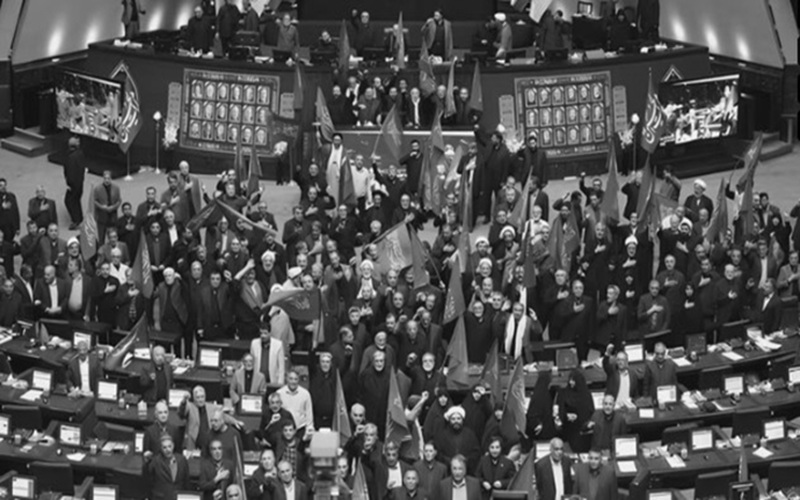

Following Ali Khamenei’s absence, escalating factional infighting has become the regime’s dominant priority, exposing deeper structural weakness and widening the gap between the ruling establishment and a society seeking fundamental change.
The absence of Ali Khamenei has not ushered in a period of stability for the Iran regime. Instead, it has intensified a struggle for dominance among competing factions, with political energy increasingly devoted to internal confrontation rather than governance. Recent developments suggest that the regime’s immediate priority is no longer addressing the country’s mounting crises, but securing power by eliminating rival factions from within.
Some may question why these internal disputes deserve close attention when much of Iranian society has already rejected the ruling system as a whole. The answer lies in the direct relationship between the regime’s internal dynamics and the broader political, economic, and social realities facing the country. Even if the overwhelming majority of Iranians no longer identify with any faction of the ruling establishment, the outcome of these power struggles will inevitably shape the conditions under which the public continues its demand for change.
Internal Conflict Reflects Structural Weakness
Authoritarian systems often become most vulnerable when internal contradictions intensify. As political cohesion deteriorates, governing institutions increasingly turn inward, devoting their resources to factional competition instead of addressing public needs.
That pattern is becoming increasingly visible in the Iran regime. The growing rivalry among political camps reflects more than ordinary disagreements over policy. It points to a broader contest over succession, authority, and control in the post-Khamenei political landscape.
Rather than presenting a united front, different centers of power appear focused on consolidating their own influence while weakening their rivals.
State Media Becomes a Battleground
One of the clearest examples of this struggle is the role of the regime’s state broadcasting organization. Official media, traditionally operating under the authority of the Supreme Leader, has increasingly provided a platform for hardline voices that openly attack the government and even the parliament speaker.
This development has not gone unnoticed within the regime itself.
The newspaper Arman Melli, in its July 14, 2026 edition, asked in a prominent headline:
“Why should the podiums and state broadcasting be in the hands of the hardliners?”
The paper went on to criticize the broadcaster, writing:
“State television invites virtually no one except the hardliners.”
Such criticism from within the regime highlights growing frustration over the unequal distribution of political influence and media access, underscoring how state institutions are increasingly being used as instruments in an internal power struggle rather than as mechanisms of governance.
Calls for Unity Contradict Political Reality
At the same time that state media amplifies factional attacks, reports indicate that Mojtaba Khamenei has urged political figures not to undermine national unity or cohesion.
Yet the contradiction between such appeals and the behavior of institutions under the Supreme Leader’s influence illustrates the fragmented nature of the current political environment. While official rhetoric emphasizes unity, practical politics increasingly revolves around marginalizing competing factions.
The result is a widening disconnect between calls for cohesion and the realities of escalating internal confrontation.
Rival Factions Speak the Language of Elimination
The intensity of these disputes is also reflected in comments published by newspapers aligned with different political camps.
The daily Arman Emrooz, also on July 14, argued that the government should build a political alliance capable of decisively defeating the hardliners, writing:
“The government and the youth can build the body and foundation of the wall of national unity with such strength that any confrontation with this unity, in the form of a powerful force, will rebound upon the hardliners themselves and strike them so hard that they abandon all thoughts of lawlessness and political theatrics.”
Such rhetoric illustrates that the competition is no longer centered on policy differences but on neutralizing political opponents altogether.
Two Competing Priorities
The contrast between the regime’s priorities and those of Iranian society has become increasingly stark.
Within the ruling establishment, the dominant objective appears to be the consolidation of one faction’s control through the political elimination of its rivals. Resources and attention are concentrated on preserving power rather than solving the country’s economic collapse, social unrest, or governance failures.
For much of Iranian society, however, the priority is fundamentally different. Rather than favoring one faction over another, many view the internal struggles as evidence that the entire political structure has entered a period of irreversible fragmentation.
As divisions deepen and competition within the ruling establishment becomes more difficult to contain, the regime’s internal conflicts risk generating greater political instability. In turn, these fractures may create broader space for public demands for democratic change, as the weakening cohesion of the ruling system reduces its capacity to suppress growing social and political pressures.
The current wave of factional infighting therefore represents more than a contest between rival political camps. It reflects a deeper crisis within the Iran regime itself—one in which the struggle for internal dominance increasingly overshadows governance, while society continues to look beyond the regime’s competing factions toward a fundamentally different future.