



Long before governments moved to blacklist the IRGC, the NCRI and the MEK documented how the Revolutionary Guards built a financial empire that funded repression, regional warfare, and international terrorism.
The United Kingdom’s recent decision to designate the Islamic Revolutionary Guard Corps (IRGC) as a terrorist organization marks another milestone in a years-long international reassessment of the regime’s principal instrument of repression and terrorism. While the designation reflects the UK’s own legal and national security assessment, it also follows decades of accumulating evidence documenting the IRGC’s role in financing terrorism, suppressing dissent, and destabilizing the Middle East.
Among the earliest and most comprehensive efforts to expose the IRGC’s economic and security apparatus came from the National Council of Resistance of Iran (NCRI) and the People’s Mojahedin Organization of Iran. Their investigations, public briefings, and detailed reports helped place the Guards’ financial empire under international scrutiny long before many governments adopted tougher policies toward the organization.
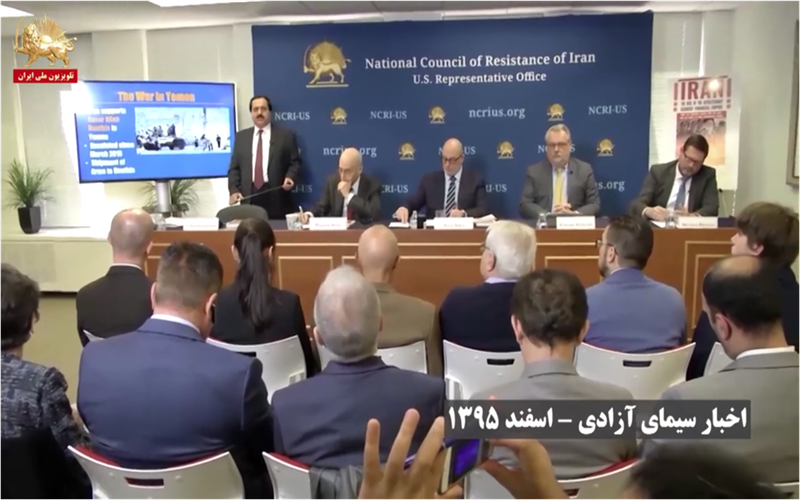
One of the most significant milestones in that effort came in March 2017 with the publication of the book “The Rise of Iran’s Revolutionary Guards’ Financial Empire: How the Supreme Leader and the IRGC Rob the People to Fund International Terror.”
A Landmark Investigation Into the IRGC’s Economic Empire
The book was introduced during a conference at the NCRI’s U.S. Representative Office in Washington, D.C., bringing together American political figures, researchers, diplomats, and security experts to examine the IRGC’s expanding control over Iran’s economy.
Rather than portraying the Revolutionary Guards merely as a military institution, the report argued that the organization had evolved into the central economic pillar of the ruling system. According to its findings, the IRGC’s growing commercial empire financed three interconnected objectives:
- Domestic repression.
- Regional military intervention.
- International terrorism.
The report contended that these activities were inseparable from the Supreme Leader’s consolidation of political and economic power.
Privatization That Expanded State Control
Presenting the report, NCRI U.S. Deputy Director Alireza Jafarzadeh argued that what the regime described as “privatization” after 2005 was, in reality, a systematic transfer of state assets into institutions controlled by the Supreme Leader and the IRGC.
According to the report, nearly every major sector of Iran’s economy—including oil and gas, banking, insurance, construction, mining, aviation, shipping, agriculture, telecommunications, and manufacturing—gradually came under the control of entities affiliated with the Supreme Leader or the Revolutionary Guards.
The investigation mapped fourteen major economic conglomerates linked to the IRGC and the Supreme Leader, including powerful foundations and holding companies that, according to the NCRI, accumulated enormous wealth through confiscation of public assets and opaque financial structures.
Following the Money Behind Terrorism
The book’s central argument was that understanding the IRGC required following its financial network.
It documented how revenues generated through these economic monopolies allegedly funded ballistic missile programs, the nuclear project, regional proxy forces, and overseas military interventions, while simultaneously financing domestic surveillance and repression.
Among the figures presented in the report were estimates that:
- The regime spent between $15 and $20 billion annually supporting the Assad government in Syria.
- Military expenditures increased dramatically between 2008 and 2015.
- Billions of dollars were directed toward ballistic missile development.
- Significant annual budgets were allocated to internal security and the export of terrorism.
- Iranian-controlled militias operating in Syria received substantial financial support through the IRGC’s overseas operations.
The report concluded that Iran’s economy had increasingly become what it described as “an economy dedicated to terrorism, repression, and warmongering.”
Calling for Terrorist Designation Years Before It Became Policy
Perhaps the most significant aspect of the 2017 conference was not simply its economic analysis but its policy recommendation.
Speakers repeatedly argued that the IRGC met the legal criteria for designation as a foreign terrorist organization because of its direct involvement in terrorist activities, overseas military operations, and systematic violence against civilians.
Alireza Jafarzadeh stated during the conference that the Revolutionary Guards fulfilled all the characteristics of a terrorist organization and should therefore be formally blacklisted.
Former U.S. State Department military-political officer Edward Stafford similarly argued that the IRGC existed primarily to export terrorism and religious extremism, making terrorist designation both justified and necessary.
William Nitze, a senior fellow associated with strategic policy institutions in Washington, also described the IRGC as a dangerous combination of wealth, military power, and ideological extremism while expressing support for the NCRI’s democratic alternative for Iran.
International Attention
The conference attracted considerable attention from journalists, diplomats, and policy specialists.
Among the publications covering the event was The Washington Times, which highlighted the report’s warning that financial resources released after the 2015 nuclear agreement risked strengthening institutions controlled by the Supreme Leader and the IRGC rather than benefiting Iran’s private sector or ordinary citizens.
The investigation argued that foreign investment flowing into the regime without structural safeguards would ultimately reinforce the very institutions responsible for regional destabilization and internal repression.
Years of Documentation Before International Consensus
The significance of the 2017 publication lies not in claiming that it alone produced subsequent government decisions. Terrorist designations are sovereign legal determinations made independently by national authorities based on their own intelligence, legal standards, and security assessments.
However, the book formed part of a much broader body of documentation produced over many years by the NCRI and the MEK that consistently exposed the IRGC’s economic empire, military activities, terrorism financing, and role in suppressing the Iranian people.
Those disclosures contributed to expanding international awareness of how deeply the Revolutionary Guards had become intertwined with every major pillar of the regime.
Over time, governments increasingly adopted policies reflecting concerns that had long been raised by the Iranian Resistance, including sanctions against IRGC commanders, restrictions on affiliated companies, and terrorist designations targeting various branches of the organization.
From Evidence to Accountability
The UK’s designation of the IRGC as a terrorist organization represents another chapter in the international response to the Revolutionary Guards’ activities. It reflects years of growing concern over the organization’s role beyond Iran’s borders as well as its central role in enforcing repression at home.
Looking back at the 2017 publication of The Rise of Iran’s Revolutionary Guards’ Financial Empire underscores the importance of sustained documentation in shaping international understanding of authoritarian systems. By tracing the financial architecture that connected economic monopolies to terrorism, regional intervention, and domestic repression, the NCRI and the MEK helped illuminate dimensions of the IRGC that were, at the time, far less widely understood.
Nearly a decade later, many of the concerns raised in that investigation have become central to international policy discussions, illustrating how persistent evidence-gathering and public exposure can contribute to greater global accountability for state-sponsored terrorism.