Speakers at a July 16 gathering in Rome urged Europe to abandon appeasement, support the Iranian people’s democratic resistance, and take action against the regime’s escalating executions.
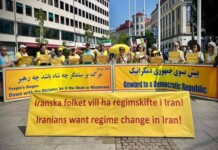
ROME – July 16 — Hundreds of supporters of the Iranian Resistance gathered in the Italian capital under the slogan “No to Executions, Yes to a Democratic Republic,” calling on European governments to recognize the Iranian people’s right to overthrow the ruling dictatorship and support their organized democratic resistance.
Message to the gathering of Free Iranians in Italy
No to Executions, Yes to a Democratic RepublicThe solution lies in the very force and rival that has, for 48 years, driven the regime to the depths of ruin and the verge of overthrow.
The solution is the overthrow of this… pic.twitter.com/ZGzWKRGhBn— Maryam Rajavi (@Maryam_Rajavi) July 16, 2026
The event, held alongside growing international concern over the regime’s human rights record, brought together Iranian Resistance representatives and international political figures who condemned the regime’s escalating executions while urging an end to decades of ineffective Western appeasement.
Throughout the gathering, speakers argued that Iran’s future must be determined neither by foreign intervention nor by a return to dictatorship, but by the Iranian people and their organized Resistance.
Maryam Rajavi: Democratic Change Must Come from the Iranian People
In a message to participants, Maryam Rajavi, President-elect of the National Council of Resistance of Iran (NCRI), praised supporters of the Resistance as the leading democratic force working for change inside Iran.
She described the regime as facing its deepest political crisis in decades following the nationwide January uprising, saying years of repression had only intensified public determination to seek democratic change.
According to Rajavi, the ruling establishment remains trapped by the consequences of nearly five decades of repression and regional adventurism, while growing divisions have weakened every major institution of power.
She argued that recent developments have reinforced what the Iranian Resistance has maintained for years: neither appeasement nor foreign military intervention offers a solution to Iran’s crisis.
Instead, she reaffirmed what the NCRI calls the “Third Option”—regime change led by the Iranian people through nationwide uprisings, Resistance Units, and organized democratic opposition.
Rajavi welcomed the United Kingdom’s recent designation of the IRGC as a terrorist organization, describing it as a long-overdue step, and called on European governments to formally recognize both the Iranian people’s struggle to overthrow the regime and the Resistance Units fighting against the IRGC.
Concluding her message, she urged supporters to intensify their efforts in backing the Resistance, declaring that the path toward a democratic republic depends on sustained organization and public participation.
Calls to End Executions and Reject Both Dictatorships
Opening the rally, NCRI representative Abolghasem Rezaei paid tribute to renowned Resistance artist Reza Olia, whose sculptures and decades of activism, he said, symbolized the struggle against both the Shah’s dictatorship and the current clerical regime.
Rezaei argued that Iran has entered one of the most decisive periods in its modern history, with the international community increasingly recognizing the true nature of the regime.
He emphasized that the Resistance’s long-standing analysis—that the solution for Iran is neither war nor appeasement but democratic change led by the Iranian people—has been vindicated by recent events.
He also highlighted the expanding activities of the Resistance Units despite intensified repression, saying thousands of operations carried out over the past year demonstrate that the movement continues to grow despite executions and arrests.
Rezaei urged Italy and the European Union to abandon decades of appeasement and officially recognize the Iranian people’s legitimate struggle for democratic change.
International Support for the Democratic Alternative
Several international figures addressed the gathering, emphasizing support for the Iranian people’s democratic aspirations.
Former New York City Mayor Rudy Giuliani argued that no organized democratic alternative exists outside the Iranian Resistance. Rejecting any return to monarchical rule, he expressed support for Maryam Rajavi’s Ten-Point Plan as a framework based on popular sovereignty, religious freedom, democratic governance, and equality before the law.
In Rome today, @RudyGiuliani says the Shah's son Reza Pahlavi is not a credible alternative to the mullahs in Iran.
"After you overthrow one tyrant and then you overthrow the second tyrant, you don't put the first tyrant back in charge. That's stupid."
CC: @RapidResponse47 https://t.co/uTV85x1MPG pic.twitter.com/sxJSnUuKVg
— M. Hanif Jazayeri (@HanifJazayeri) July 16, 2026
Former U.S. Congressman Patrick Kennedy similarly rejected both the former monarchy and the current theocratic dictatorship, arguing that the regime’s increasing reliance on executions reflects its fear of the organized Resistance. He also endorsed Rajavi’s Ten-Point Plan and called for greater international support for the Resistance Units and the PMOI.
Its time for the world to recognize the organized resistance of Iran!
Neither war nor appeasment are the solution for the Iran. Only a democratic revolution lead by the People and their organized resistance will bring peace and freedom!#noshahnomullah #freeiran… pic.twitter.com/lC9MutvBca
— Sahar Sanaie (@SanaieSahar) July 16, 2026
Human Rights at the Center of the Campaign
NCRI representative Aziz Paknejad focused his remarks on the regime’s escalating human rights abuses, paying tribute to Reza Olia before outlining the worsening wave of executions.
Citing reports by Human Rights Monitor, he described a dramatic increase in executions during late 2025 and early 2026, including women and public executions, while documenting mass arrests, enforced disappearances, torture, and coerced confessions following the nationwide uprising.
Paknejad noted that hundreds of executions were reportedly carried out during January 2026 alone, with many taking place secretly and without fair judicial proceedings.
He called on the United Nations, international human rights organizations, and democratic governments to hold the Iranian regime accountable for crimes against humanity and to increase pressure aimed at ending the machinery of executions and repression.
A Unified Message to Europe
Despite addressing different aspects of Iran’s political crisis, speakers delivered a consistent message: Europe’s policy toward Tehran requires fundamental change.
Former US Congressman @PJK4brainhealth says neither negotiations, nor war with Iran will work.
Instead, he says the West must show solidarity with the Iranian people and their Resistance movement that are rising up to overthrow the mullahs' dictatorship. 💯
CC: @RapidResponse47 https://t.co/uTV85x1MPG pic.twitter.com/7UwFOTnj61
— M. Hanif Jazayeri (@HanifJazayeri) July 16, 2026
Rather than continuing engagement with a regime they described as irredeemably repressive, participants urged European governments to recognize the Iranian people’s right to resist dictatorship and support a democratic republic founded on separation of religion and state, gender equality, abolition of the death penalty, and respect for fundamental human rights.
Held on the same day that Maryam Rajavi addressed the Italian Senate’s Human Rights Commission, the Rome rally reinforced the Iranian Resistance’s central message that the path to lasting peace, stability, and democracy lies in supporting the Iranian people—not the regime that continues to suppress them.