


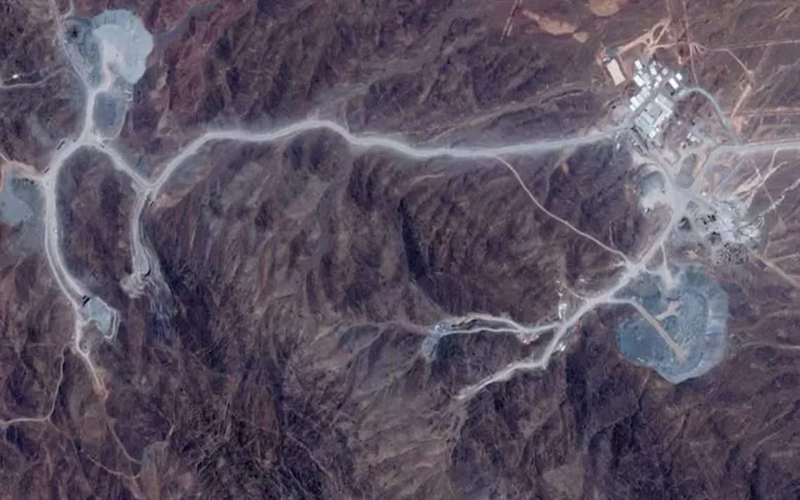

As the Iranian regime pours vast resources into one of its deepest underground nuclear complexes, ordinary citizens continue to bear the cost through deepening poverty, economic collapse, and international isolation.
The Iranian regime’s massive underground nuclear complex beneath Kolang Gaz La Mountain has once again become the focus of international attention. Recent reports indicate that the site—one of the deepest and most heavily fortified facilities associated with the regime’s nuclear program—has emerged as a potential military target as Washington reassesses Tehran’s nuclear ambitions.
Yet beyond its strategic and military significance lies another pressing question: How much has this secret project cost the Iranian people? While the regime allocates billions of dollars to constructing fortified underground facilities, millions of Iranians continue to struggle with inflation, unemployment, collapsing public services, and growing poverty.
A Hidden Nuclear Fortress
According to a recent report by The Wall Street Journal, U.S. officials are increasingly concerned that the underground complex under Kolang Gaz La Mountain could become a critical component of the regime’s future nuclear activities. The concern intensified after U.S. President Donald Trump publicly warned that the mountain could become the target of a “major and powerful attack,” saying American intelligence is closely monitoring developments at the site.
Construction of the facility began in 2020 following the severe damage inflicted on the Natanz enrichment facility in what Tehran described as a sabotage operation. A year later, officials from the regime’s Atomic Energy Organization stated that the underground complex would house “sensitive” equipment.
Despite years of construction, however, the regime has revealed virtually nothing about the site’s design or intended purpose. It has not submitted design information to the International Atomic Energy Agency (IAEA), and IAEA Director General Rafael Grossi has previously requested access for inspectors—requests the regime has ignored.
Built for Survival
Former U.S. officials believe the facility could play a key role in any future attempt by the regime to revive or expand its nuclear program.
Located beneath a mountain rising more than 1,585 meters above sea level, the complex is believed to consist of multiple underground levels connected by long access tunnels. The Washington-based Institute for Science and International Security estimated in 2022 that the underground space may exceed 5,000 square meters.
Satellite imagery has identified two tunnel entrances on opposite sides of the mountain. Analysts estimate that if the main halls lie beneath the mountain ridge, each access tunnel extends more than 300 meters. Reinforced tunnel entrances and multiple underground levels suggest the facility was specifically engineered to withstand conventional military strikes.
Recent satellite images also show continued construction activity following last year’s conflict, with portions of the eastern entrance deliberately covered with earth while western access points remain operational.
Experts believe the facility could eventually house uranium enrichment centrifuges capable of producing weapons-grade uranium. According to assessments by the Institute for Science and International Security, the complex may also be large enough to accommodate activities related to uranium metal production and other processes associated with nuclear weapons development.
A Difficult Military Target
Military analysts caution that Kolang Gaz La presents a far greater challenge than previously targeted nuclear facilities such as Fordow.
Matthew Sharp, a senior nuclear researcher at the Massachusetts Institute of Technology (MIT) and former U.S. diplomat to the IAEA, told The Wall Street Journal that the mountain’s greater depth and the limited understanding of its internal structure make successful air strikes considerably more difficult than those carried out against Fordow.
Even America’s 30,000-pound bunker-buster bombs may not be capable of completely destroying the underground chambers.
Nevertheless, experts note that the complex remains vulnerable through its external infrastructure. Electrical supply lines, ventilation systems, cooling equipment, transportation routes, construction logistics, and tunnel entrances all represent potential weak points that could disrupt operations even if the underground chambers themselves remain intact.
Secrecy Fuels International Concern
The regime’s refusal to provide design information or allow international inspections has only intensified concerns regarding the true purpose of the facility.
The underground complex has reportedly remained under continuous surveillance by U.S. intelligence agencies for years, yet remarkably little is publicly known about what is actually being built inside.
Meanwhile, American officials continue evaluating military options as part of broader efforts to prevent the regime from rebuilding capabilities damaged during previous strikes on Natanz, Fordow, and Isfahan.
Billions Underground While Poverty Grows Above Ground
The enormous financial investment required to construct a hardened underground complex of this scale stands in stark contrast to the daily realities facing ordinary Iranians.
At a time when millions struggle with soaring prices, declining purchasing power, chronic electricity shortages, water crises, deteriorating healthcare, and widespread unemployment, the regime continues to prioritize secret military and nuclear infrastructure over public welfare.
The resources devoted to excavating mountains, reinforcing tunnels, and expanding protected nuclear facilities represent funds that could instead address urgent economic and social needs. Rather than investing in infrastructure that improves citizens’ lives, the regime has consistently directed national wealth toward projects that deepen international tensions while leaving the Iranian population to shoulder the economic consequences.
Kolang Gaz La has therefore become more than a symbol of the regime’s nuclear ambitions. It illustrates the broader priorities of a government willing to spend billions on hidden strategic facilities while millions of its citizens face worsening poverty and economic hardship.