


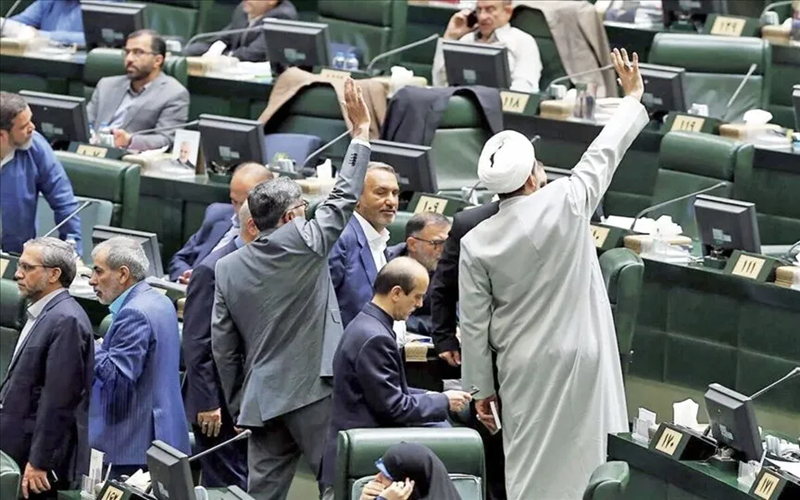

The Iranian regime used wartime conditions to tighten repression and suppress unrest, but the ceasefire has exposed widening factional divisions that reveal a deeper structural crisis.
Since the outbreak of war on February 28, 2026, the Iranian regime has sought to transform an external military conflict into a mechanism for its own political survival. Rather than focusing solely on confronting foreign adversaries, the wartime atmosphere became a convenient pretext for intensifying domestic repression, silencing dissent, and postponing the regime’s growing internal crises.
Yet as the fighting subsided and a ceasefire took hold, the strategy began to unravel. The tensions that had been temporarily masked by the conflict quickly resurfaced, exposing a leadership increasingly divided over the future of the regime itself.
War as a Tool of Domestic Repression
Throughout the conflict, the regime exploited wartime conditions to tighten its grip on society.
Thousands of young dissidents were reportedly arrested, while numerous participants in the January uprising and ten members of the PMOI were executed. At the same time, Basij forces remained deployed across cities for months in an effort to deter renewed public protests.
The authorities also resorted to extraordinary political measures designed to prevent internal disputes from spilling into the public sphere. Among them was the prolonged suspension of parliamentary activity, reflecting concerns that factional conflicts could further undermine the regime’s authority during a period of heightened instability.
Rather than creating unity, however, the war merely delayed the inevitable re-emergence of deeper structural tensions.
Ceasefire Reveals Growing Divisions
Since the ceasefire, the regime’s internal instability has become increasingly visible.
A major flashpoint has emerged over the memorandum of understanding signed with the United States. The agreement exposed profound disagreements at the highest levels of the political establishment and triggered public confrontations among competing factions.
Even the funeral of Ali Khamenei, an event intended to demonstrate cohesion following the leadership transition, instead highlighted these divisions. During the ceremony, supporters of rival factions reportedly chanted “Death to the compromisers” against President Masoud Pezeshkian and Parliament Speaker Mohammad Baqer Qalibaf, while Iran’s foreign minister was pelted with stones.
What should have projected unity instead underscored the depth of the regime’s political fragmentation.
A Leadership at Odds with Itself
The divisions became even more pronounced immediately after the memorandum was signed.
Within hours, the regime’s Supreme Leader publicly indicated that he had held a different view regarding the agreement, further fueling disputes across the political establishment.
The controversy quickly spread to the Assembly of Experts, the body responsible for selecting the Supreme Leader. Numerous members openly opposed the memorandum, illustrating the extent of disagreement within one of the regime’s most important institutions.
The conflict did not stop there. Reports indicated that divisions also extended into the ranks of the Islamic Revolutionary Guard Corps (IRGC), the Basij, and their senior commanders.
Unprecedented Warnings from Within the IRGC
Perhaps the clearest indication of growing instability came from an unusual intervention by the Supreme Leader’s representative to the IRGC.
In a rare public warning, he urged commanders, Guards members, and Basij personnel to refrain from debating the memorandum or accusing senior officials of betrayal. He stressed that labeling officials approved by the Supreme Leader as traitors, or rejecting an agreement authorized by the leadership, was incompatible with loyalty to the system.
Such an extraordinary appeal suggested that factional disputes had reached a level serious enough to threaten cohesion within the regime’s own security apparatus.
Political Infighting Spreads Across the Establishment
The divisions have become increasingly visible throughout the broader political system.
Friday prayer leaders across the country have publicly criticized the memorandum, while state-controlled media have increasingly turned into platforms for attacks on the government.
Public threats directed at the president, calls for violence against senior officials, and repeated verbal assaults on the Foreign Ministry all point to a political crisis that extends far beyond routine disagreements over policy.
Rather than isolated disputes, these developments reflect a governing establishment struggling to maintain consensus at a time of mounting pressure.
A Structural Crisis, Not a Temporary Dispute
The regime’s internal conflicts are not new. They are the culmination of years of institutional decay, economic failure, and strategic contradictions that have steadily weakened the foundations of the ruling system.
The current confrontation is therefore not a temporary political disagreement that can be resolved through compromise. It reflects a deeper crisis rooted in the regime’s governing model, ideological foundations, and long-standing methods of maintaining power.
For years, external confrontation has served as a means of postponing internal reckoning. War provided an opportunity to suppress society, rally loyalists, and delay the explosion of accumulated political tensions.
The experience of recent months, however, demonstrates the limits of that strategy. As wartime conditions have receded, the underlying crises have returned with greater intensity.
The ceasefire did not create the regime’s internal divisions—it merely revealed how profound they had already become. With factional conflict escalating, public discontent unresolved, and the regime’s traditional mechanisms of control under increasing strain, the structural crisis confronting Iran’s rulers appears deeper than at any point in recent history.