


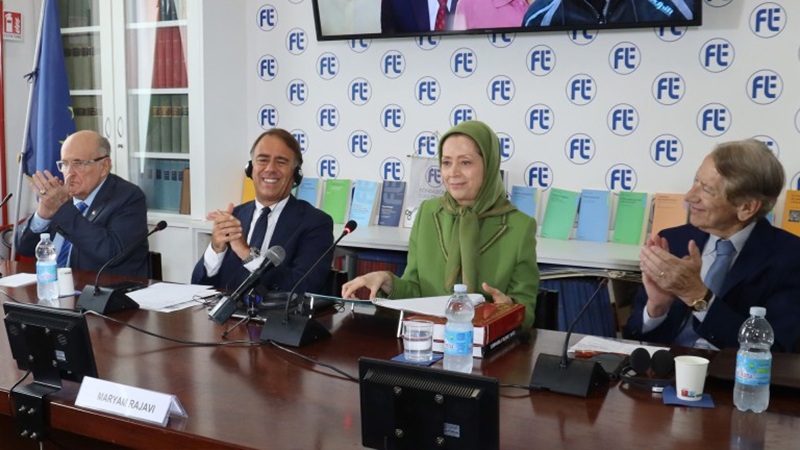

Speaking at two international conferences in Italy on July 17, the NCRI President-elect said the clerical regime faces an irreversible crisis and that only the Iranian people and their organized Resistance can establish a democratic republic.
Speaking at two separate conferences in Italy on July 17, Maryam Rajavi, President-elect of the National Council of Resistance of Iran (NCRI), outlined what she described as the only viable solution to Iran’s decades-long crisis: the overthrow of the ruling regime by the Iranian people and their organized Resistance, followed by the establishment of a democratic republic.
Addressing an audience at the Luigi Einaudi Foundation as well as the conference “Iran Beyond War, the Power of the People as the Solution,” Rajavi argued that the regime is experiencing its deepest internal crisis since coming to power and cannot survive the mounting pressure from popular unrest and organized opposition.
Neither War Nor Appeasement Can Change Iran
Rajavi rejected claims that the regime emerged stronger following recent regional conflicts, calling such assertions “an echo of the regime’s own propaganda.”
She reiterated that foreign military intervention cannot bring freedom to Iran.
“The overthrow of this regime can only be achieved by the people of Iran and their organized Resistance.”
Likewise, she rejected policies aimed at preserving the current regime through diplomacy or reviving the former monarchy, arguing that both represent failed models of dictatorship.
“The solution lies neither in preserving the status quo nor in returning to the past,” she said. “It lies in establishing a democratic republic.”
A Regime Trapped in an Irreversible Crisis
Rajavi described the ruling establishment as being caught in a strategic deadlock from which it cannot escape.
She pointed to widening divisions within the regime following the recent ceasefire and disputes surrounding the memorandum of understanding with the United States. According to Rajavi, public infighting has spread from the Assembly of Experts to the Revolutionary Guards (IRGC), the Basij, Friday prayer leaders, and state media.
She noted that even the funeral of Ali Khamenei, intended to project unity, instead exposed unprecedented factional conflict, with rival supporters openly attacking senior officials.
These divisions, she argued, are not temporary political disagreements but symptoms of a structural collapse rooted in the regime’s ideology, strategy, and governance.
A Society Ready for Another Uprising
Rajavi emphasized that the regime’s greatest fear is not external pressure but another nationwide uprising.
She said decades of executions, repression, corruption, economic collapse, environmental destruction, and systematic denial of basic freedoms have transformed Iranian society into what she described as “an active social volcano.”
The January uprising, she argued, demonstrated that the Iranian people remain determined to end clerical rule despite severe repression, mass arrests, internet blackouts, and executions.
“The trajectory of these uprisings,” she said, “makes it clear that they will eventually overpower the forces of suppression and violence.”
Resistance Units: The Driving Force for Change
Central to Rajavi’s message was the role of the People’s Mojahedin Organization of Iran (PMOI/MEK) and its nationwide Resistance Units.
She argued that successful democratic change requires three essential elements: a willingness to confront the IRGC, an organized nationwide presence inside Iran, and complete independence from foreign governments.
According to Rajavi, the Resistance Units embody all three characteristics.
She cited hundreds of operations carried out by Resistance Units during the January 2026 uprising and highlighted a February operation targeting Khamenei’s headquarters in Tehran as evidence of the Resistance’s growing capabilities.
Rajavi said these units are steadily evolving into the nucleus of a future Liberation Army capable of supporting nationwide uprisings.
Economic Collapse and Systemic Failure
Rajavi also painted a bleak picture of Iran’s economy, arguing that nearly five decades of clerical rule have squandered the country’s vast natural wealth.
Instead of investing in development, she said, the regime diverted national resources toward nuclear weapons, missile production, regional proxy groups, and military expansion.
She pointed to chronic unemployment, the collapse of the middle class, severe inflation, water shortages, environmental degradation, and widespread poverty as evidence that the regime is incapable of meaningful reform.
Even increased oil revenues or sanctions relief, she argued, would not improve living conditions because additional resources would continue to finance military programs and repression rather than public welfare.
A Democratic Alternative
Rajavi stressed that the NCRI offers a clear democratic alternative based on popular sovereignty rather than dictatorship.
She highlighted the Resistance’s Ten-Point Plan, which calls for:
- A democratic republic based on free elections;
- Separation of religion and state;
- Gender equality;
- Abolition of the death penalty;
- Equality for all ethnic groups with autonomy within Iran’s territorial integrity;
- An independent judiciary;
- Freedom of expression, assembly, and political parties;
- A non-nuclear Iran living peacefully with its neighbors.
She emphasized that this vision has been sustained through decades of sacrifice, including the execution of more than 100,000 members and supporters of the Iranian Resistance and the 1988 massacre of 30,000 political prisoners, most of whom were members of the PMOI.
Recalling the final message of executed political prisoner Babak Alipour, Rajavi quoted his words from solitary confinement:
“Everything we long for—unconditional freedom, a society free from discrimination, gender equality, and justice—can only be achieved through the overthrow of this regime. There is no other way.”
“The Right to Popular Sovereignty”
Concluding both speeches, Rajavi reaffirmed that the Iranian Resistance is not waiting for foreign governments to bring change.
“We have risen,” she said, “to reclaim what is fundamentally ours: the right to popular sovereignty, and the right of our people to dignity and freedom.”
She maintained that the convergence of nationwide uprisings with an organized Resistance offers Iran its first genuine opportunity in decades to replace both religious dictatorship and monarchy with a democratic republic founded on the will of the Iranian people.