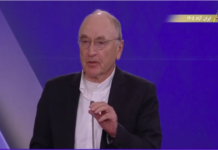
At the “Iran Beyond War – Human Rights and the Power of the People as the Solution” conference in Rome, former German ambassador Dr. Hans-Ulrich Seidt argued that military action cannot determine Iran’s future, urging the European Union to support the Iranian people and their democratic opposition.
Dr. Hans-Ulrich Seidt: Democratic Change in Iran Must Come from the Iranian People
ROME – Dr. Hans-Ulrich Seidt, former German ambassador and veteran diplomat, addressed the international conference “Iran Beyond War – Human Rights and the Power of the People as the Solution” in Rome, arguing that the Iranian regime is facing unprecedented internal weakness and that genuine political change can only be achieved through the Iranian people and their organized democratic opposition.
Opening his remarks, Seidt noted that although today’s international environment is marked by conflict and uncertainty, the foundations of the Iranian regime are increasingly unstable.
“Today, there is no doubt the foundations of the Iranian regime are shaking.”
He organized his analysis around three strategic dimensions—military, economic, and political—to explain why he believes the regime is entering a period of profound vulnerability.
Military Pressure Alone Cannot Bring Political Change
Seidt argued that recent military developments have demonstrated the limitations of using force to resolve Iran’s long-standing political crisis.
While acknowledging the ongoing conflict, he stressed that air campaigns alone cannot produce democratic transformation.
“Political change in Iran will not be brought about by the American and Israeli air campaigns.”
Instead, he urged policymakers to recognize that lasting political change must emerge from within Iranian society rather than through foreign military intervention.
Economic Crisis Continues to Undermine the Regime
According to Seidt, the regime’s gravest challenge remains its deteriorating economy.
He pointed to persistent inflation, the collapse of the national currency, unemployment, and chronic shortages of electricity, water, and energy as evidence of deep structural weakness.
The ongoing conflict, he argued, has only accelerated these existing problems.
“The economic decline of the regime will continue, and as a result of the war, the economic decline will accelerate.”
Seidt noted that these economic pressures have already fueled widespread public discontent, contributing to nationwide protests, including the January uprising.
Internal Divisions Are Weakening the Leadership
Turning to the political landscape, Seidt emphasized that while Iranians strongly oppose foreign interference, it would be a mistake to interpret this patriotism as support for the ruling establishment.
“It would be a serious misperception to assume that the regime’s leadership is today stronger and more cohesive than before the war.”
Instead, he argued that recent events have exposed growing disagreements within the regime over its future survival.
He cited public criticism directed at senior officials, including President Masoud Pezeshkian and Foreign Minister Abbas Araghchi during the funeral ceremonies for Ali Khamenei, as evidence of increasing tensions within the ruling elite.
The Iranian People Hold the Key to Change
Reflecting on the repeated nationwide uprisings over the past decade, Seidt said they demonstrate that a large segment of Iranian society rejects the current political system.
“The January uprising demonstrated the people’s willingness to challenge their repression and to end the regime.”
Looking beyond the current conflict, he argued that Iran’s future will ultimately be determined by its democratic opposition rather than outside powers.
“The future of Iran will not depend on foreign intervention, but on the democratic opposition within the country.”
Support for the NCRI and Maryam Rajavi’s Vision
Seidt expressed strong support for the National Council of Resistance of Iran (NCRI), describing it as a genuine democratic movement prepared to make sacrifices for freedom.
“This opposition is genuine. It is ready to make sacrifices for freedom and democracy.”
He also cautioned against efforts to promote alternative political figures who, in his view, distract from the organized democratic movement inside Iran.
According to Seidt, creating false expectations through externally promoted alternatives only weakens democratic forces within the country.
He endorsed Maryam Rajavi’s Ten-Point Plan, describing it as a realistic roadmap for Iran’s democratic transition.
“Maryam Rajavi’s Ten-Point Plan reflects the aspirations of the Iranian people.”
Seidt noted that under this framework, free and fair elections could be held within six months after the current regime’s downfall.
“Today, such a scenario is no utopian idea. It is a realistic option for the future.”
A Call for European Support
Concluding his remarks, Seidt argued that a secular, democratic Iran based on human rights and the rule of law would serve not only the Iranian people but also regional and international stability.
He urged European governments to actively support this democratic alternative.
“The member states of the European Union must support it.”
According to Seidt, constructive European engagement in support of the Iranian people’s democratic aspirations represents the most effective path toward lasting peace, regional stability, and a future Iran founded on democracy, secular governance, and respect for fundamental human rights.