


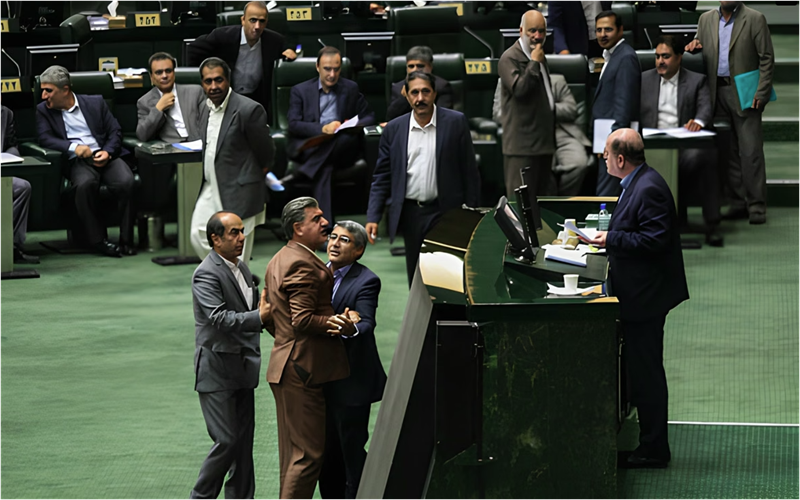

Senior IRGC commanders, parliamentarians, and state media exchange accusations over negotiations, the Strait of Hormuz, and security failures, exposing growing divisions within the ruling establishment.
As Iran’s political and military crises continue to intensify, public infighting among the regime’s rival factions has become increasingly visible. Statements by senior IRGC commanders, members of parliament, government officials, and state-controlled newspapers reveal widening disagreements over negotiations with the United States, the Strait of Hormuz, and the regime’s handling of growing internal and external challenges.
The latest exchanges demonstrate that the ruling establishment is struggling not only with mounting domestic unrest but also with deepening divisions over how to respond to escalating pressure.
Military spokesman attacks supporters of negotiations
On July 22, Brigadier General Abolfazl Shekarchi, spokesperson for the regime’s Armed Forces, accused advocates of negotiations with the United States of serving enemy interests.
He claimed that the regime’s enemies were attempting to create divisions among officials and alleged that individuals whose “hopes and aspirations lie with America and the West” had “come out of their hiding places” to undermine national unity.
Shekarchi warned that any weakening of internal cohesion would allow the regime’s enemies to recover from recent setbacks and insisted that preserving what he described as the regime’s “victories” depended entirely on obedience to Supreme Leader Ali Khamenei. He declared that all officials must “line up behind” the Supreme Leader, presenting loyalty to him as the defining measure of unity.
His remarks reflected growing concern within the security establishment over visible disagreements among senior officials.
Hardliners brand former President Mohammad Khatami a traitor
The attacks quickly spread to former President Mohammad Khatami, who has advocated engagement with the West.
Hardline parliamentarian Hamid Rasaei, deputy chairman of the parliament’s Cultural Commission, denounced Khatami as an “American-turbaned cleric” and accused him of promoting compromise with Washington.
Rasaei argued that Khatami’s calls for what he described as an “honorable peace” amounted to betrayal, claiming that any effort to seek reconciliation with the United States constituted treason. He further accused reformist figures of attempting to shift attention away from the regime’s calls for retaliation against its adversaries.
The remarks illustrate the increasingly hostile rhetoric directed at officials who advocate diplomacy rather than confrontation.
State broadcaster accused of censoring judiciary chief
Even differences among the regime’s highest institutions have become public.
The state-run newspaper Jomhouri Eslami reported that state television censored key remarks made by Judiciary Chief Gholam-Hossein Mohseni-Ejei following a meeting with President Masoud Pezeshkian.
According to the newspaper, while state television reported that the meeting had taken place, it deliberately omitted Mohseni-Ejei’s expressions of support for the president, suggesting that internal media censorship is now being used to suppress messages that conflict with the dominant political narrative.
Heated parliamentary confrontation over the Strait of Hormuz
One of the most dramatic episodes unfolded inside parliament during a debate over the Strait of Hormuz.
Hardline MP Amir-Hossein Sabeti and parliamentarian Habib Shahriari became involved in a heated verbal confrontation over whether the regime should close or reopen the strategic waterway during wartime.
Sabeti accused Shahriari of advocating reopening the Strait, insisting that public opinion supported keeping it under tighter control.
The exchange rapidly descended into personal insults, with Shahriari responding angrily that the Strait was not anyone’s private property before insisting that, although international law governs the waterway, the regime would take whatever action it deemed necessary during wartime.
The unusually public argument highlighted growing disagreements over one of Tehran’s most sensitive strategic issues.
Dispute over Foreign Minister Abbas Araghchi’s interview
Another controversy erupted following an interview by Foreign Minister Abbas Araghchi, which triggered criticism from hardline factions.
The interview reportedly included comments about the scale of unrest during last winter’s nationwide protests, particularly in the city of Mashhad, prompting accusations that Araghchi had acknowledged serious security failures.
In response, parliamentary National Security Commission spokesperson Hassan Ghashghavi sought to calm the dispute, stating that the Supreme Leader’s directives were “final” and warning against fueling internal disagreements under current conditions.
Interior Ministry rejects reports about Mashhad unrest
The controversy deepened after claims circulated that Mashhad had come close to falling out of government control during the January uprising.
Interior Ministry spokesperson Ali Zeini-Vand rejected those reports outright.
He stated that although Mashhad experienced severe unrest alongside Tehran, Isfahan, Rasht, and several other cities, the claim that the city was on the verge of collapse was entirely false.
Zeini-Vand said he had been in constant communication with the governor of Razavi Khorasan Province during the unrest and insisted that government officials remained fully in control throughout the events.
He also expressed doubt that Araghchi had ever made such remarks, suggesting that the controversy had been misrepresented.
Government newspaper criticizes anti-negotiation camp
Signs of division also emerged in the regime’s own media.
The government-affiliated newspaper Ettelaat criticized opponents of negotiations, questioning how long they intended to intensify political and psychological pressure while refusing to assume responsibility during critical moments.
The newspaper argued that hardline opponents of diplomacy were obstructing efforts to find a way out of the regime’s growing crises.
Regime insider accuses hardliners of silencing dissent
Political commentator Javad Moghouei also condemned the campaign against Araghchi’s interview.
He accused hardline factions of attempting to silence all competing voices so that only their narrative could be broadcast through what he described as the regime’s “party television.”
His comments reflected broader frustration among officials who argue that internal debate is increasingly being suppressed by dominant security factions.
Growing divisions expose a regime under pressure
The latest disputes reveal far more than routine political disagreements. Public attacks between senior military commanders, cabinet officials, parliamentarians, government newspapers, and state institutions point to an increasingly fragmented leadership struggling to respond to mounting domestic unrest and international pressure.
As economic deterioration, security concerns, and political instability continue to deepen, these increasingly public confrontations underscore the regime’s inability to present a united front, exposing widening fractures at the highest levels of power.